
Solar Permit Delays in 2026: Top 7 Causes for US Installers
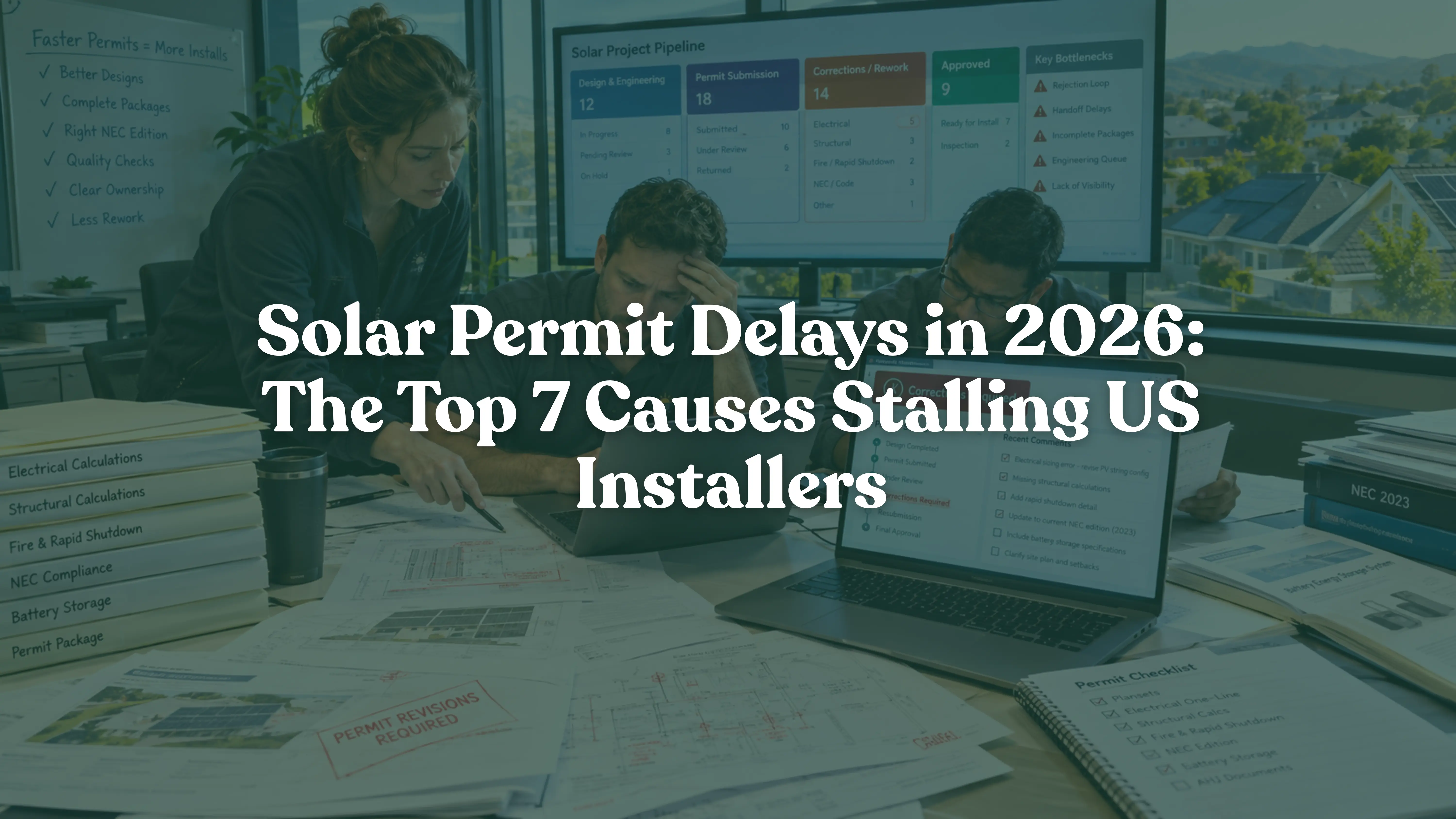
Solar Permit Delays in 2026: The Top 7 Causes Stalling US Installers
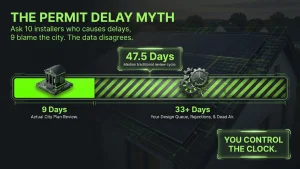
Ask ten installers about solar permit delays and nine will blame the city. The data says otherwise. According to NREL’s SolarAPP+ performance review, the median duration from permit submission to final passed inspection was 47.5 days under traditional review, yet actual plan review accounts for only about nine business days of that 42-day cycle.
So where do the other 33 days go? They sit in your design queue, your rejection loop, and the dead air between handoffs. That stings. However, it also means you control most of the clock.
Short answer: what causes solar permit delays?
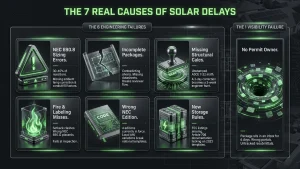
Solar permit delays in 2026 come from seven sources: electrical sizing errors, incomplete packages, missing structural calcs, fire and rapid-shutdown misses, the wrong NEC edition, new storage requirements, and no clear owner for the permit file. Six are engineering failures. One is a visibility failure.
The 7 causes of solar permit delays in 2026
1. NEC 690.8 conductor sizing errors
This is the biggest offender by far. Energyscape Renewables reports that NEC 690.8 violations cause 30–40% of solar permit rejections nationwide, and the most common miss is applying the 125% continuous current multiplier while skipping ambient temperature correction and conduit fill factors.
A plan checker catches it in four minutes. You lose three weeks. Therefore, lock sizing into a reviewed calculation block on the single-line diagram instead of leaving it to designer judgment.
2. Incomplete or inconsistent packages
Not wrong. Just missing. A datasheet nobody attached. An inverter model on sheet PV-3 that contradicts sheet PV-1. A title block with no license number or revision date.
Reviewers read submittals in a fixed order. Consequently, anything that breaks that order invites harder scrutiny on every sheet after it. Our solar permit plan set checklist covers the full sheet set.
3. Missing or unstamped structural calculations
Roof-mounted arrays need ASCE 7-22 loading math, attachment spacing, and a stamp the AHJ accepts. Many teams submit a generic letter and hope for the best.
When it bounces, you aren’t fixing a drawing. Instead, you’re hunting a licensed engineer in that state. That hunt turns a three-day correction into a three-week one. See our PE stamp turnaround guide.
4. Fire setbacks, rapid shutdown, and labeling
Setback dimensions that clash with the roof plan. Missing 690.12 labeling. Placards citing the wrong code year.
These slip past plan review and fail at inspection instead. Meanwhile, a failed final drops you back into the same queue. The NEC 690/706 permit package lists every required document.
5. The wrong NEC edition for that jurisdiction
This one blindsides teams entering new territory. NFPA enforcement data shows four NEC editions in force at once as of March 2026. Twenty-eight states finished their update cycle, while Arizona, Illinois, Kansas, Nevada, and New York leave adoption to local jurisdictions.There are over 20,000 permitting jurisdictions in the US, and requirements differ between neighboring cities
. As a result, one national template will fail somewhere in your footprint. Build a template library per AHJ instead.
6. Storage requirements nobody had two years ago
Battery storage now accompanies 45% of new residential solar systems, a record high. That means roughly half your packages carry ESS listings, siting clearances, and Article 706 documentation your 2023 template never included. Tech Times
Plan examiners are still calibrating too. Some ask for more than code requires. Others miss it entirely, and your inspector catches it later.
7. Nobody owns the permit file
Here’s the invisible one. The package was fine. It sat in an inbox for six days because the designer assumed ops submitted it, and ops assumed the designer did.
This shows up as wrong-portal submittals, missing interconnection prerequisites, and resubmittals nobody chases. In short, it never appears on a redline, so it never gets fixed.
What solar permit delays actually cost you
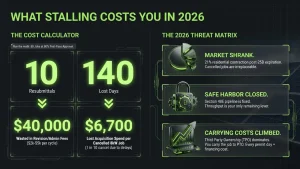
Run the math on 50 jobs at an 80% first-pass rate. One rejection restarts the clock and costs $2,000–$5,000 per correction cycle. At an 80% first-pass rate across 50 jobs, that’s ten resubmittals, roughly $40,000, and 140 lost days.
Then add attrition. NREL survey work shows roughly 1 in 10 signed contracts get cancelled before install, with permitting delays ranked among the top causes. On an 8 kW job, that’s about $6,700 in acquisition spend you never recover.
Compare that to the benchmark. Top teams hold first-submission approval between 96% and 99%; budget providers often fall below 80%. That gap is the entire argument for fixing this now.
Why 2026 punishes delays harder than 2025 did
Three things shifted. First, the market shrank. SEIA and Wood Mackenzie forecast a 21% residential contraction in 2026, following the expiration of the Section 25D tax credit at year-end 2025. Fewer jobs means a cancelled one isn’t replaceable.
Second, the safe harbor window closed. Projects that began construction before July 4, 2026 stay eligible for the Section 48E credit through 2030. That pipeline is fixed and already qualified. Consequently, throughput is the only lever left.
Third, carrying costs climbed. With 25D gone, third-party ownership is now the main route to federal benefit for homeowners, while customer acquisition costs spiked 40% to $0.84 per watt. Under TPO you carry the job until PTO. Every permit day is a financing day.
Where instant permitting helps
SolarAPP+ has cut permit review from as many as 20 business days to zero, so projects get installed about 12 days faster than traditional review. It also delivers roughly 14.5 days of savings, and permits issued through it fail inspection about 29% less often.
Use it where you can. That said, adoption covers 240-plus communities, Florida has zero adopting jurisdictions, and ground mounts, 400A service, and high wind zones drop back into full plan review. Our virtual permitting guide maps the fast states.
Stop paying twice for the same mistake
Six of these causes are engineering problems. The seventh is a tracking problem. They get solved in different places.
Energyscape Renewables solves the first six. You get PE-stamped, code-compliant plan sets in all 50 states, 24-hour stamping, structural calcs included, and an AHJ and utility database that names the portal, sequence, and enforced code edition before design starts. That’s backed by a 99% first-submission approval rate across 188,000-plus projects.
Sunscape solves the seventh. Tag every project with its AHJ, permit status, resubmittal deadline, and interconnection milestone. Then watch all of it from one screen, so nothing stalls in an inbox.
Energyscape gets it approved the first time. Sunscape keeps it from stalling again.
FAQ: Solar Permit Delays
Why is my solar permit taking so long?
Usually the AHJ isn’t the problem. Plan review averages about nine business days. Slow engineering, one rejection cycle, and untracked handoffs create most of a six-week timeline.
What causes most solar permit rejections?
NEC 690.8 conductor sizing errors lead the list at 30–40% of rejections nationwide. Incomplete packages and outdated code editions follow closely behind.
How much does a solar permit rejection cost?
Between $2,000 and $5,000 per correction cycle. That covers revision fees, admin time, and crew rescheduling, plus two to four weeks of delay.
Does SolarAPP+ replace the permit?
No. It issues an approval number. You still submit that through the AHJ’s own portal.
sjayakanth@energyscaperenewables.com