
Solar Permitting Process 2026: The Template-Per-AHJ Playbook
Solar Permitting Process 2026: The Template-Per-AHJ Playbook
Your solar permitting process in 2026 probably runs on one person’s memory. Ask your permit coordinator why one city wants the placard on the meter side, and they’ll know instantly. Then ask where that rule is written down. The room goes quiet.
That’s the scramble. It worked fine when volume was high and mistakes were cheap. Today, neither is true.
So here’s the shift worth making. Stop treating every permit as a research project. Instead, treat each jurisdiction as an asset you build once and reuse forever. Your first job in a city should cost real money. Your seventh should cost almost nothing.
Why the Solar Permitting Process in 2026 Feels Harder
Three things changed at the same time.
Volume dropped, so learning slowed. SEIA and Wood Mackenzie project a 21% residential contraction for 2026 after Section 25D expired. Q1 2026 landed at 7.8 GWdc, down 27% year over year. Because you touch each jurisdiction less often, knowledge goes stale between jobs.
Mistakes got expensive. Customer acquisition cost climbed roughly 40% to $0.84 per watt. Meanwhile, each rejection cycle burns $2,000 to $5,000 in rework and crew rescheduling. You can no longer sell your way out of that.
People started moving. Over 100 solar companies have closed or filed since 2023, including the second-largest residential installer in April 2026. As a result, undocumented AHJ knowledge walks out the door regularly.
Then add the code picture. NFPA enforcement data shows four NEC editions in force at once as of March 2026. Twenty-eight states finished their update cycle, while Arizona, Illinois, Kansas, Nevada, and New York leave adoption to local jurisdictions. Therefore one national template will be wrong somewhere in your footprint.

Where Your Permit Clock Actually Goes
Most teams blame the city. However, the data says otherwise.
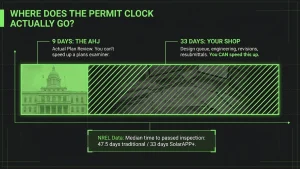
NREL research puts median time from submission to final passed inspection at 47.5 days for traditional permits and 33 days with SolarAPP+. Yet actual plan review accounts for only about nine business days of a 42-day cycle.
The other 33 days sit inside your own shop. Design queue, engineering, revisions, resubmittals. That’s good news, honestly. You can’t speed up a plans examiner, but you can absolutely speed up your half of the permit-to-install timeline.
The AHJ Profile Card: 12 Fields That Fix Your Permitting Process
A working system follows one rule. Every jurisdiction gets a written profile, and every plan set comes from that profile. No memory. No Slack archaeology.
Copy these twelve fields into a spreadsheet today:
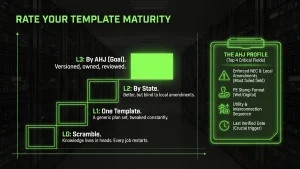
- Enforced NEC edition plus local amendments
- Enforced IBC or IRC edition
- Wind, snow, and seismic design values
- PE stamp format — wet seal or certified digital
- Submittal portal and file format
- Required sheet order and titleblock rules
- Mandatory calculations and attachments
- Fire setback interpretation
- Utility and interconnection sequence
- SolarAPP+ eligibility and routing call
- Inspection sequencing rules
- Last verified date and record owner
Field one trips up more crews than anything else, so verify the enforced NEC edition before you build the profile. Field twelve is the one everybody skips. Still, it’s what keeps the library honest.
Rate Your Template Maturity
Where does your team actually sit?
- Level 0 — Scramble. Knowledge lives in heads. Every job restarts.
- Level 1 — One template. A generic plan set, tweaked each time.
- Level 2 — By state. Better, but blind to local amendments.
- Level 3 — By AHJ, versioned. Each jurisdiction has a profile, an owner, and a review date.
Most installers sit at Level 1 while believing they’re at Level 2. Be honest here.
Automation Already Proved This Works
SolarAPP+ is a template-per-AHJ system, and NREL built it. Consequently, it delivers roughly 14.5 days of savings, and permits issued through it fail inspection about 29% less often. Adoption now covers 240-plus communities, up from 160 in December 2023.
That said, it won’t cover you everywhere. Florida has zero adopting jurisdictions. Ground mounts, 400A service, and high wind zones drop back into full plan review. Check which states run instant permitting, then build for both paths.
Templates Rot. Version Them.
An unmaintained library beats no library only until it doesn’t. Stale templates fail quietly, and they fail across every job in that city.
Set clear re-verification triggers:
- A code adoption or new local amendment
- A portal migration or format change
- Ninety days without a submittal there
- Any rejection at all
That last trigger matters most. Every AHJ redline you receive is free intelligence. Pay for it once, never twice.
Start Monday On Your Solar Permitting Process 2026
Don’t attempt forty profiles. Pull twelve months of permits, rank jurisdictions by volume, and build your top ten first. Everything else runs the generic template plus a verification call.
Next, run the math on your own numbers. Multiply your rejection rate by $3,500, then multiply by annual job count. That number usually funds the fix twice over.
Build the Library Once. Keep It Alive Forever.
Energyscape Renewables already maintains the profiles you’d otherwise collect through eighteen months of rejections. You get PE-stamped, code-compliant plan sets in all 50 states, a 99% first-submission approval rate across 188,000-plus projects, and an AHJ and utility database that names the portal, sequence, and code edition before you submit. Request a plan set today.
Sunscape keeps that system alive. Tag every project with its AHJ, permit path, code edition, and last verified date. Then watch permit, interconnection, and PTO status from one screen.
Energyscape builds the templates. Sunscape stops them from going stale.
Frequently Asked Questions: Solar Permitting Process 2026
How many permitting jurisdictions are in the US?
Over 20,000. Requirements differ between neighboring cities, which is exactly why state-level templates fail.
Why do solar permits get rejected most often?
NEC 690.8 conductor sizing and ampacity issues cause 30% to 40% of US rejections. Wrong code editions and missing sheets follow close behind.
How often should AHJ templates be updated?
Every 90 days minimum. Update immediately after any code adoption, portal change, or rejection.
Does a SolarAPP+ approval replace a permit?
No. It gives you an approval number, and you still submit that through the AHJ’s own portal.
sjayakanth@energyscaperenewables.com