
Back to Blog Page
Solar Permit Plan Set Checklist: 2026 AHJ-Ready Guide
Solar Permit Plan Set Checklist: The Complete 2026 AHJ-Ready Guide
Solar Permit Plan Set Checklist Key Takeaways:
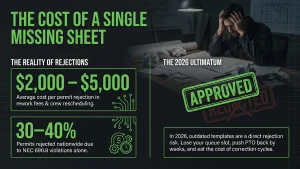
- A single missing sheet or wrong code edition in your solar permit plan set costs $2,000–$5,000 per rejection in rework fees and crew rescheduling.
- NEC 2026 is actively enforced in more jurisdictions every month — outdated templates are now a direct rejection risk.
- EnergyScape Renewables reports that NEC 690.8 violations cause 30–40% of all solar permit rejections nationwide.
Solar permit plan set checklist — three words that separate installers who pull permits on the first shot from those who burn weeks on correction cycles. If your plan sets keep coming back from the AHJ with revision notices, this guide is for you. Most permit rejections in the US are preventable. The problem is not a difficult AHJ. It is a missing sheet, a wrong code edition, or an incomplete calculation. This checklist covers every document and drawing your plan set needs in 2026 to clear AHJ review — the first time.
Why Your Solar Permit Plan Set Checklist Matters More in 2026
AHJ permit reviews have gotten stricter. NEC 2026 enforcement is rolling out across more states every month. SolarAPP+ adoption in Florida, Texas, and Arizona adds a second compliance layer on top of standard AHJ review. Additionally, FEOC documentation requirements for battery systems are now hitting plan sets in California, Texas, and Florida.
Get the plan set wrong and you lose your queue slot. In high-growth markets, that pushes your PTO back by weeks — not days. According to EnergyScape Renewables, each correction cycle costs installers and EPCs between $2,000 and $5,000 per rejected project, before crew rescheduling and client delay penalties even enter the picture.
However, the fix is simple: run the checklist before every submission.
The Complete Solar Permit Drawing Checklist for 2026
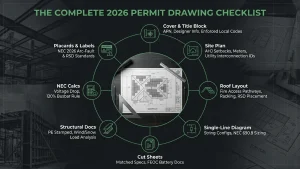
1. Cover Sheet and Title Block
Every sheet in your plan set must carry a consistent title block. It needs: project address and APN, designer name and license number, date and revision number, the NEC edition the jurisdiction enforces, and IBC/IRC edition with local amendments.
Missing title block information is one of the top five reasons AHJs reject solar permit plan sets. It seems minor. However, reviewers are required to log this data, and if it is not there, the submittal goes straight back.
2. Site Plan
Your site plan gives the reviewer a property-level picture of the installation. It must show: building footprint, array location, utility meter placement, main service panel location, and setback distances from roof edges, ridges, and hips per your local fire access code.
In California, Texas, and New England, many utilities now require interconnection application numbers referenced directly on the site plan before AHJ approval is granted.
3. Roof Layout and Array Drawing
This drawing shows panel placement with row and column counts, fire access pathways, setback distances, module orientation, racking attachment points, and rapid shutdown equipment placement per NEC 690.12.
Every setback must reflect your specific AHJ’s building code — not a generic national template.
4. Electrical Single-Line Diagram (SLD)
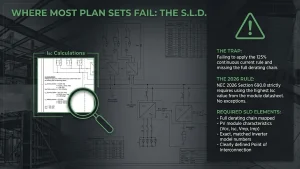
This is the section where most solar permit plan sets fail AHJ review. Your SLD needs: PV module electrical characteristics (Voc, Isc, Vmp, Imp), string counts and configurations, inverter ratings and model numbers, all disconnects, overcurrent protection devices sized per NEC 690.8, conductor sizes with the full derating chain applied, grounding details, and the point of interconnection.
EnergyScape Renewables reports that NEC 690.8 violations cause 30–40% of solar permit rejections nationwide. The most common miss: applying the 125% continuous current multiplier but skipping ambient temperature correction factors and conduit fill derating. Document the entire derating chain on the diagram — reviewers should not have to ask for it.
5. Equipment Specifications and Cut Sheets
Include manufacturer cut sheets for PV modules, inverters, racking, rapid shutdown devices, disconnects, and any battery system. Every equipment callout on your electrical sheet must match the cut sheet exactly. Mismatches between the inverter model on your one-line and the spec sheet trigger correction notices every time.
2026 update: AHJs in California, Texas, and Florida now require FEOC compliance documentation for battery equipment. Build it into your submittal package from the start.
6. Structural Documentation
Structural documents are the most commonly missing item in both residential and commercial submittals. Your plan set needs: roof load calculations showing added dead load from racking and modules, wind uplift and snow load analysis where applicable, roof material type, and rafter or truss attachment details.
For commercial projects — and increasingly for larger residential systems — PE-stamped structural calculations are required. NEC 2026 Section 690.4(G) also added a rounding rule that affects final voltage and amperage calculations. Teams using previous code templates are catching correction notices on this specific change right now.
7. NEC Calculations Sheet
This sheet documents: voltage drop calculations, the 120% busbar rule per NEC 705.12, conductor sizing per NEC 310, overcurrent protection per NEC 240, and string voltage calculations including temperature correction factors. Under NEC 2026, Isc calculations must use the highest Isc value from the module datasheet — no exceptions per Section 690.8.
8. Labels, Placards, and Equipment Schedules
AHJ reviewers in 2026 cross-reference label placements against mobile review tools. Your plan set needs: rapid shutdown initiation label, PV system disconnect label, back-fed breaker label, and arc-fault protection labels per NEC 2026 standards. Keep labeling language consistent across every sheet — drawings, placards, and installation notes must match exactly.
Three 2026 Factors Every Installer Should Know About Solar Permit Plan Set Checklist
NEC 2026 is live in more markets than you think. California fully enforces it. More states are adopting it monthly. Therefore, submitting against the wrong code edition guarantees a correction cycle.
SolarAPP+ adds a parallel requirement. In Florida, Texas, and Arizona, the platform processes many residential permits in one to three days — but only if your plan set meets the platform’s specific requirements, not just general AHJ standards.
Multi-state EPCs face a patchwork of PE stamp rules. Texas has no statewide framework — requirements vary city by city. Florida requires a PE stamp on virtually every installation.
Skip the Guesswork. Use a Partner Who Already Runs This Checklist.
Every plan set EnergyScape Renewables delivers is pre-checked against this exact solar permit plan set checklist before it leaves the team — NEC 2026 compliant, PE-stamped, and built to your specific AHJ’s requirements. With a 99% first-submission approval rate and turnaround of 15–24 hours for residential and 24–48 hours for commercial projects across all 50 states, there are no scrambles for local engineers and no lost queue slots on preventable corrections.
👉 Request your plan set → energyscaperenewables.com
Once your plan set is submitted, you need to know exactly where it stands. Sunscape Solar is the project management CRM built for US solar installers and EPCs. It tracks permit status, AHJ submissions, interconnection milestones, and inspection schedules in one real-time dashboard — so your back-office and field team stay locked in together, on every job.
👉 See Sunscape Solar → sunscape.solar
Frequently Asked Questions: Solar Permit Plan Set Checklist
Q: What documents are required for a solar permit plan set?
A solar permit plan set must include a cover sheet, site plan, roof layout drawing, electrical single-line diagram, equipment cut sheets, structural documentation, NEC calculations, and labels and placards. Requirements vary by AHJ, so always confirm the local code edition before submitting.
Q: Does a residential solar plan set need a PE stamp?
It depends on your AHJ and system size. Most commercial projects require a structural and electrical PE stamp. Many AHJs across Florida, California, and high-load states require a PE stamp on residential systems as well. Confirm requirements before submittal.
Q: What NEC edition do I need for my solar plan set in 2026?
NEC adoption varies by state. California enforces NEC 2026; others still use NEC 2020 or earlier. Submitting to the wrong edition is a common, preventable rejection cause.
Q: What is FEOC and why does it affect my plan set?
FEOC stands for Foreign Entity of Concern. As of January 2026, commercial solar systems receiving ITC incentives must source at least 40% of manufactured product value from non-FEOC suppliers. AHJs in some states now require FEOC compliance documentation for battery storage as part of the permit package.
Q: What is SolarAPP+ and does my plan set need to comply with it?
SolarAPP+ is an automated permitting platform used by AHJs in Florida, Texas, Arizona, and other jurisdictions to process residential solar permits quickly. If your AHJ uses SolarAPP+, your plan set must meet the platform’s specific requirements — not just standard AHJ guidelines.
Q: How much does a solar permit rejection cost?
EnergyScape Renewables reports each rejection costs $2,000–$5,000 in revision fees and crew rescheduling — before client delay penalties.

1 Comment
[…] Consequently, anything that breaks that order invites harder scrutiny on every sheet after it. Our solar permit plan set checklist covers the full sheet […]