
Virtual Permitting in 2026: Which States Now Accept Digital Submittals And How Much Faster Are They?
Virtual Solar Permitting Is Rewriting the 2026 Approval Game
You submit a clean permit package. Then you wait. Two weeks pass, yet the AHJ stays silent. Meanwhile, your crew sits idle and your client keeps calling. That delay quietly drains margin on nearly every job. Fortunately, virtual solar permitting is changing that math in 2026. More states now accept digital submittals and approve compliant systems in minutes. As a result, installers reclaim days they once lost at the permit desk. So this guide breaks down which states moved first, how much faster they run, and where the real gaps remain.
What Virtual Solar Permitting Actually Means
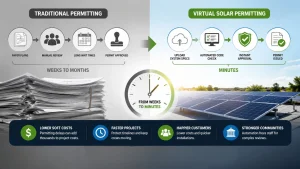
Virtual solar permitting replaces manual plan review with automated software. The contractor uploads system specs into a portal. The platform then checks the design against safety and code standards. If everything passes, the permit issues instantly.
SolarAPP+ leads this shift. The NREL-built tool runs an automated review for safety and code compliance and lets local governments approve solar permits instantly. Symbium offers a similar automated path. Both verify compliance in real time. Therefore, qualifying projects skip the multi-week queue entirely.
This matters for one simple reason. Permitting is a soft cost, not a hardware cost. In fact, bureaucratic permitting hurdles can add several thousand dollars to a typical residential rooftop system. Cut that delay, and you protect both your timeline and your client’s price. Local governments win too, since automation frees overwhelmed staff for complex reviews.
Which States Now Accept Digital Submittals
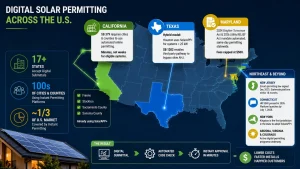
Adoption is uneven, so location drives everything. Still, the map keeps expanding. Today, hundreds of cities and counties across more than 17 states have adopted instant permitting for home solar, representing nearly one-third of the national market.
California
California leads the country. Senate Bill 379 requires most cities and counties to deploy automated, online permitting platforms for residential solar and battery storage. Fresno, Stockton, Sacramento County, and Sonoma County already run SolarAPP+. As a result, eligible systems clear review in minutes, not weeks.
Maryland
Maryland moved aggressively in 2026. The 2024 Brighter Tomorrow Act and the 2026 Utility RELIEF Act now mandate automated, same-day permitting statewide, with residential fees capped at $500. Same-day approvals are quickly becoming the norm there.
Texas
Texas runs a hybrid model. Houston processes SolarAPP+ permits for systems under 25 kW. Meanwhile, SB 1202 lets installers bypass a slow AHJ through a third-party pathway. So even tough jurisdictions have a faster route.
The Northeast and Beyond
Momentum is spreading fast. New Jersey’s governor signed smart-permitting legislation in December 2025, requiring a statewide automated platform within 18 months. Connecticut passed HB 5340 in 2026, though its platform must launch by July 1, 2028. New York’s Kingston became the state’s first jurisdiction to adopt SolarAPP+. Arizona, Virginia, and Colorado also field active programs.
How Much Faster Is Virtual Solar Permitting?
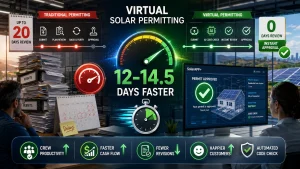
Virtual solar permitting delivers a speed gain that’s real and measurable. SolarAPP+ has cut review times from as many as 20 business days down to zero, so projects finish about 12 days faster than traditional review. Some jurisdictions report even larger savings. NREL estimated the platform sped up permitting by an average of 14.5 days and saved 15,400 hours of local government staff time in 2023.
Consider what that means across a pipeline. Each saved week shortens your cash cycle. It also frees your crew for the next install. Moreover, faster permits lower cancellation rates, because clients stay excited. In 2026, that time advantage is a pure competitive edge.
Automated solar permitting also reduces revision cycles. The portal flags code issues before submission. Thus, you fix problems in real time instead of weeks later. Clean inputs mean clean approvals.
Where Virtual Solar Permitting Still Falls Short
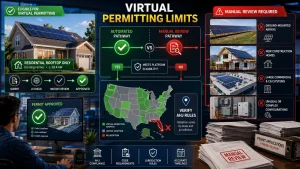
The tools are powerful, yet they have limits. Eligibility rules are strict. Most platforms only accept roof-mounted systems on existing homes, generally under 38.4 kW.
So several project types still need manual review:
- Ground-mounted arrays
- New-construction homes
- Large commercial and C&I systems
- Unusual or complex configurations
Geography adds another gap. Florida, for example, has no SolarAPP+ adoption in any jurisdiction, so manual submissions remain the statewide standard. Therefore, you can’t assume your California workflow travels well. Always confirm the rules in each AHJ before you commit a timeline.
How to Win Across Every State
First, verify the permitting path for each jurisdiction. Next, build templates for both instant and manual markets. Then, name the exact NEC edition on every sheet. These small habits prevent costly rejections.
Above all, treat permitting as a system. Track each project’s status in one place. That visibility keeps your whole pipeline moving, even across mixed-speed states.
The Bottom Line for Installers and EPCs
Virtual solar permitting is no longer a novelty. Instead, it’s becoming the baseline for competitive installers in 2026. The winners will match each state’s process to a tight, repeatable workflow.
That’s where the right partners matter. EnergyScape Renewables delivers PE-stamped, NEC 2026-compliant plan sets across all 50 states. Their team holds a 99% first-submission approval rate across 188,000-plus projects. Each package includes structural and electrical stamps, FEOC documentation, and interconnection details. As a result, your submittals stay clean whether the AHJ runs SolarAPP+ or manual review.
Pair that engineering with strong pipeline control. Sunscape Solar, a CRM built for US installers and EPCs, keeps permit tracking, interconnection status, and PTO visible in one place. Together, they cover both the precision and the speed that virtual solar permitting demands. Ultimately, that combination turns faster approvals into real, repeatable margin.
sjayakanth@energyscaperenewables.com