
Solar PE Stamp Turnaround: Stop Permit Rejections in 2026

Solar PE Stamp Turnaround: Stop Permit Rejections in 2026
Your solar PE stamp turnaround could be the single biggest thing slowing down your project pipeline — and most installers don’t realize it until they’re already three weeks behind schedule.
You had everything lined up. The client signed. Equipment was ordered. Then the AHJ sent the permit back rejected. Suddenly your crew is sitting idle, your client is asking questions, and you’re staring at a correction notice that costs real money and real time. If you’ve been in the solar business long enough, that scenario sounds painfully familiar.
In 2026, with NEC 2026 enforcement expanding and AHJ permit queues backed up across high-growth states, a flawed PE stamp costs far more than a resubmission fee. It costs you weeks, cash flow, and project momentum you can’t recover.
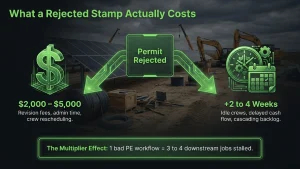
What a Rejected PE Stamp Actually Costs You
A permit rejection is not just a paperwork problem. It’s a cash flow event that hits your entire pipeline.
Solar permit rejections typically cost between $2,000 and $5,000 per project in revision fees, administrative time, and crew rescheduling — before client delay penalties even enter the picture. Moreover, the average resubmission adds two to four weeks to a project schedule. During that window, your crew either sits idle or gets juggled across other jobs, which creates a cascading backlog across every active project you’re managing.
For example, an EPC managing 30-plus active jobs doesn’t just lose time on one project. One bad PE stamp workflow can stall three or four downstream jobs simultaneously.
Furthermore, roughly 20% of solar installations nationwide experience costly delays. For a company running 200 projects a year, that’s 40 stalled jobs carrying cash flow drag, frustrated homeowners, and scheduling waste.
The Most Common Reasons Solar PE Stamps Get Rejected
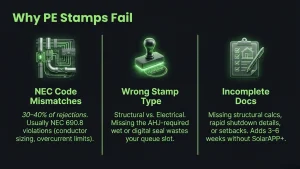
Most rejections don’t come from obscure local codes. Instead, the same three failures show up time and again.
NEC code mismatches top the list. NEC 690.8 violations — typically conductor sizing, overcurrent protection, or string configuration errors — account for roughly 30–40% of solar permit rejections nationwide. This is especially painful right now because California actively enforces NEC 2026, while most North Carolina jurisdictions still reference NEC 2020. Therefore, if your plan set was built for the wrong code edition, you’re getting rejected before the reviewer looks at your layout.
Wrong stamp type is another silent killer. Structural and electrical PE stamps are different certifications. Some AHJs require both. Consequently, sending only one — or the wrong one — wastes your entire queue slot. In states like Florida, a PE stamp is required on virtually every installation. There is no workaround.
Incomplete documentation rounds out the top three. Missing structural calculations, unspecified rapid shutdown details, and incorrect setbacks force full resubmissions. In jurisdictions without SolarAPP+, that cycle adds another three to six weeks. For context on how tightening adoption affects timelines, the Solar Energy Industries Association (SEIA) publishes annual market data worth bookmarking.
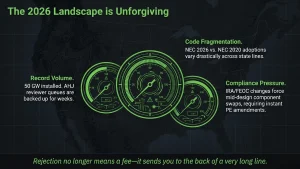
Why Solar PE Stamp Turnaround Matters More Than Ever in 2026
The solar industry installed approximately 50 GW of new capacity in 2024 — a back-to-back record year, according to SEIA. As a result, AHJ offices are busier than ever. In the Southeast and Mountain West, solar adoption is outpacing local reviewer capacity. Even a clean, complete plan set can wait two to three weeks in the queue. Consequently, a rejection doesn’t just cost a resubmission fee — it sends you to the back of the line.
In addition, NEC 2026 adoption is fragmenting permit requirements across state lines more than ever before. Commercial and industrial EPCs face added pressure from the ITC safe harbor construction deadline of July 4, 2026. A PE rejection that costs three weeks can mean the difference between locking in the four-year ITC window and missing it entirely.
FEOC compliance under the IRA is adding yet another layer. When a module or inverter spec changes mid-design — increasingly common as restricted components get phased out — the PE stamp may need an amendment. That’s a rejection trigger that barely existed two years ago. The National Renewable Energy Laboratory (NREL) has documented how SolarAPP+ is reducing timelines in participating jurisdictions, however statewide adoption remains limited.
The Cheap PE Stamp Trap That Stalls Growth
Many growing installers chase the lowest-cost provider to push jobs through faster. However, they end up spending far more on fixing rejections than they ever saved upfront.
Top engineering firms maintain first-time AHJ approval rates between 96% and 99%. Budget providers frequently fall below 80%. At a 20% rejection rate across 50 annual projects, you absorb 10 resubmissions per year — adding $4,000+ in direct costs plus weeks of compression and unrecoverable staff hours.
Speed and accuracy are not a tradeoff. The right solar PE stamp turnaround partner delivers both, every time.
How to Fix Your Permit Process Before the Next Rejection
The installers hitting 30-day-or-faster permit timelines share one discipline: they submit complete, AHJ-specific, NEC-compliant plan sets on the first attempt. That single habit eliminates the most common cause of delay.
Here’s what that workflow looks like in practice:
- Confirm the NEC edition your jurisdiction enforces before design starts — not after.
- Know stamp requirements upfront — structural, electrical, or both, and wet vs. digital seal.
- Partner with a nationwide PE firm licensed across all 50 states, current on NEC 2026 by jurisdiction.
- Build PE coordination in from day one — not the day before permit submission.
- Track every milestone in one dashboard so no job stalls in a shared inbox.
Rejection notices get buried in email threads. Correction deadlines pass quietly. However, real-time pipeline visibility stops that from happening. That visibility is ultimately what separates installers who scale cleanly from those always managing avoidable fires.
Ready to Get Every Permit Right the First Time?
EnergyScape Renewables delivers NEC 2026-compliant, AHJ-ready plan sets with structural and electrical PE stamps across all 50 states — with a 99% first-submission approval rate and 15–24 hour residential turnaround. No scrambling for local engineers. No wasted queue slots on preventable rejections.
👉 Request your plan set at EnergyScape Renewables →
Sunscape Solar gives your ops team real-time visibility across every project stage — permit status, resubmission deadlines, AHJ notes, and interconnection milestones in one place. When EnergyScape handles your engineering and Sunscape manages your pipeline, you’re building a solar operation that scales without the chaos.
👉 Explore Sunscape Solar — Your Solar OS →
Frequently Asked Questions: Solar PE Stamp Turnaround
How much does a solar permit rejection cost per project?
Solar permit rejections typically cost between $2,000 and $5,000 in revision fees, administrative time, and crew rescheduling — not including schedule delays or client relationship damage. (Source: EnergyScape Renewables, 2026)
What causes most solar PE stamp rejections in 2026?
NEC 690.8 violations account for 30–40% of rejections nationwide, followed by wrong stamp type and incomplete documentation such as missing setback calculations or rapid shutdown specifications.
What is a good solar PE stamp turnaround time?
Top solar engineering firms deliver residential PE stamps in 15–24 hours and commercial in 24–48 hours. Turnaround beyond 48 hours for residential work is a warning sign your provider doesn’t specialize in solar — and longer waits increase your rejection risk directly.
sjayakanth@energyscaperenewables.com