
NEC 690/706 Permit Package: 12 Documents You Need in 2026

NEC 690/706 Permit Package: 12 Documents You Need in 2026
Your crew is booked, the customer signed, and then the AHJ rejection email lands. Nine times out of ten, it traces back to one missing sheet in your NEC 690/706 permit package — not a hard reviewer. And in 2026, that risk went up. Most jobs now ship with a battery, so a solar permit package carries roughly double the paperwork it used to.
Quick answer: A complete NEC 690/706 permit package needs 12 core documents — the shared admin and structural sheets, the NEC 690 documents for the PV side, and the NEC 706 documents for the storage side. Miss one, and you lose your queue slot.
What is a NEC 690/706 permit package?
NEC Article 690 covers solar photovoltaic (PV) systems. NEC Article 706 covers energy storage systems (ESS). So a NEC 690/706 permit package is the coordinated set of drawings, calculations, listings, and forms that proves your PV-plus-storage system meets electrical, structural, and fire code at once.
Reviewers don’t read it casually. Instead, they audit it in a set order — site, layout, equipment, labeling. When those pages don’t agree, you get redlines. In short, a clean package is your biggest lever on first-pass approval.
The 12 documents your NEC 690/706 permit package needs
Shared documents (admin and structural)
1. Cover sheet and title block. List the project address, APN, designer license, revision number, and the exact NEC and IBC/IRC editions your AHJ enforces. A recycled template naming the wrong edition is a preventable rejection.
2. Site plan. Show property lines, building footprint, equipment locations, conduit routing, and fire setbacks. Mismatched setbacks trigger a fast rejection.
3. Structural plan and PE-stamped calculations. Confirm the roof carries the added load and resists uplift under local wind and snow. In states like Florida, a PE stamp is required on nearly every install. For turnaround tips, see our solar PE stamp guide.
NEC 690 documents (the PV side)
4. Single-line diagram (SLD). This is the page reviewers trust most. It maps the full power path from array to interconnection. Our single-line diagram checklist breaks it down sheet by sheet.
5. Three-line diagram. Add grounding, bonding, and detailed conductor routing. Larger and commercial systems almost always require it.
6. Electrical load and conductor calculations. Cover voltage drop, the 120% busbar rule under NEC 705.12, conductor sizing, and string voltage with temperature correction. Under NEC 2026, Section 690.4(G) added a rounding rule that’s catching teams still on old templates.
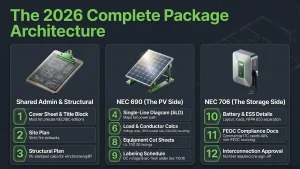
7. Rapid shutdown documentation and placards. Show how the system meets NEC 690.12 and the 690.56(C) placard graphics for the adopted code year.
8. Equipment cut sheets with UL listings. Include specs for every module, inverter, and disconnect. Inverters should carry a UL 1741 SB listing to clear interconnection.
9. Labeling schedule. Cover DC voltage and PV-source labels, plus arc-flash labels under Section 110.16 — whose scope expanded in 2026 to more commercial gear.
NEC 706 documents (the storage side)
10. Battery and ESS details. Add a separate battery layout, updated load calculations, ESS nameplate data, and NFPA 855 separation distances. Reviewers flag storage jobs that lean on a standard PV template, so don’t assume your old set covers it.
11. FEOC compliance documentation. As of January 2026, commercial ITC systems must source at least 40% of product value from non-FEOC suppliers. AHJs in California, Texas, and Florida now ask for this on battery packages.
12. Interconnection application. Utilities in California, Texas, and New England want your interconnection number on the plan set before sign-off. So treat it as a permit document, not a later step.
Why your 2026 permit package got heavier
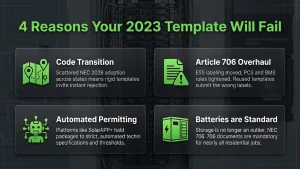
Four things converged this year, and together they explain the jump from a 7-document PV set to a 12-document package.
Code is in transition. NEC 2026 published in October 2025, yet adoption is scattered. Many states still run NEC 2023, some sit on NEC 2020, and only a handful enforce 2026. As a result, designing to the wrong edition is a pure own goal.
Article 706 changed. Section 706.16 was deleted and ESS labeling moved, while PCS and BMS rules tightened. So a reused 2023 storage template will submit the wrong labels.
Automated permitting raised the floor. SolarAPP+, backed by NREL, has processed over 100,000 permits across 520-plus jurisdictions and holds your package to its own spec.
Storage is standard. Battery attach rates keep climbing. Because of that, the NEC 706 documents are on most residential jobs now, not just the odd one.
What a missing document actually costs you
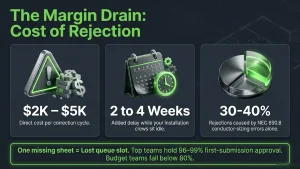
This isn’t a paperwork lecture — it’s margin. Industry data pins 30–40% of solar permit rejections on NEC 690.8 conductor-sizing errors alone. Each correction cycle then runs $2,000–$5,000 and adds two to four weeks. Meanwhile, your crew sits idle or bounces to another job.
Run the math on a 20% rejection rate across 50 projects. That’s roughly 10 resubmissions, $4,000-plus in direct cost, and weeks you can’t recover. For context, SEIA reports the U.S. installed about 50 GW in 2024, so AHJ offices are busier than ever. Top teams hold first-submission approval between 96% and 99%; budget providers often fall below 80%.
How to hit first-pass approval
First, standardize your package to these 12 documents. Next, confirm the enforced NEC edition per AHJ before you design. Then build FEOC and interconnection checks into your pre-design step. Finally, keep your cover sheet, calculations, and labels in perfect agreement. Our 2026 plan set checklist walks through each sheet in order.
Get a permit-ready package — and keep it moving to PTO
You shouldn’t have to choose between speed and a clean approval. Energyscape Renewables delivers PE-stamped, AHJ-ready NEC 690/706 permit packages in as little as 24 hours, built to the exact code edition your jurisdiction enforces, across all 50 states, and backed by a 99% approval rate. One partner handles your plan sets, engineering stamps, and the full 12-document package — no correction chaos.
Once your package is in, Sunscape keeps it moving. It tracks every stage — plan sets, permits, AHJ follow-ups, interconnection, and PTO — in one pipeline. So nothing stalls in a reviewer’s inbox and no job slips through the cracks.
Ready to stop losing queue slots to missing documents? Request a quote from Energyscape Renewables or book a Sunscape demo and get your next permit package approved the first time.
Frequently asked questions
What is a NEC 690/706 permit package?
It’s the coordinated set of drawings, calculations, listings, and forms proving a PV-plus-storage system meets electrical, structural, and fire code. NEC 690 governs the PV side; NEC 706 governs storage.
Why do solar permits get rejected?
Most rejections are preventable. The top causes are conductor-sizing errors under NEC 690.8, wrong code editions, incomplete title blocks, and mismatched fire setbacks.
Do battery storage projects need extra permit documents?
Yes. Battery jobs add NEC 706 load calculations, ESS details, NFPA 855 separation, storage labeling, and, for commercial ITC systems, FEOC documentation.
Which NEC edition should I design to in 2026?
Design to the edition your AHJ enforces, not the newest one. Adoption varies by state, so confirm the cycle before every submittal.
sjayakanth@energyscaperenewables.com