
Meter Socket Adapter vs MPU: Skip the $3,000 Upgrade in 2026
Meter Socket Adapter vs. Main Panel Upgrade: How Installers Skip the $3,000 MPU in 2026
If you sold a battery job this year, you’ve probably watched a main panel upgrade wreck the numbers. A meter socket adapter can often skip that $3,000 line item. That matters more in 2026. The federal 25D and 25C credits ended with 2025, so the homeowner has nothing to offset panel work, and the cost falls on your proposal or your margin.
The catch is approval. A collar only pays off when the utility signs off on that exact model and the plan set shows the meter-point connection the way the utility wants it. Check both before you quote.
Key Takeaways
A meter socket adapter connects solar or storage at the meter and can replace a $1,200 to $4,500 panel upgrade. Approval is model-specific. As of September 2026, Enphase’s collar is approved by 80 utilities and ConnectDER’s line by 54, yet two utilities in the same state can still give different answers for the same device and battery.
What Is a Meter Socket Adapter for Solar?
A meter socket adapter is a UL 414-listed device that plugs in between the utility meter and the meter socket, giving solar, storage, or EV equipment a place to connect at the meter instead of on the panel busbar. You’ll see four on most jobs: the ConnectDER Solar MSA, Tesla’s Backup Switch, the Enphase IQ Meter Collar, and ConnectDER’s newer IslandDER.

The meter socket belongs to the utility. Under NEC 705.11 and 705.12, only connections the utility approves can go there, so nothing goes in until the utility says yes.
Why Does the 120% Rule Trigger So Many Panel Upgrades?
The 120% rule caps backfeed into a busbar, and batteries blow past that cap. Multiply the busbar rating by 1.2 and subtract the main breaker. On a 200A panel with a 200A main, that leaves room for a 40A solar breaker, or about 7.68 kW of inverter output.
Now add a Powerwall 3. At its default 11.5 kW output it draws 48A and needs a 60A breaker. With attach rates climbing, a lot of your jobs hit this wall.
The upgrade costs money and calendar days. National estimates average about $2,800, with most jobs landing between $1,200 and $4,500, and California installers routinely see $5,000 or more. PG&E averaged 42 business days end to end per MPU from 2023 to 2025.
Code numbering moves between editions too, so check our 50-state NEC edition map before you cite 705.12 on a plan set.
Which Utilities Approve Meter Collars in 2026?
More than 80 utilities in the US and Canada approve at least one meter collar. Each approval covers specific models and uses.
| Device or Market | Approval Status | As Of |
|---|---|---|
| Enphase IQ Meter Collar | 80 utilities, 38M+ customers (US and Canada) | Sept 2026 |
| ConnectDER (full line) | 54 utilities, nearly 40M households | 2026 |
| ConnectDER IslandDER | APS, TEP, and SRP in Arizona | Jan 2026 |
| Tesla Backup Switch | PG&E, SCE, SDG&E, ComEd, Green Mountain Power, others | 2025-2026 |
| New York | Statewide pilot approved, applications open June 1, 2027 | Sept 2026 |
| New Jersey | State law requires utilities to authorize qualifying collars | 2024 |
Read the fine print on every line. SCE’s July 2026 approved product list still marks some collar and battery pairings as pilot phase, and an EV-only approval tells you nothing about solar. Some states are slower still. New York’s pilot decision doesn’t open applications until June 1, 2027.
How to Check If a Meter Socket Adapter Can Replace an MPU
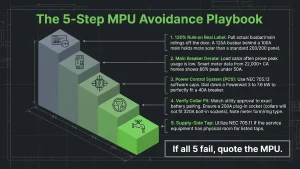
Run these five checks in order before quoting a panel upgrade. Each one is cheaper than the next.
- Run the 120% rule on the real label. Pull the busbar and main breaker ratings off the panel door. A 125A busbar behind a 100A main holds more solar than a 200/200 panel, which surprises a lot of designers.
- Try a main breaker derate. A load calc may show the home never comes close to 200A. Smart meter data from 22,000+ California homes found 86% peaked under 50A.
- Set a power control system (PCS). NEC 705.13 lets listed systems cap current into the panel, so a Powerwall 3 dialed down to 7.6 kW fits a 40A breaker. Confirm the utility won’t judge it at full nameplate.
- Verify the collar fits. You need approval for the exact model and battery pairing, plus a 200A plug-in socket. Collars won’t fit 320A bolt-in sockets. Note the meter form and any utility request form while you’re there.
- Look at a supply-side tap. NEC 705.11 works when the service equipment has room for listed taps.
If all five fail, quote the MPU.
Where Do Meter Collar Jobs Go Wrong?
Usually in the paperwork. The most expensive miss happens at the site survey. Nobody photographs the meter socket, the ring type, or the meter form, so the crew shows up with a collar that doesn’t fit and you eat a change order. Our solar site survey checklist lists every photo you need.
Plan sets cause the next round of trouble. If the single-line diagram shows a load-side breaker while the utility expects a meter-point connection with the collar model and rating called out, that’s a classic reason interconnection applications get kicked back.
Two smaller ones round it out. A designer specs a collar that’s approved one territory over. Or the utility approval step never makes it into the pipeline, and someone books the install before the utility signs off.
Why Does This Matter More in 2026?
Because the MPU costs more now, in cash and in days. The 25D and 25C credits are gone, and California’s HEEHRA panel rebates were fully reserved on February 24, 2026. On TPO deals, lease and PPA financiers pay on milestones, so a two-month utility wait pushes your cash back two months. Our TPO milestone funding checklist shows where those delays hit.
PG&E’s timelines may slip too. Its extra SB 410 energization funding expires at the end of 2026. Approvals keep moving in the other direction, so if your “collars aren’t allowed here” info dates from 2023, check again. For the wider permitting picture, see why solar projects get stuck in permitting.
Skip the MPU Without Gambling on the Approval
Send Energyscape Renewables a photo of the panel label and the meter socket. Our designers run the 120% rule, derate, PCS, collar, and tap options against your utility’s rules using our AHJ & Utility Database, then hand back a meter-point SLD with 24-hour PE stamping in all 50 states. Interconnection paperwork comes with it, backed by a 99% AHJ and utility approval rate. If you’d rather not chase the photos yourself, our SiteScape site survey team captures the socket data on the first visit. Explore our engineering services or request a quote today.
Sunscape keeps the approval step on the board. Log the interconnection method and collar model on each project, and track utility approval as its own pipeline stage so nobody schedules a crew early. Book a Sunscape demo and follow every job from survey to PTO.
Meter Socket Adapter FAQs
Does a meter socket adapter replace a main panel upgrade?
Often, for solar and storage backfeed. The utility has to approve the model and the socket has to fit. It won’t add service capacity, so a home that needs more amps for new loads still needs the upgrade.
Do I need utility approval for a meter collar?
Yes. The meter socket is utility equipment, and only connections the utility approves can go there.
Can a Powerwall 3 go in without a panel upgrade?
Usually. A PCS output limit, a derate, an approved Backup Switch, or a supply-side tap can each avoid the MPU.
Do meter collars work on 320A services?
No. Today’s collars need a standard 200A plug-in meter socket.
sjayakanth@energyscaperenewables.com