
Back to Blog Page
SolarAPP+ States 2026: Where Instant Permits Work
SolarAPP+ States 2026: Where Instant Permits Work — and Where Your Job Falls Off the Cliff.
Key Takeaways
- SolarAPP+ now runs in 240+ communities across roughly a dozen states, but Florida still has zero adopting jurisdictions.
- A SolarAPP+ approval is not a permit. You still submit the approval number through the AHJ’s own portal.
- Eight eligibility rules push projects back into full plan review, including ground mounts, 400A+ service, and 140 mph wind zones.
- NREL measured a 12-day faster install-to-inspection cycle on qualifying projects.
- Automation never checks NEC edition mismatches, FEOC paperwork, or your field inspection.
A crew in Fresno pulled a residential permit last week in under five minutes. Ninety miles away, another crew sits on day eleven of plan check for a nearly identical system.
Same state. Same code cycle. Very different economics.
That gap explains why SolarAPP+ states in 2026 matter so much to installers and EPCs. But here’s the part most teams learn the expensive way: living in an adopted jurisdiction does not mean your project qualifies. The map tells you where automation exists. The eligibility checklist decides whether you actually get to use it.
What Instant Solar Permitting Actually Does
SolarAPP+ is a free web platform built by NREL with U.S. Department of Energy funding. You enter your equipment and design specs. Then the software runs an automated code-compliance check, and a compliant system gets approved on the spot.
Houston’s certified building official reported dropping from nine days to one day after implementation.
Two details trip up installers constantly.
First, the approval is not the permit. It’s a document with an approval number. You still carry that number into the AHJ’s own portal — Accela, eTrakit, LAMA, whatever they run — to get the permit issued.
Second, using it is your choice. SolarAPP+ is a voluntary product for contractors, and you can still submit the traditional way if you prefer. So being in a fast jurisdiction doesn’t make your operation fast. Somebody has to own the routing call.
Which SolarAPP+ States Lead in 2026?
Adoption keeps climbing. More than 240 communities now use SolarAPP+ nationwide — up from 160 communities across 10 states in December 2023.
Here’s where the mandates stand today:
California — SB 379 requires most cities and counties to run automated residential permitting. Jurisdictions over 50,000 had to comply by September 30, 2023; cities of 50,000 or fewer by September 30, 2024. Fresno, Stockton, Sacramento County, and Sonoma County are live.
Maryland — The Brighter Tomorrow Act and the 2026 Utility RELIEF Act mandate same-day permitting statewide, with residential fees capped at $500. Montgomery, Prince George’s, and Worcester counties adopted early, while the rest phase in through 2026 and 2027 under HB 1532.
Texas — Houston runs SolarAPP+ for systems under 25 kW. Meanwhile, SB 1202 gives you a third-party review path around a slow AHJ.

New Jersey — Smart-permitting legislation signed in December 2025 requires a statewide platform by mid-2027.
Virginia — The state platform is funded, with a hard deadline requiring localities to accept it or an approved alternative by January 1, 2028.
Connecticut — HB 5340 passed in 2026, though the platform deadline sits at July 1, 2028.
Also active: Arizona, Colorado, Iowa, Oklahoma, Wisconsin, and New York. Florida still has none.
One caution worth pricing in. A mandate is not a working portal. The California Energy Commission does not certify SB 379 compliance, and jurisdictions reporting zero online permits stay classified as “Without Platform.” So verify before you promise a homeowner a three-day permit.
The Eligibility Cliff Inside SolarAPP+ States in 2026
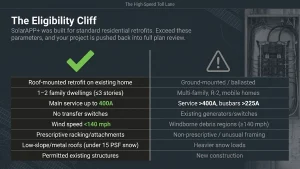
This is where margin leaks. SolarAPP+ was built for standard residential retrofits, so anything outside that box lands back in full plan review — often after you’ve already committed to a date.
| Automated approval works | Full plan review required |
|---|---|
| Roof-mounted retrofit on existing home | Ground-mounted or ballasted arrays |
| 1–2 family dwellings, townhomes ≤3 stories | Multi-family, R-2, mobile homes |
| Main service up to 400A | Service above 400A, busbars above 225A |
| No transfer switches | Existing generators or transfer switches |
| Wind speed under 140 mph | Windborne debris regions at 140 mph or greater |
| Prescriptive racking and attachments | Non-prescriptive attachments, unusual framing |
| Metal or low-slope roofs under 15 PSF snow load. | Heavier snow loads, jurisdiction-specific caps |
| Permitted existing structures | New construction |
Exceed the 400A main service, 225A disconnect, or 225A busbar thresholds and the platform flags the project ineligible. Meanwhile, SolarAPP+ is not a blanket exemption from engineering — projects outside its criteria may still need PE review, especially when the attachment method skips prescriptive tables or the roof has unusual spans and heavy exposure.
Revisions carry their own trap. Staff review revisions manually rather than auto-issuing them, and a revision that breaks eligibility forces a separate submittal path.
What Automation Still Won’t Check
Three things bite you even on a qualifying job.
NEC edition. Automated review validates against whatever edition that AHJ adopted. Because states move on staggered schedules, one template passes in one county and fails in the next.
FEOC documentation. Since January 2026, ITC-claiming commercial systems need 40%+ non-FEOC content. AHJs in California, Texas, and Florida now request that paperwork at submittal.
Inspection. Instant permitting speeds review, not field work. Houston still runs rough-in, structural, and final.
How to Run Two Permit Clocks Without Losing Days
Once your territory spans instant and manual jurisdictions, you’re managing two very different cycle times inside one pipeline. Averaging them wrecks crew scheduling.
Three habits fix most of it:
- Triage at site survey. Capture roof slope, roof material, panel rating, transfer switches, and ground snow load in the field. Every one is a disqualifier.
- Keep two plan-set templates ready. One prescriptive package, one PE-stamped package. Name the NEC edition on every sheet.
- Track permit path as a pipeline field. Not a note — a field you can filter and schedule against.
The payoff is measurable. NREL found SolarAPP+ projects were installed and inspected 12 days faster than traditionally permitted projects, with comparable inspection pass rates. NREL also estimated a 14.5-day average speedup and 15,400 staff hours saved in 2023. Still, you only collect that on jobs that qualify.
Keep Both Permit Paths Moving
Automation rewards one thing: clean inputs.
Energyscape Renewables delivers PE-stamped, NEC 2026-compliant plan sets across all 50 states, backed by a 99% first-submission approval rate across 188,000+ projects. Our AHJ and utility database tells you which portal, which sequence, and which code edition applies before you submit. So when a job falls off the checklist, you’re already covered.
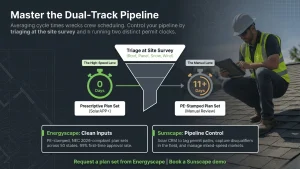
Then pair that with pipeline control. Sunscape is a solar CRM and site survey platform built for U.S. installers and EPCs. Capture disqualifying field data on the first visit, tag each project’s permit path, and keep permit, interconnection, and PTO status visible across mixed-speed markets.
👉 Request a plan set from Energyscape | 👉 Book a Sunscape demo
SolarAPP+ States 2026: Frequently Asked Questions
Which states use SolarAPP+ in 2026?
California, Maryland, Texas, Arizona, Colorado, Virginia, New York, Iowa, Oklahoma, and Wisconsin all have adopting communities, totaling over 240 jurisdictions. New Jersey and Connecticut have statewide platforms mandated but not yet live. Florida has no adopting jurisdictions.
Does my city use SolarAPP+?
Check the official SolarAPP+ jurisdiction list and your local building department page. In California, cross-reference the CEC dashboard, then confirm directly with the AHJ, because the CEC does not certify compliance.
Do I still need a PE stamp in a SolarAPP+ jurisdiction?
Not for qualifying systems that meet prescriptive structural criteria. However, ground mounts, ballasted arrays, non-prescriptive attachments, and high wind or snow exposure still require stamped engineering.
Is SolarAPP+ mandatory for contractors?
No. It’s voluntary, so you can always submit through traditional plan review instead.
How much faster is instant permitting?
Review drops from as much as 20 business days to zero, and NREL measured a 12-day faster install-to-inspection cycle overall.
Tag:
automated solar permit approval do I need a PE stamp with SolarAPP+ does my city use SolarAPP+ instant solar permitting is SolarAPP+ mandatory for contractors same-day solar permit states solar permitting by state 2026 SolarAPP+ eligibility requirements SolarAPP+ ground mount eligibility SolarAPP+ ineligible projects SolarAPP+ vs traditional plan review

1 Comment
[…] path? And does this job actually fit inside it? For market-level detail, see our breakdown of where instant permitting works today, and check the official eligibility checklist before you […]