
Interconnection Application Errors: Why 40% Get Kicked Back
Interconnection Application Errors: Why 40% Get Kicked Back
Interconnection application errors stall more solar jobs than technical grid limits do. In fact, 30 to 40 percent of residential applications carry at least one error on first submission. So the deficiency notice that lands two weeks after your permit clears is rarely bad luck. It usually traces back to a document you already produced and already paid for: the plan set.
What is an interconnection kickback?
An interconnection kickback is a utility deficiency notice that returns your application as incomplete rather than rejecting it on technical grounds. In short, the utility is not saying no. It is saying not yet, and the fix sits on your desk.
Two reviewers read one document
Most installers run permitting and interconnection as separate tracks. The AHJ gets the plan set, and the utility gets an application. However, the utility is not reading a new document. It is reading yours.
Your single-line diagram, spec sheets, site plan, and service details go to a utility engineer who grades them against a different rubric. The AHJ checks life safety, structural loading, fire setbacks, and NEC compliance. The utility checks grid impact: what interconnects, where it ties in, whether the equipment carries the right listing for that territory, and whether the existing service can carry it.
As a result, a plan set built only for the AHJ clears permit and stalls at the utility. That single gap drives most interconnection application errors. Our step-by-step PTO guide maps where this sits in the wider timeline.
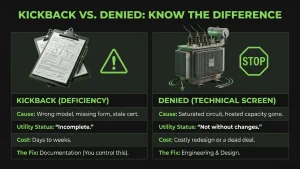
Kicked back or denied? Know the difference
| Kicked back (deficiency) | Denied (technical screen) |
|---|---|
| Wrong model number, missing form, stale certification | Saturated circuit, hosted capacity gone, penetration screen tripped |
| Utility says “incomplete” | Utility says “not without changes” |
| Costs days to weeks | Costs a redesign or the deal |
| Fixed by documentation | Fixed by design |
Most teams assume they fight denials. In practice, they generate kickbacks. That is good news, because kickbacks sit entirely on your side of the fence.
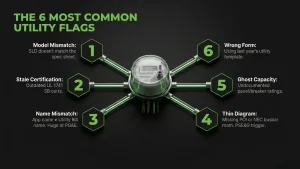
Six interconnection application errors utilities flag most
Model number mismatch. Your single-line diagram names one inverter, and the attached spec sheet names a variant. Reviewers catch this first.
Stale inverter certification. UL 1741 SB certification runs model by model, so a manufacturer can carry it on one unit and not on a close variant.
Customer of record mismatch. The application name does not match the utility account holder. PG&E flags this constantly, and a copy of the bill prevents it.
Thin single-line diagram. No point of interconnection detail, no disconnect location, and no NEC 705.12 busbar calculation. PSE&G names missing diagrams and undersized service panels among its top rejection triggers.
Undocumented service capacity. Panel rating and main breaker size belong on the page, not in someone’s head.
Wrong form revision. The utility updated its template in January, and your team submitted last year’s copy.
Most of these start in the field. Our post on site assessment mistakes covers the capture step that feeds them.
How these errors show up by utility
| Utility | Most common trigger |
|---|---|
| PG&E (Rule 21) | Customer of record mismatch; incomplete portal uploads |
| SCE | Storage documentation; limited study windows |
| Duke Energy | Capacity caps filling during rework |
| PSE&G | Missing single-line diagram; undersized service panel |
| FPL | Tariff tied to application date, not install date |
Three-phase jobs draw even more scrutiny, as our commercial interconnection breakdown explains.
Why resubmission costs more in 2026
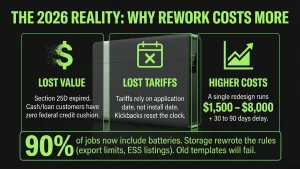
Rework always cost money. A single redesign runs $1,500 to $8,000 and pushes the project back 30 to 90 days. What changed is the downside. Energyscaperenewables
First, the application date is the money date. In many territories the tariff your customer receives depends on the interconnection application date, not the installation date. Grandfathering rules require a complete application, so an incomplete one is not a filed one. Duke’s Bridge Rate also carries annual capacity caps, so the cap can fill while your team fixes paperwork. Compare programs in our net metering state guide, and confirm current policy.
Second, the savings math has no cushion. Section 25D expired on December 31, 2025, so cash and loan customers now receive zero federal credit, and the federal benefit flows only through Section 48E on third-party-owned systems.
Third, volume is thinner. Residential installs fell roughly 15 percent quarter over quarter in Q1 2026, so every avoidable resubmission takes a bigger bite. Our plan set cost breakdown puts real numbers on that margin.
Storage quietly rewrote the application
Many EPCs now report 85 to 90 percent battery attachment on residential work. Because of that, a PV-only template stopped working. Energyscaperenewables
Storage adds power control settings, export limiting under NEC 705.13, ESS listings, revised busbar math, and usually a separate utility storage form. Teams running a 2022-era checklist therefore generate interconnection application errors on systems they designed correctly. The design was fine. The paperwork was not.
Your pre-submission QA gate
Run this gate before anything reaches the portal.
- Confirm the account holder name against the utility bill, not the contract.
- Match every model number on the diagram to the attached spec sheet.
- Pull the current certification letter for that exact model.
- Verify you are using the utility’s current form revision.
- Complete the storage package whenever a battery is on the job.
- Log the submission date, revision number, and owner in one shared system.
That last step matters more than people expect. Clean plan sets still get kicked back when someone attaches the wrong revision, and process alone fixes that.
Stop paying twice for the same job: Interconnection Application Errors
Every kickback costs you the same plan set twice, plus the install date and your customer’s patience.
Energyscape Renewables builds plan sets for both reviewers and files the utility application for you: 24-hour PE stamping in all 50 states, permitting, interconnection, and a maintained AHJ and utility database behind a 99 percent approval rate.
Sunscape stops the second failure. Track every project from proposal through permit, interconnection, and PTO, with submission dates, revision numbers, and owners visible to your whole team. Book a demo →
Frequently asked questions: Interconnection Application Errors
What is the difference between a permit rejection and an interconnection kickback?
A permit rejection comes from the AHJ and covers code compliance and life safety. An interconnection kickback comes from the utility and covers grid impact, equipment certification, and documentation completeness. The same plan set can pass one review and fail the other in the same week.
Does a kicked back application lose my place in line?
Often, yes. Many utilities date queue position from receipt of a complete application. Because of that, a deficiency notice can reset the clock that decides tariff eligibility, and your customer can land on a worse export rate.
How long does an interconnection resubmission add?
Plan on two to six weeks in most territories. Where a study window or capacity cap applies, the delay stretches further, since you wait for the next window rather than the next reviewer.
Can a clean plan set prevent every rejection?
No. It prevents the administrative category, which covers most cases. Technical screen failures still need design changes, such as export control or a different tie-in location.
sjayakanth@energyscaperenewables.com