
Back to Blog Page
Three-Phase Interconnection: Commercial & Utility-Scale Requirements
Why Three-Phase Interconnection Slows Down Commercial Solar Projects
Your commercial client signs the contract. Your crew finishes the install on schedule. Then the project sits for months, waiting on the utility. This is the reality of three-phase interconnection for most installers and EPCs today. Commercial and utility-scale systems run on 208V or 480V three-phase service. Connecting that service to the grid brings a level of review residential projects never see. The good news: most delays trace back to a handful of preventable mistakes. Get your phase balancing, point of interconnection, and IEEE 1547 documentation right from the start. Doing so can cut months off approval. This guide breaks down exactly what utilities expect. Use it to move your next three-phase interconnection application through review instead of watching it bounce back.
What Three-Phase Interconnection Actually Involves
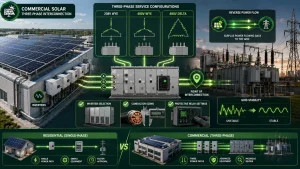
Three-phase interconnection ties a commercial or utility-scale solar system into the grid using three separate power legs. Residential circuits use just one. Commercial arrays must match the building’s existing 208V wye, 480V wye, or 480V delta configuration. The inverter selection, conductor sizing, and protective relay settings all have to align with that specific service. Utilities review these systems closely. Surplus power flowing backward through a three-phase system can destabilize the grid if it isn’t managed correctly. As a result, commercial interconnection applications go through more scrutiny and more paperwork than anything on the residential side.
Commercial Solar Interconnection Requirements Installers Must Meet

Inverter Selection and Phase Balancing
Three-phase string inverters or central inverters need to match the utility’s exact voltage and configuration. Unbalanced loads across the three legs can trip protective relays. Once that happens, your application gets kicked back to square one. This isn’t something you fix in the field later. Get the phase balancing right during design. That single step avoids one of the most common causes of utility rejection.
IEEE 1547 Compliance
The updated IEEE 1547 standard governs how distributed energy resources behave during grid disturbances. Solar systems fall under this rule. In 2026, utilities are enforcing it more strictly than before. Inverters must ride through minor voltage and frequency fluctuations instead of disconnecting automatically. If your inverter certifications don’t align with current IEEE 1547 requirements, your commercial solar interconnection application will likely stall during technical review.
Point of Interconnection (POI) Selection
Where you tie into the utility’s system matters as much as how you build the array. A poorly chosen point of interconnection can trigger a full system impact study. That single misstep adds weeks or months to your timeline. Site surveys and single-line diagrams should identify the strongest, least congested POI early. Choosing wisely at the outset saves your team from a costly redesign later.
Utility-Scale Interconnection Requirements: What Changes at Scale

Utility-scale projects face a different process than commercial rooftop or ground-mount systems. Commercial interconnection usually runs through a utility’s standard review track. Utility-scale solar instead enters a regional transmission organization’s interconnection queue. FERC’s Order 2023 reformed this process. Developers now post study deposits before moving through cluster studies with other queued projects. As of early 2026, the combined interconnection queue across U.S. grid operators exceeds 2,600 GW of proposed capacity. That’s nearly three times current national generating capacity. Most of those projects never reach commercial operation.
Substation and Transmission Considerations
For utility-scale arrays, the interconnection substation is often the single most expensive piece of the build. Cost-sharing negotiations with the utility can extend timelines significantly. This is especially true in high-demand grid regions. EPCs managing utility-scale three-phase interconnection need to budget both time and capital for this stage. Don’t treat it as a formality near the end of construction.
Realistic Timelines for Utility-Scale Approval
A 100 MW utility-scale solar project typically takes three to six years. That span runs from site identification to commercial operation. The bottleneck rarely comes from construction. Instead, it’s the development and interconnection queue process that eats the calendar. Set client expectations early, backed by real data. Doing so protects your reputation when the process runs long.
Common Mistakes That Delay Three-Phase Interconnection Approval

According to SEIA data, some commercial systems in high-demand grid areas wait more than 120 days for interconnection approval. That’s revenue sitting idle and clients losing patience. Three issues cause most of these delays. Incomplete electrical diagrams at initial submission top the list. Inverter certifications that don’t match IEEE 1547 requirements come next. POI selections that force an unnecessary impact study round out the top three. Every one of these is fixable at the design stage. Installers who submit complete, utility-ready plan sets the first time avoid the resubmission cycle. That cycle stalls so many commercial and utility-scale three-phase interconnection applications.
Documentation Checklist Before You Submit
A few extra minutes at submission saves weeks later. Confirm your single-line diagram matches the actual site conditions. Verify inverter model numbers against the utility’s approved equipment list. Double-check that your phase configuration matches the utility’s service exactly. Attach IEEE 1547 certification paperwork upfront, not as a follow-up. Utilities process complete packages faster than partial ones. A clean submission on day one beats a fast fix on day sixty.
How EnergyScape Renewables Keeps Your Interconnection Applications Moving
At EnergyScape Renewables, three-phase interconnection support sits at the center of what we do. We serve installers and EPCs across all 50 states. Our engineering team builds utility-ready plan sets, PE-stamped designs, and complete interconnection packages. These packages address phase balancing, POI selection, and IEEE 1547 compliance before you submit to the utility. We handle the technical documentation utilities scrutinize most. That means your commercial and utility-scale projects move through review instead of bouncing back for corrections.
Design and permitting are only part of the picture. Managing interconnection alongside every other project milestone gets easier with the right software behind your team. Sunscape gives installers and EPCs a single platform to track interconnection status, permitting stages, and project timelines from proposal to permission to operate. It’s built specifically for the workflow US solar companies run every day.
Ready to move your next three-phase interconnection project forward without the guesswork? Connect with EnergyScape Renewables to get your plan sets, permitting, and interconnection package built right the first time.

1 Comment
[…] the wrong service voltage do the same. At many utilities, each notice resets the review clock. Our three-phase interconnection guide covers what utilities check […]