
12 Solar Site Assessment Mistakes That Trigger Redesigns in 2026
Solar Site Assessment Mistakes That Trigger Redesigns in 2026 — A 12-Point QA/QC Audit for EPCs
Solar site assessment mistakes are costing US solar installers and EPCs thousands of dollars in avoidable redesigns every year. In 2026, the problem is getting worse. NEC 2023 is now active in most states. AHJ documentation requirements are stricter. Battery storage is standard on most residential installs. One missed measurement, one wrong jurisdiction, or one undocumented obstruction — and you’re staring at a full plan set revision, a second PE stamp, and a permit submittal that’s starting from scratch.
This 12-point QA/QC audit is built for installers and EPCs who want to catch those errors in the field, before engineering ever begins.
Why Solar Site Assessment Mistakes Are More Expensive in 2026
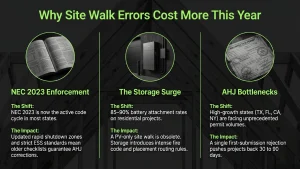
Three factors are driving up the cost of site walk errors this year.
First, NEC 2023 is the active code cycle in most states. Updated rapid shutdown zones, new ESS (battery storage) installation standards, and revised labeling requirements mean that a site walk built on older assumptions will generate AHJ correction notices — even when the plan set is otherwise well drawn. According to the ICC Code Adoption Tracker, most jurisdictions have adopted NEC 2020 or 2023 as of 2025–2026.
Second, battery attachment rates have surged. Many EPCs now report 85–90% battery attachment on residential projects. A PV-only site walk checklist is, therefore, an incomplete one the moment storage enters the picture.
Third, AHJ rejection rates are up in high-growth states. Texas, Florida, California, and New York have all seen increased permitting volume. A first-submission rejection can push your project back 30 to 90 days, according to NREL’s Solar Soft Costs benchmark data. In a tight-margin market, that schedule slip hurts.
The bottom line: your site walk is your first and most important QA/QC gate.
12 Common Solar Site Assessment Mistakes — The QA/QC Audit
Structural & Physical
1. Roof Pitch and Measurements — Measured, Not Guessed Wrong pitch is the number one trigger for plan set redraws. Use a digital gauge on every job. Confirm usable roof area against actual obstructions — satellite imagery alone is not enough.
2. Roof Condition and Structural Age Many AHJs require a structural load letter when a roof exceeds 15 years or shows visible wear. Miss this on the site walk and your permit stalls while you track down documentation after submittal.
3. Full Obstruction Mapping HVAC units, skylights, plumbing stacks, vents, and chimneys must be logged with exact locations and dimensions. A single undocumented 12-inch vent stack can shift panel rows and break firepath setback rules.
Electrical & Mechanical
4. Main Service Panel Capacity and Clearances Confirm the panel’s amperage rating, available breaker slots, and NEC workspace clearances. A maxed-out 200A panel means a main panel upgrade — a separate permit, separate cost, and its own timeline.
5. Utility Meter Type and Interconnection Point Document whether the meter is net-meter eligible, the exact service entrance location, and any utility-required disconnects. Get this wrong and your interconnection application gets kicked back — restarting the utility queue entirely.
6. Battery and Load Center Placement With storage now standard, document interior versus exterior wall space, conduit routing paths, and local fire code compliance for ESS placement. Under NEC 2023, some jurisdictions restrict battery installations in attached garages. Missing this detail triggers a redesign every time.
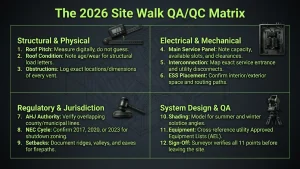
Regulatory & Jurisdiction
7. AHJ Jurisdiction — Confirm, Don’t Assume Do not identify the AHJ by city name alone. Many markets have overlapping county and municipal authority. A wrong AHJ submittal means starting over. Use EnergyScape’s AHJ Utility Database to confirm the correct jurisdiction before design begins.
8. NEC Code Cycle Currently in Force Confirm which NEC year the local AHJ enforces — 2017, 2020, or 2023. This directly changes rapid shutdown zoning, ESS specs, and labeling requirements. This check alone prevents a significant share of plan set correction notices.
9. Setback and Firepath Documentation Document every roof ridge, valley, hip, and eave length. Firepath setbacks depend on the building code year in force, sprinkler status, and AHJ interpretation. If this is not captured in the field, it generates a design correction — without exception. Learn more in our Solar Permitting Guide.
System Design Inputs
10. Shading Analysis With Seasonal Accuracy A shading report run in June does not reflect December 21 sun angles. Use tools like Aurora or Nearmap and model both the summer and winter solstice. Inflated production estimates from incomplete shading data do not just trigger a redesign — they become customer disputes after commissioning.
11. Equipment Verification Against Utility Interconnection Rules Some utilities maintain Approved Equipment Lists (AELs) that restrict eligible inverters and modules. Assuming equipment without checking the utility’s current list is a direct path to an interconnection rejection. See SEIA’s interconnection resources for current utility policy updates.
12. Signed Field Verification Before Submittal Before site data leaves the field, the technician must sign off that all 11 prior points were captured and confirmed. This is not extra paperwork. It is the quality gate that separates first-time approvals from costly back-and-forth cycles. Review our Plan Sets service page to see how clean data feeds faster engineering.
What These Solar Site Assessment Mistakes Actually Cost
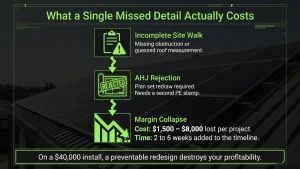
A single solar redesign — revised plan set, second PE stamp, corrected AHJ submittal — costs between $1,500 and $8,000, depending on system size and jurisdiction. On a $40,000 residential install, that is real margin gone on a preventable process failure.
EnergyScape Renewables has processed over 280,000 solar projects nationwide and holds a 99% AHJ approval rate. When our engineers review redesign cases, the root cause almost always traces back to something missed during the site walk — not during engineering.
Standardizing your site assessment process protects your margins, your schedule, and your customer relationships.
Stop Paying for Redesigns That Were Preventable
Capture clean site data from day one. The Sunscape Site Survey App gives your field reps a structured, digital site walk workflow — so every measurement, obstruction, panel detail, and equipment note flows cleanly into your project pipeline. No more guesswork. No more correction notices from a detail that got lost in a text thread.
👉 Start your free trial → sunscape.solar
Turn clean data into overnight engineering. EnergyScape Renewables converts verified site walk inputs into permit-ready plan sets and 24-hour PE stamps — across all 50 states, with a 99% AHJ approval rate across 280,000+ completed projects. When your site walk is right, overnight engineering is possible.
👉 Request a quote today → energyscaperenewables.com
FAQ: Solar Site Assessment Mistakes
What is the most common solar site assessment mistake in 2026?
Inaccurate roof measurements and missing obstruction documentation remain the top two triggers for plan set redesigns. Both are fully preventable with a standardized, field-verified site walk checklist applied on every job before data leaves the field.
How do solar site assessment mistakes affect permit timelines?
A wrong AHJ jurisdiction or incorrect NEC code cycle assumption typically results in a plan set correction and re-submittal. That adds 2–6 weeks to permitting in most markets, and longer in high-volume states like Texas and California.
Does battery storage change what needs to be documented on a site walk?
Yes — significantly. Storage jobs require load center location, interior or exterior wall availability, conduit routing paths, and compliance with NEC 2023 ESS installation requirements. A PV-only checklist is no longer sufficient on the majority of new residential installs.
How can solar EPCs reduce redesign costs in 2026?
The three most effective steps are: standardizing your site walk with a structured QA/QC checklist, using a digital capture tool like the Sunscape Site Survey App, and partnering with an engineering firm that cross-references AHJ requirements before design starts — not after.
sjayakanth@energyscaperenewables.com