
Solar PTO Process: Step-by-Step Guide for Installers In 2026

Solar PTO Process: Step-by-Step from Permit Approval to Permission to Operate
Key Takeaways
- The solar PTO process has six distinct stages after permit approval — each with its own delay risk.
- Administrative phases account for 80% of total project duration, even though installation takes just one to two days.
- Over 90% of interconnection applications contain errors that trigger revision cycles and delay PTO.
- Parallel-tracking your interconnection application with permitting is the single most effective way to shorten your timeline.
- EnergyScape Renewables and Sunscape Solar together close the gap between permit approval and energization.
Your permit just got approved. That’s great news — but here’s what many installers miss: permit approval is the halfway point, not the finish line.
The solar PTO process — the steps between permit approval and Permission to Operate — is where projects stall, cash slows down, and customers start calling for updates. In 2026, with utility interconnection backlogs growing and NEC 2026 enforcement expanding across more jurisdictions, this second half of the project needs as much attention as the first.
This guide walks you through every stage of the solar PTO process, what causes delays at each one, and how to build a tighter workflow from final inspection to energization.
What Is Solar PTO?
Permission to Operate (PTO) is the utility company’s official authorization for a solar system to connect to the grid and legally generate electricity. No PTO means no net metering, no tax credit eligibility confirmation, and no system revenue for your customer.
For installers and EPCs, PTO is also a direct cash milestone. Until it’s issued, the job isn’t closed. Getting there faster isn’t just good customer service — it’s a competitive advantage that shows up directly in your close-to-cash speed.
The Solar PTO Process: 6 Steps After Permit Approval
Step 1: Schedule the AHJ Final Inspection
After installation wraps up, you need a final inspection from the Authority Having Jurisdiction (AHJ). The inspector checks that the physical install matches the approved permit drawings — panel placement, electrical connections, rapid shutdown labeling, and NEC 2026 compliance.
This step catches more projects than most teams expect. Any discrepancy between your as-built install and the approved plan set — including minor equipment substitutions — will trigger a correction and a re-inspection. That adds time you didn’t plan for.
Best practice: Make sure your install crew works directly from the approved drawings. Any field change to panels or inverters must be documented and updated in the as-built package before the inspection, not after.
Step 2: File Your Interconnection Application — Don’t Wait
Here is where high-volume EPCs get ahead of everyone else. The best solar installers don’t wait for the permit to clear before filing the interconnection application — they run both in parallel. Utilities like PG&E, Duke Energy, SCE, and National Grid carry interconnection backlogs that stretch 60 to 90 days in busy queues. Waiting until after installation to start that clock is a workflow choice that costs real weeks.
Your interconnection application typically includes:
- Final system specs and equipment list
- PE-stamped single-line electrical diagram
- Site plan and roof layout
- Inverter certifications confirming IEEE 1547-2018 compliance
- Rapid shutdown documentation per NEC 690.12
Important: In 2026, utilities are enforcing stricter documentation standards. Grid operators report that over 90% of interconnection applications contain errors that require revision — each one adding days or weeks to your PTO timeline.
Step 3: Utility Technical Review
After submission, the utility reviews your application to confirm the system won’t negatively impact grid stability. For standard residential systems, this is usually a desk review. For larger commercial projects, it can trigger a full grid impact study.
Current timelines vary widely across service territories:
- Standard residential systems: 2 to 4 weeks
- Battery-paired solar systems: 8 to 12 weeks (up to 16 weeks in some California utility territories)
- Commercial systems in congested grids: Up to 120 days, per SEIA data
For commercial projects, treating interconnection as a design consideration from day one — not a final step — is the best way to protect your schedule. According to industry data, most interconnection delays are preventable and typically result from incomplete applications or design changes made after submission.
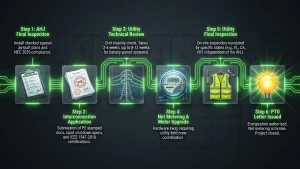
Step 4: Net Metering Enrollment and Meter Upgrade
Most residential and small commercial installs require a meter swap — replacing the standard consumption meter with a bi-directional net metering meter. This needs the utility to schedule a field crew, which adds coordination time.
Don’t assume the meter exchange happens quickly. In high-demand service territories, this step alone can add one to three weeks. Submit your net metering enrollment paperwork at the same time as the interconnection application so both move through the utility simultaneously.
Step 5: Utility Final Inspection (Where Required)
Some utilities require their own on-site inspection — separate from the AHJ inspection. The utility inspector confirms the meter installation, checks inverter configuration, and verifies rapid shutdown labeling requirements are met.
Not every utility does this. Many approve remotely based on documentation. However, in states like Florida, California, and New York, expect this step and build it into your project schedule from the start. Florida, for example, mandates PE-stamped plan sets on virtually every residential and commercial install because of strict wind zone and hurricane code requirements.
Step 6: PTO Letter Issued
Once all inspections pass, the interconnection application clears review, and the meter is upgraded, the utility issues the PTO letter. For clean, first-submission applications, residential approvals in standard service territories typically arrive within 15 to 20 business days of the final inspection.
That letter is your finish line. The system is live, net metering activates, and your customer’s experience with your company ends on a strong note.
Why the Solar PTO Process Gets Delayed in 2026
Most PTO delays come from a short list of controllable failure points:
Incomplete engineering documentation — Plan sets that don’t meet NEC 2026 requirements or are missing PE stamps are the leading reason interconnection applications get rejected. This flows directly from the quality of your permit package upstream. Learn more about PE-stamped plan set requirements for solar.
As-built discrepancies — If the installed system differs from the approved plans, the AHJ flags it at inspection. Equipment substitutions made in the field without updating documentation are a recurring issue.
Battery storage complexity — Solar-plus-storage systems face longer utility review timelines. In SCE’s territory in 2026, battery systems are averaging 8 to 12 weeks for PTO approval, compared to 4 to 6 weeks for solar-only installs.
Missed internal handoffs — Projects stall when a stamped plan set arrives and sits untracked in an inbox. No system means no one catches the gap until the customer calls. This is where project management discipline separates fast operations from slow ones.
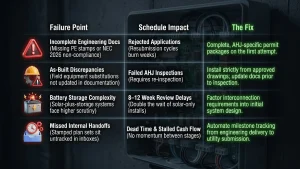
The Workflow That Gets You to PTO Faster
The installers hitting the fastest close-to-PTO timelines consistently do three things:
- They submit complete, AHJ-specific permit packages on the first attempt — eliminating the most common upstream delay driver.
- They file interconnection applications in parallel with permitting — not after installation is done.
- They track every milestone in a single dashboard so no project sits unnoticed between stages.
That third point is where most residential and commercial operations have the biggest gap. A PE-stamped plan set that arrives and sits untracked for two days costs you time you didn’t know you lost — multiplied across 30 or 50 active projects.
How EnergyScape Renewables and Sunscape Shorten Your PTO Timeline
EnergyScape Renewables handles the engineering layer that keeps your solar PTO process clean from the start. Their team delivers PE-stamped plan sets in 15 to 24 hours for residential projects and 24 to 48 hours for commercial work — across all 50 states, with NEC 2026 compliance built into every package. With a 99% AHJ first-submission approval rate across 188,520+ completed projects, resubmission cycles that burn your schedule stop before they start. They also manage interconnection applications, so the documentation your utility needs arrives complete and technically correct the first time.
Sunscape Solar covers the project management layer. The platform tracks every job milestone — permit submission, interconnection application, utility review, AHJ inspection, meter upgrade, and PTO status — all in one dashboard built for US solar installers and EPCs. When EnergyScape delivers a stamped plan set, the next step in the workflow fires automatically. No manual handoffs. No projects getting stuck between stages.
Together, they create one connected workflow: clean engineering in, tracked execution out, PTO delivered faster. You can also explore how solar project management software reduces permitting delays when engineering and CRM work as a single system.
Ready to Shorten Your PTO Timeline?
If your projects are consistently taking longer than they should to reach Permission to Operate, the fix usually starts upstream — with documentation quality and workflow visibility.
EnergyScape Renewables delivers PE-stamped plan sets and interconnection applications built to clear AHJ review and utility technical review on the first submission — with a 99% AHJ approval rate and 15 to 24-hour residential turnaround across all 50 states. 👉 Get a plan set quote at EnergyScapeRenewables.com
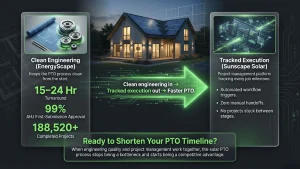
Sunscape Solar gives your team the project management platform to track every job from permit approval to PTO — with automated handoff triggers, interconnection milestone tracking, and a dashboard purpose-built for solar installers and EPCs. 👉 Start managing your pipeline at Sunscape.solar
When engineering quality and project management work together, the solar PTO process stops being a bottleneck and starts being a competitive advantage.
Frequently Asked Questions About the Solar PTO Process
What is solar PTO? Solar PTO (Permission to Operate) is the official authorization from the utility company allowing a solar energy system to connect to the electric grid and begin generating electricity. Without PTO, a system cannot legally operate, and the customer cannot benefit from net metering or solar incentives.
How long does the solar PTO process take? Timelines vary by utility and project type. Standard residential systems typically take 2 to 4 weeks after installation. Battery-paired systems average 8 to 12 weeks. Commercial systems in high-demand grid areas can take up to 120 days. Filing your interconnection application in parallel with permitting is the most effective way to reduce total project duration.
What causes solar PTO delays? The most common causes are incomplete or non-compliant engineering documentation, as-built discrepancies between the installed system and the approved plans, utility interconnection backlogs, battery storage system complexity, and missed internal handoffs between project stages.
Can I turn on my solar system before receiving PTO? No. Operating a solar system before receiving Permission to Operate is illegal across all 50 states and violates your utility interconnection agreement. It also prevents net metering activation and can result in billing errors or safety violations.
What documents are needed for the solar interconnection application? Most utilities require final system specs, a PE-stamped single-line diagram, site plan, inverter certifications confirming IEEE 1547-2018 compliance, and rapid shutdown documentation per NEC 690.12. Requirements vary by utility, so always verify before submitting. For a full checklist, see the solar permit plan set guide from EnergyScape Renewables.
sjayakanth@energyscaperenewables.com