
Solar Permit Rejections 2026: The 12 Reasons AHJs Send Plan Sets Back
Why Solar Permit Rejections Keep Stalling US Solar Installers
You lined up the crew. Then the correction notice lands. Solar permit rejections are the quiet margin killer in US solar, and they rarely start with a hostile reviewer. Instead, they start with a wrong code edition, a missing calculation, or a title block nobody checked twice. In fact, each AHJ plan set rejection costs $2,000 to $5,000 once you add revision fees and crew rescheduling. Meanwhile, residential re-reviews add 5 to 15 business days apiece. Because the ITC energization deadline sits at December 31, 2027, that slack no longer exists. Here is the good news, though: almost every one of these denials is preventable. Therefore, this guide covers the 12 reasons plan sets bounce in 2026, plus the fix for each one.
Electrical Design Errors That Cost Installers Weeks
Electrical sheets draw the sharpest scrutiny. As a result, they trigger the largest share of solar permit rejections nationwide.
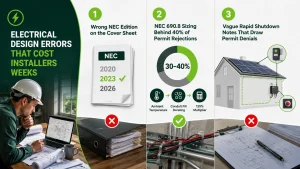
1. Wrong NEC Edition on the Cover Sheet
NEC 2026 arrived in October 2025. Still, most states enforce NEC 2023, and several remain on NEC 2020. Consequently, recycled templates cite the wrong cycle and invite permit denials. Confirm the adopted edition per jurisdiction first, then list it in your general notes.
2. NEC 690.8 Sizing Behind 40% of Permit Rejections
NEC 690.8 violations drive an estimated 30 to 40% of solar permit rejections nationwide. Most designers apply the 125% multiplier. However, they skip ambient temperature correction and conduit fill derating. Therefore, show the whole chain on the diagram, because reviewers should never chase your math.
3. Vague Rapid Shutdown Notes That Draw Permit Denials
Article 690.12 compliance takes more than a note. For instance, show the initiation device, the boundary, the label location, and module-level electronics on your one-line. Otherwise, reviewers read vague callouts as gaps, and gaps become corrections.
Structural and Site Plan Mistakes AHJs Catch First

Structural sheets cause nearly as many plan set rejections as electrical ones, especially on retrofits.
4. Fire Setbacks That Ignore Local Amendments
Setback rules shift by municipality, since many AHJs amend the IFC. Consequently, a compliant California layout can fail in Texas. Rather than burying setbacks in a note, dimension ridge, eave, and rake clearances directly on the roof plan.
5. Missing PE-Stamped Structural Calculations
Many jurisdictions demand a licensed engineer’s stamp on load calcs, attachment details, and wind and snow analysis. Thus, unstamped sets return automatically. Above all, verify stamp rules per AHJ, because permit denials often hinge on county-level differences.
6. Site Plans That Trigger Plan Set Rejections
A site plan needs property lines, footprint, array location, service entrance, disconnects, and conduit runs. After all, reviewers use it to orient every other sheet. When routing disappears, rejections follow quickly.
Documentation Gaps That Send Packages Back

These three look administrative. Nevertheless, they cause a surprising share of solar permit rejections every quarter.
7. Incomplete or Inconsistent Title Blocks
Missing title block data ranks among the top five causes of permit rejection, because reviewers must log that information. Accordingly, every sheet needs the address, APN, designer name and license, date, revision number, and enforced code editions.
8. Equipment Cut Sheet Mismatches
Every callout must match the cut sheet exactly. For example, a module swapped after design or an inverter listed by family instead of model creates a mismatch. As a result, corrections land before the reviewer reaches your structural sheets.
9. Missing Interconnection Numbers Cause Plan Set Rejections
Utilities in California, Texas, and New England now expect the interconnection number on the set before sign-off. Therefore, file early. Then reference that number on the cover sheet, since omitting it causes preventable solar permit rejections.
Three New Failure Modes Emerging in 2026
Meanwhile, three newer triggers are climbing fast across US jurisdictions.
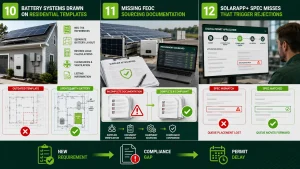
10. Battery Systems Drawn on Residential Templates
Storage is standard now. Because of that, battery projects need NEC 706 references, a separate layout diagram, and revised load calculations. In addition, include ESS clearances, ventilation notes, and listing data. Otherwise, denials arrive on day one.
11. Missing FEOC Sourcing Documentation
Commercial and utility-scale packages increasingly require foreign entity of concern records tied to credit eligibility. Since reviewers and lenders both check this, gather supplier attestations during procurement. In other words, act before solar permit rejections stall the job.
12. SolarAPP+ Spec Misses That Trigger Permit Rejections
SolarAPP+, backed by NREL, has processed over 100,000 permits across 520-plus jurisdictions. Moreover, these platforms enforce their own spec, so one mismatched field costs your queue slot.
How to Cut Solar Permit Rejections From Your Workflow
Fixing sheets helps. Building a system helps more. First, organize your template library by AHJ instead of running one national template, since amendments change constantly. Second, run a pre-submission QA pass against the reviewer’s checklist. Third, log every correction notice and feed it back, because rejection patterns repeat. Finally, treat permitting as critical path. While AHJ reviews run two to eight weeks, one avoidable denial can push a project past its energization window.
Turn Solar Permit Rejections Into First-Time Approvals
Most installers do not lose permits because their engineering is weak. Rather, they lose them because tracking 20,000-plus jurisdictions, shifting NEC editions, and new storage rules is a full-time job.
That is exactly what EnergyScape Renewables handles. Our licensed engineers deliver PE-stamped, NEC-compliant plan sets built for first-time AHJ approval across all 50 states. In addition, we manage permit packages, structural and electrical calculations, interconnection applications, and site surveys. As a result, crews stay on roofs instead of waiting on revisions. Visit EnergyScape Renewables to see how our engineering support reduces solar permit rejections and shortens approval timelines.
Want tighter control over the projects behind those permits? Then pair your workflow with Sunscape, a solar CRM and project management platform built for US installers and EPCs, and track every permit, revision, and milestone in one place.
sjayakanth@energyscaperenewables.com