VPP-Ready Plan Sets: Get Batteries Enrolled in 2026
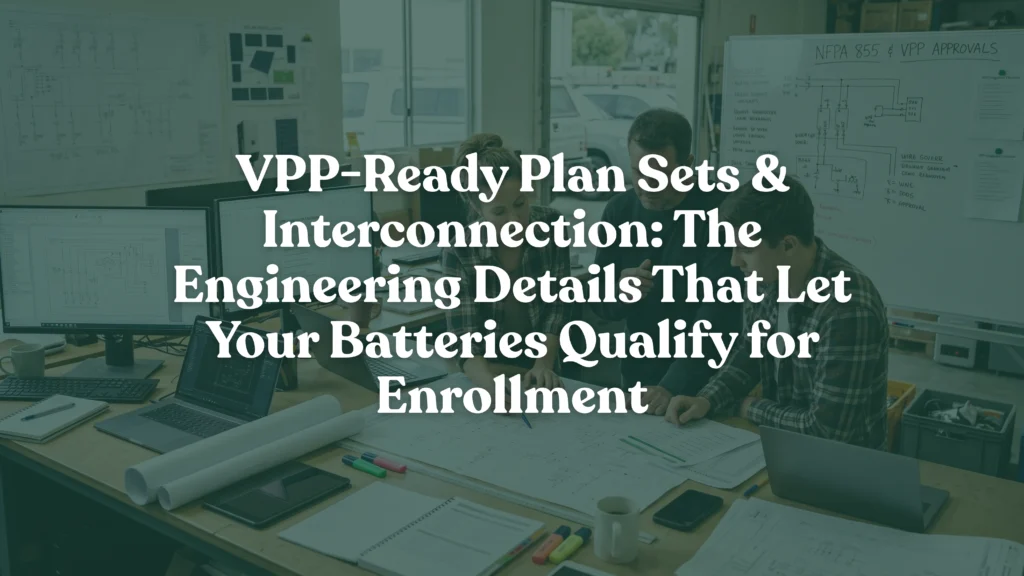
Quick answer: VPP-ready plan sets are what get a home battery accepted into a virtual power plant program. Before PTO, the interconnection application has to allow battery export, the one-line has to show the export path and power control system (PCS) settings, the hardware has to sit on the program’s approved list, and the install has to clear NFPA 855. Skip one and the battery you sold as an earner may never get dispatched.
Below are the five design mistakes that keep batteries out of programs, costliest first, plus a checklist your designers can run on every job.
Why VPP-Ready Plan Sets Matter More in 2026
January 1 took the 30% homeowner credit off the table. Section 25D expired at the end of 2025 for every cash and loan customer. Ohm Analytics expects TPO market share to go from 43% in 2025 to 64% in 2026, and TPO companies put their batteries into VPPs by the fleet.
The programs are big now. Wood Mackenzie counted 47.2 GW of VPP capacity in North America, up 25.9% in a year, and residential wholesale capacity grew 155%. Homeowners added a record 1.3 GWh of batteries in Q1 2026 alone.
Here’s why your customer cares. Massachusetts’ ConnectedSolutions pays $275 per kW of average summer performance. National Grid says that works out to roughly $1,200 a year, locked for five summers on new systems. Whether that check ever arrives depends on paperwork your team files months before the battery goes on the wall.
Where Batteries Lose Virtual Power Plant Eligibility
Ask most crews when VPP enrollment happens and they’ll say after PTO, in the app. The aggregator who approves it is checking decisions you made back at design and interconnection, though. Each failure below starts as a line in the paperwork and ends as a battery nobody can dispatch.
1. The Interconnection Application Says “Non-Export”
This is the expensive one. Filing a battery as non-exporting can speed up utility review. It also blocks the battery from any program that pays for grid discharge, because an aggregator can’t dispatch a battery the utility agreement says can’t export. Undoing it after PTO means an amended application and another wait in the utility queue.
Program rules can make timing matter, too. In Rhode Island, the state storage rebate requires ConnectedSolutions enrollment and won’t pay for projects whose interconnection application went in before the program launched. Your filing date can cost the customer their rebate.
2. PCS Settings Don’t Match What You Filed
Commissioning has to agree with the application. Most batteries control export through a UL 1741 power control system, and the mode is the installer’s call. Tesla’s Powerwall, for instance, has three modes: No Site Export, PV Only Export, and PV + Battery Export. Only the last one sends battery power to the grid during an event. Pick a different mode in the field and the inspector may flag it against your utility approval. If the inspector misses it, the aggregator won’t.
3. The Equipment Isn’t on the Program List
Check approved device lists while you’re still quoting. In Rhode Island, larger systems missing from the list need UL 9540 with UL 9540A testing, UL 1741, and IEEE 1547 certification, plus 15-minute interval data. Catching a mismatch after the hardware ships usually means swapping equipment.
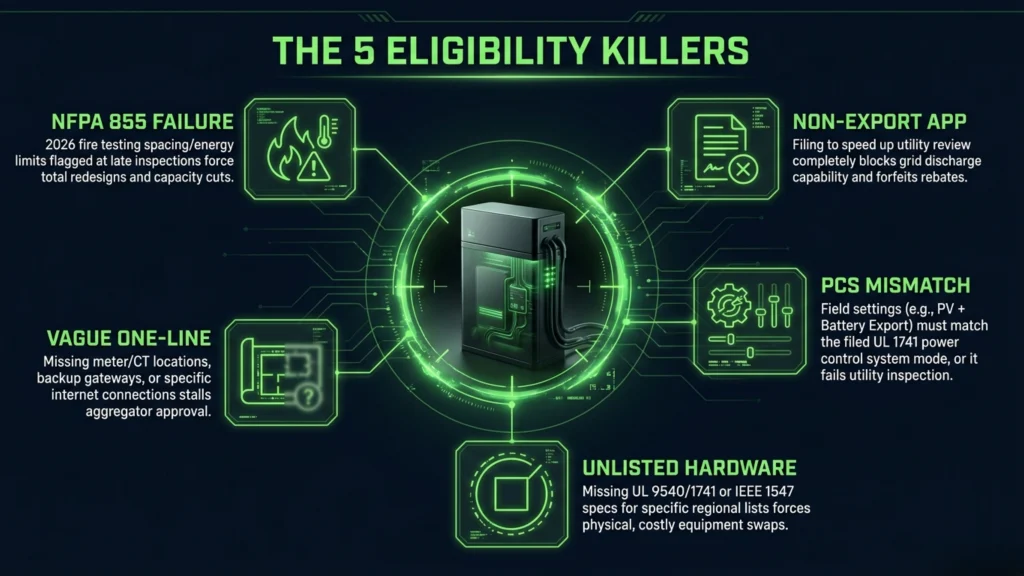
4. The One-Line Diagram Leaves Out VPP-Ready Plan Sets Details
Aggregators and utilities read the drawings too. The one-line in VPP-ready plan sets should show:
- Battery and inverter make, model, and continuous kW (AC)
- Export path, PCS operating mode, and export limit
- Revenue meter and CT locations
- Backup gateway, plus whole-home or partial-backup load setup
- Internet connection type (Ethernet, Wi-Fi, or cellular) for dispatch signals and telemetry
5. NFPA 855 Forces a Late Redesign
This one can undo the first four. The 2026 edition of NFPA 855 broadens hazard mitigation analysis and adds large-scale fire testing provisions. If a fire marshal flags the battery’s location, spacing, or energy limits at a late inspection, the fix may mean moving the unit or cutting capacity. Then the system on the wall no longer matches your interconnection file or your one-line, and you’re back to step one. Settle ESS placement and PE-stamped details in the first submittal.
How Texas and California Raise the Bar for VPP-Ready Plan Sets Design
Texas and California are pushing VPPs into wholesale markets, and wholesale participation comes with tighter telemetry and control rules. ERCOT’s ADER pilot grew from 8 MW of discharge capacity in June 2025 to 171 MW by September 2026, mostly from home batteries. California’s DSGS program kept its market-aware storage VPP option for 2026. In either state, design every battery around a dependable internet connection.
A VPP-Ready Plan Set Checklist for Every Storage Job
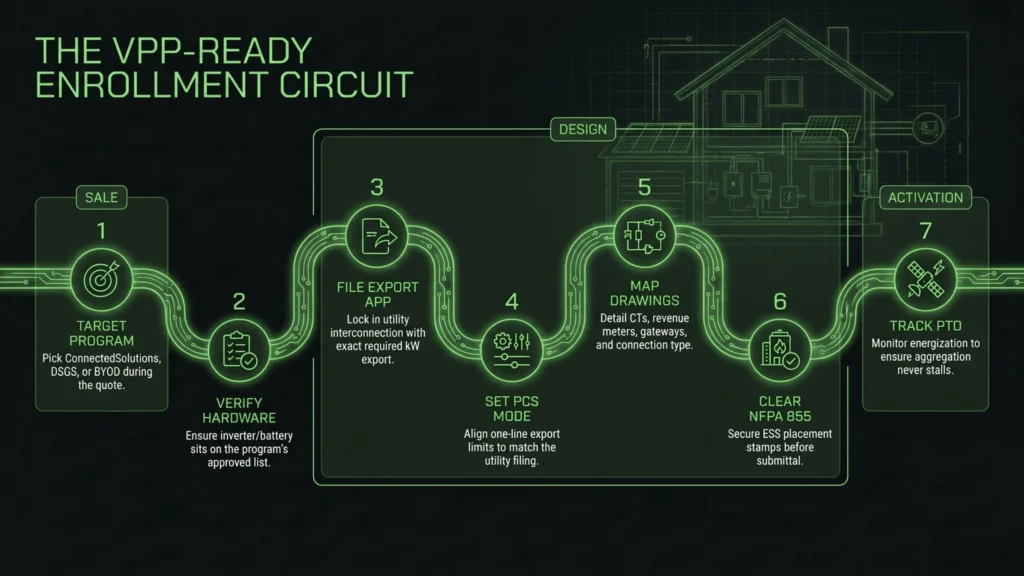
Here’s everything above in seven steps, in the order your team will hit them:
- Pick the target program during the sale, whether that’s ConnectedSolutions, DSGS, a utility BYOD program, or a TPO fleet.
- Confirm the battery and inverter are on that program’s approved list.
- File the interconnection application with battery export allowed at the kW the program expects.
- Set the PCS mode and export limit on the one-line to match what you filed.
- Show the meter, CTs, gateway, and internet connection on the drawings.
- Clear NFPA 855 placement and get ESS stamps before submittal.
- Track each system from PTO through enrollment so nothing stalls after energization.
Selling VPP-Ready Batteries the Right Way
Writing “VPP-ready” on a proposal is easy. Back it up. Name the target program and an estimated annual payment, and attach a plan set that supports both. Then keep tracking the job after PTO until the aggregator confirms enrollment.
Build Every Battery Job VPP-Ready With Energyscape and Sunscape
To recap: file the battery as exporting, match the PCS mode to that filing, confirm the hardware is on the program list, and lock down NFPA 855 placement before you submit.
Energyscape Renewables can take that engineering off your plate. We draw solar plan sets with VPP-ready one-lines, handle PE stamping for ESS, run NFPA 855 permitting, and file your utility interconnection with the export settings your program needs. Every set goes through Greenlight QC first. That process has delivered 350,000+ plan sets at a 99% first-pass approval rate. Residential sets come back within 24 hours of a complete submission, in all 50 states, with no minimum order.
Once the job is sold, Sunscape keeps it moving. Its CRM and project management tools track each storage project from signed contract through PTO and program enrollment, so the payment in your proposal reaches your customer.
Got a storage job on deck? Get a quote from Energyscape Renewables, and see how Sunscape works to keep every battery moving from contract to enrollment.