Solar Battery Proposal: Win Resilience Buyers in 2026

Solar battery proposal showing critical loads and backup hours on a tablet
Odds are your next homeowner has already lost power at least once this year, and a solar battery proposal that opens with panels won’t speak to that. Two-thirds of US homeowners had at least one power outage in 2026, according to a Sunrun survey. And 59% think outages will get worse where they live.
Plenty of installers still lead with panels anyway, and the battery shows up on page six. That worked while the 30% credit did the selling. The credit ended January 1.
Below you’ll find why the battery should open the proposal in 2026, a five-part checklist for building one, and the mistakes that stall battery deals. First, a quick definition, since “storage-first” gets used loosely.
What Is a Storage-First Solar Battery Proposal?
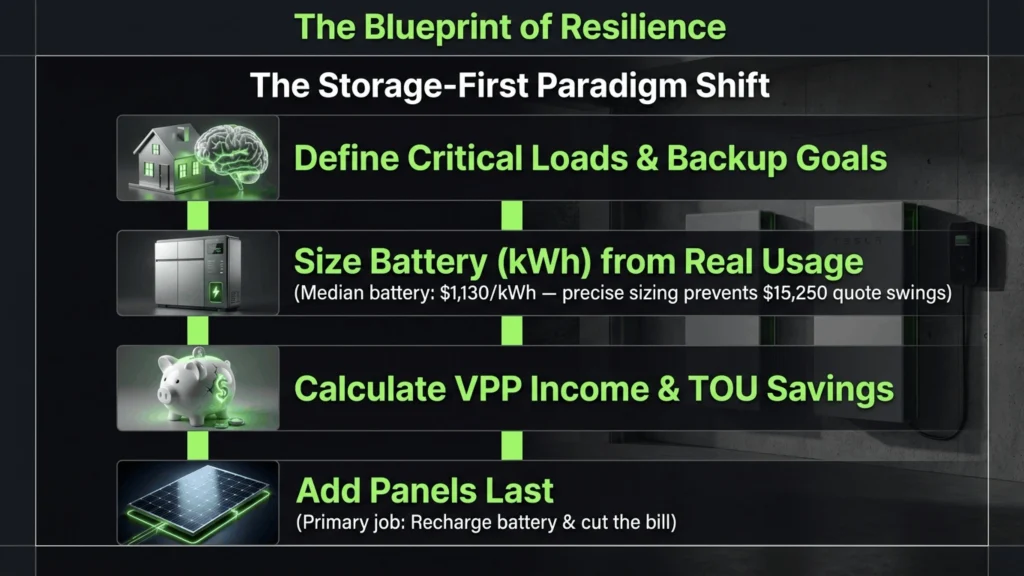
A storage-first solar battery proposal is a sales proposal that starts with the home battery and sizes everything else around it. It begins with critical loads and backup goals, sizes the battery in kWh from real usage, and only then shows bill savings, virtual power plant (VPP) income, and financing. The array comes last. Its job is to recharge the battery and cut the bill.
Why the Solar Battery Proposal Matters More in 2026
Five numbers changed the math this year.
Start with the tax credit. Customer-owned systems lost the 30% federal credit on January 1, 2026, with no phase-down. Cash and loan buyers now feel the full sticker price, so a pitch built only on payback is a harder close.
Batteries, meanwhile, went mainstream. The national solar-plus-storage attachment rate hit 46% in Q2 2026, and outside California, Berkeley Lab found attachment jumped from 7% to 17% in a single year.
Then there’s ownership. Ohm Analytics projects third-party ownership near 70% of residential installs in 2026, up from 45% the year before. Leases and PPAs pencil better with a battery.
Wood Mackenzie expects customer acquisition costs to rise 40% to $0.84/W. And the median residential battery now runs $1,130/kWh, up 9% year over year. At that price, one 13.5 kWh battery adds about $15,250 to the quote. Quote one battery too many, or one too few, and the price swings by five figures.
US residential battery attachment rate chart for 2026.
Who Are Resilience Buyers?
Resilience buyers have sat through an outage. They want to skip the next one. Think families in hurricane and wildfire country, people who work from a home office, and anyone running a CPAP at night. In the same Sunrun survey, 28% of homeowners said someone in the house depends on electricity for health needs.
Installers tend to sell backup, but homeowners are watching the bill. EnergySage data showed homeowners named rate savings (30%) and self-supply (29%) a bit ahead of backup (26%) as their reason to buy storage. Yet 67% of installers called backup a main motivation, and only 11% brought up savings at all.
So open the proposal with resilience, then close with the savings math the homeowner was already running in their head.
Here’s how that plays out on a typical job. Say a family outside Houston needs the fridge, a well pump, Wi-Fi, a CPAP, and a few lights during outages, which averages roughly 1 kW. One 13.5 kWh battery covers about 12 hours of that, and two cover a full day. Put both options on one page, with backup hours next to the monthly bill impact. Now the homeowner picks with real numbers in front of them.
5 Parts of a Winning Solar Battery Proposal
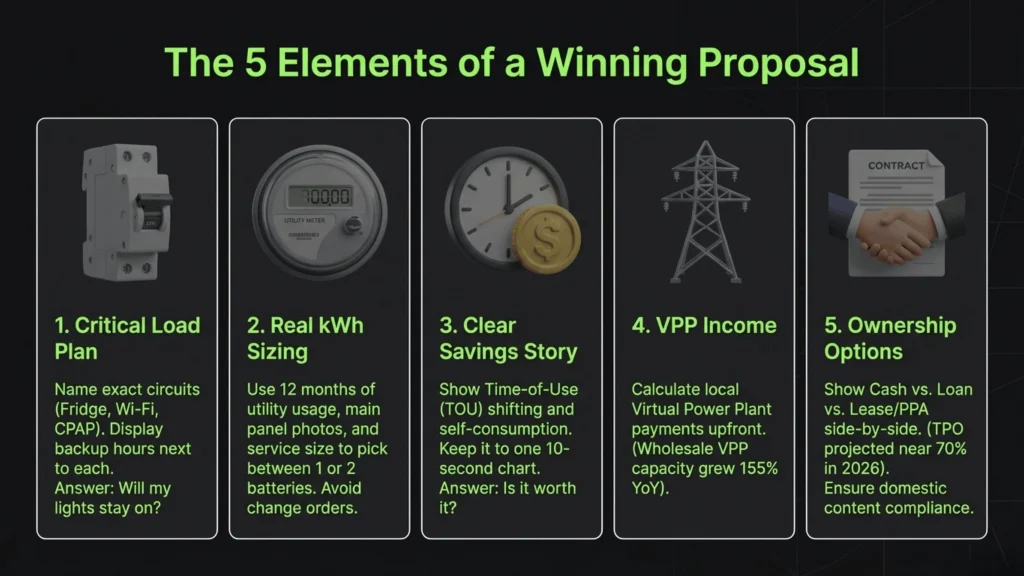
Each part below answers one of the homeowner’s two questions: will the lights stay on, and is it worth the money?
1. Critical Load Plan
Name what stays on: the fridge, the well pump, the sump pump, medical devices, Wi-Fi, maybe one HVAC zone. Add backup hours beside each. A promise of “whole-home backup” with no load calc behind it is how crews end up making awkward callbacks after the first storm.
2. kWh Sizing From Real Data
The median residential battery is 13.5 kWh. Treat it as a starting point. Pull 12 months of utility usage, main panel photos, breaker ratings, and service size before you pick a number. Those four items tell you whether the home needs one battery, two, or a main panel upgrade before anything else gets designed.
3. Clear Savings Story
Show how the battery trims the bill through time-of-use shifting and self-consumption, which matters most in net billing states where exports earn less. Where full retail net metering still exists, lean harder on backup and VPP payments. Keep it to one chart a homeowner can read in ten seconds.
4. VPP Income
Residential wholesale VPP capacity grew 155% year over year, per Wood Mackenzie, and utilities like Austin Energy now pay battery owners an annual incentive to join. If a program runs in your territory, put the estimated payment right in the proposal and enroll the customer at signing.
5. Ownership Options Side by Side
Put cash, loan, lease, and PPA on one page. With 25D gone, many will pick TPO. Also check that the equipment you quote meets your financier’s domestic content and FEOC rules, because a battery rejected at funding kills the deal late.
Solar Battery Proposal Checklist
| Proposal section | What to include | Why it closes deals |
|---|---|---|
| Critical load plan | Backed-up circuits and backup hours | Answers “Will my lights stay on?” |
| kWh sizing | 12 months of usage, panel and service data | Avoids redesigns and change orders |
| Savings story | TOU shifting and self-consumption | Answers “Is it worth it?” |
| VPP income | Local program and estimated payments | Adds yearly income |
| Ownership options | Cash, loan, lease, PPA | Fits post-25D buyers |
Five-part solar battery proposal checklist for installers.
Common Solar Battery Proposal Mistakes
Each of these six mistakes skips one of the five parts above:
- Quoting the same battery size for every home
- Promising whole-home backup with no load calc
- Sending the quote three days later, after the outage memory fades
- Missing panel or service details on the survey and redesigning later
- Saving financing for the last slide, after the cash price scared the buyer
- Going quiet after install and never tracking VPP enrollment
How to Scale Solar Battery Proposals
A good proposal only helps if your team can produce one for every lead, fast. Storage-first quotes need extra data like usage history, panel photos, and service size, so scaling them comes down to three handoffs, in this order:
- Survey: Get load and electrical data right on the first visit with a technician-led site survey.
- Proposal: Turn that data into an engineering-accurate quote the same day through Sales Proposals.
- Pipeline: Track every storage lead, follow up after storms, and manage VPP enrollment in Sunscape CRM.
Site survey to battery sales proposal to CRM workflow for solar installers
For EPCs and fast-growing installers, a partner team can handle these steps while your own people close and install. You also skip hiring designers before volume can carry the payroll. See our residential installer services and commercial & industrial pages for details.
Build Your Storage-First Pitch With Energyscape Renewables and Sunscape
Lead with resilience, size from real kWh data, and close on savings. Speed matters too, because the homeowner’s urgency fades a few days after the power comes back. Energyscape Renewables builds engineering-accurate battery proposals from your site data in 15 to 20 minutes. Our team has completed 500,000+ proposals for more than 300 US installers. Pair it with SiteScape Site Survey so load and panel data is checked on-site before design starts.
After signing, track each deal in Sunscape CRM, from storm-season follow-ups to VPP enrollment, while our team handles permitting and PTO.
Next step: send us your next battery lead and compare our proposal side by side with your current one.
👉 Get a storage-first proposal from Energyscape Renewables
👉 Manage your storage pipeline with Sunscape