Battery-Only Interconnection: 2026 Storage Retrofit Guide
Battery-only interconnection applications are piling up on installer desks this year, and most of them come from homeowners who already have panels on the roof. These customers have PTO. They know your crew, they’ve seen what solar does to their bill, and after a summer of shrinking export credits a lot of them want a battery in the garage.
The paperwork is where these jobs stall. A battery added to an existing PV system usually needs a new utility review, a new permit, and in more places every year, a sign-off from the fire marshal. Pick the wrong interconnection path at the start and the file sits in a utility queue for weeks. Get it right and the retrofit moves faster than almost anything else on your schedule.
What Is Battery-Only Interconnection?
Battery-only interconnection is the utility approval process for adding an energy storage system (ESS) to a site that already has interconnected solar, without adding solar capacity. The utility wants to know how the battery charges and whether it can send power to the grid, and it checks which device controls that behavior. Your answers decide whether the job gets a fast-track review, a standard review, or a full study.
Your original agreement covered the solar, so the battery needs its own approval.
Why Storage Retrofits Matter for Installers in 2026
Start with demand. Residential storage set a record of 1,334 MWh in Q1 2026, up 86% from a year earlier, and 45% of new home solar systems went in with a battery, according to Wood Mackenzie and ACP data reported by pv magazine USA. California’s attachment rate has climbed to 69% (ESS News). Battery sizing hasn’t moved much. LBNL puts the median residential battery at 13.5 kWh, which keeps quoting simple.
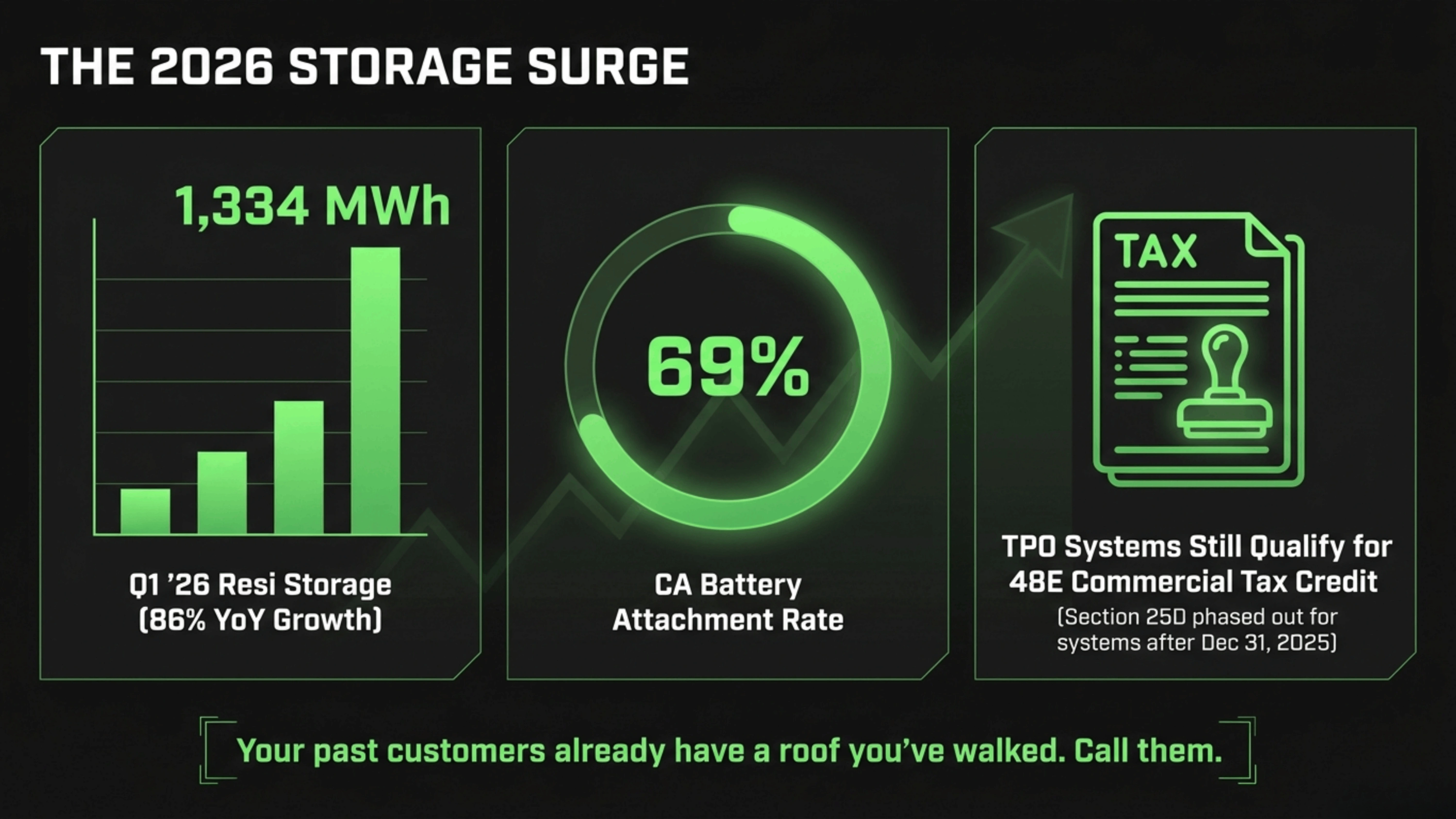
Then there’s the tax picture. Homeowners lost the Section 25D credit for systems installed after December 31, 2025 (CALSSA). Third-party-owned (TPO) systems still qualify for the commercial credit under Section 48E, so leases and PPAs stay on the table.
New-customer solar sales got harder this year. Meanwhile, your past customers already have a roof your crew has walked and a service panel you’ve photographed. You also have their phone number.
Step 1: Choose Your Storage Retrofit Interconnection Path
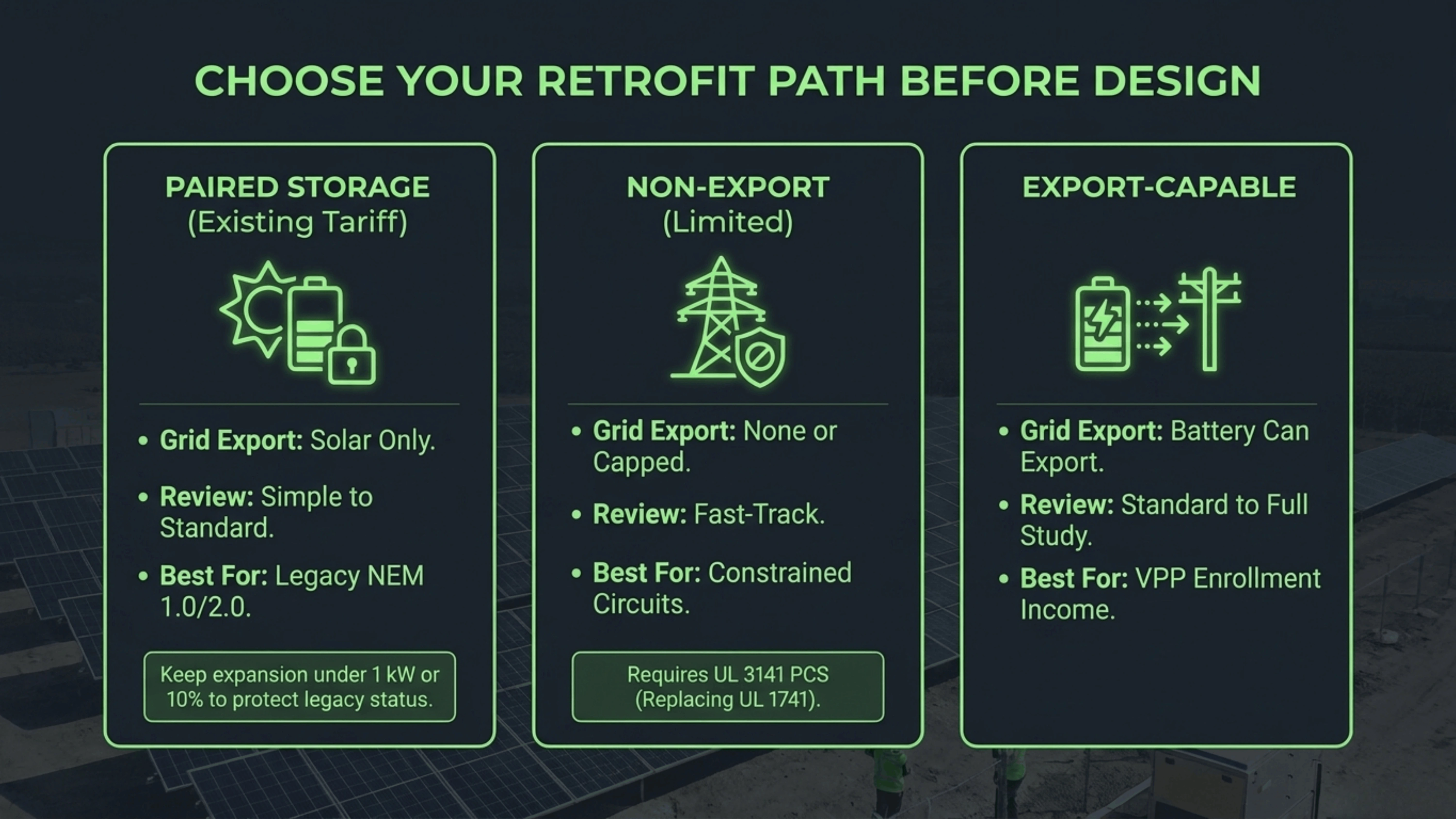
Most rejected storage applications we see share one problem. Nobody decided up front how the battery would behave. Settle that first, using the three paths below, before anyone opens a design file.
| Path | Grid export | Typical review | Best for |
|---|---|---|---|
| Paired storage | Solar only, under existing tariff | Simple to standard | Legacy NEM customers |
| Non-export / limited export | None or capped | Often fast-track | Constrained circuits, quick PTO |
| Export-capable | Battery can export | Standard to full study | VPP enrollment |
Path 1: Paired Storage Under the Existing Tariff
The battery charges only from on-site solar and runs under the customer’s current net metering agreement. For California installers this is usually the easy call, because existing NEM 1.0 and 2.0 customers can add a battery and keep their legacy status. energytoolbase
Watch the solar cap, though. If you add more than 1 kW or 10% of the original system size, whichever is larger, the customer can land on the Net Billing Tariff. Quote the battery alone and that risk disappears.
Path 2: Non-Export or Limited-Export Storage
A control system keeps power from flowing back to the grid, or caps export at an approved number. Many utilities give these systems their quickest battery-only interconnection track because the distribution circuit barely notices them. Minnesota’s municipal non-export process, for example, explicitly covers storage added to existing solar.
Everything hinges on the power control system (PCS). According to CALSSA, UL 3141 is phasing in to replace the older UL 1741 PCS certification requirement, and the 2026 NEC now recognizes two PCS types. Match the PCS listing and settings on your spec sheet to the application line for line. Reviewers check.
Path 3: Export-Capable Storage
Here the battery can discharge to the grid. Expect a longer review and more utility-specific requirements. If the homeowner wants virtual power plant (VPP) income, the wait usually pays off, so bring up the timeline at the first meeting.
Step 2: Plan the Permit and NFPA 855 Review
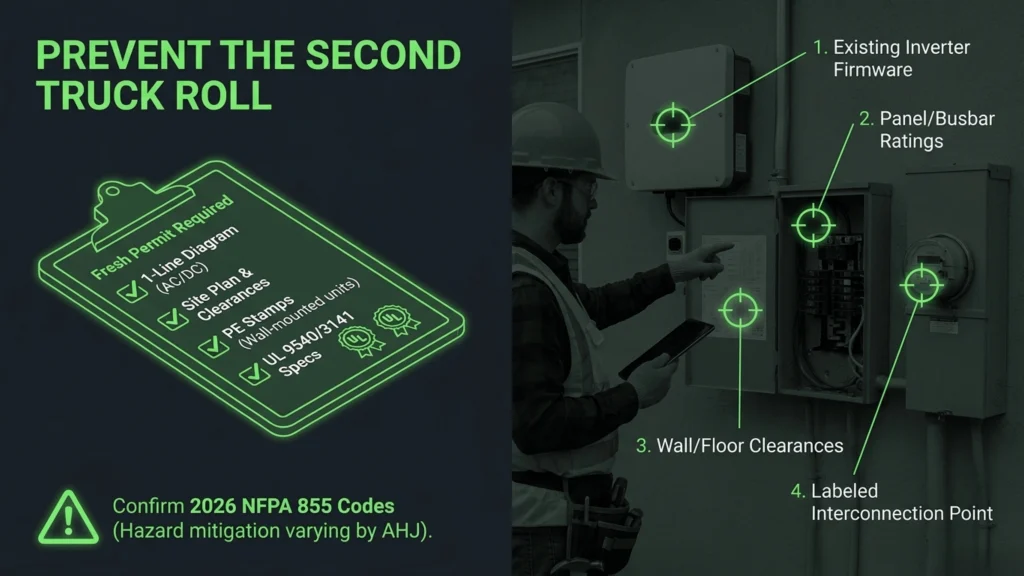
The original solar permit won’t cover the battery. Plan a fresh submission that includes:
- A battery one-line diagram showing AC or DC coupling, the PCS, disconnects, and the backup loads panel (see our plansets)
- A site plan with ESS location, clearances, and egress
- PE stamps for wall-mounted units or service changes when the AHJ asks for them
- Spec sheets carrying UL 9540 and UL 3141 listings
Fire code is tightening too. The 2026 edition of NFPA 855 widens the hazard mitigation analysis requirement, and Massachusetts is among the states moving to adopt it. So two AHJs in the same county can enforce different editions in the same month. Our permitting team confirms which one applies before we submit anything.
Step 3: Collect Site Data That Passes Battery-Only Interconnection Review
Missing field data sits behind most of the rejections we track. Before design starts, your survey should record:
- Existing inverter make, model, and firmware
- Main panel and busbar ratings
- Service size and meter location
- Wall and floor clearances in the garage or utility room
- Photos of the current interconnection point and its labels
A second truck roll can eat the whole margin on a retrofit. A structured SiteScape site survey captures it all on the first visit.
Step 4: Sell Faster PTO as Customer Value
VPP payments start only after the battery receives permission to operate. Massachusetts’ ConnectedSolutions program, for instance, pays $275 per kW of average summer performance (pv magazine USA), and homeowners can enroll only after PTO.
So every week a battery-only interconnection application spends in a utility queue costs your customer money. Put that in your proposal, right next to the expected enrollment date, so the homeowner can see why approval speed matters to them.
Turn Your Installed Base Into a Storage Pipeline
Energyscape Renewables works as a white-label extension of your team. We handle site surveys, battery plansets, PE stamping in all 50 states, permitting, and PTO and interconnection, backed by a database of 1,000+ utilities and 15,000+ AHJs. Every deliverable goes through Greenlight QC, which is how we hold a 99% first-pass approval rate. Send us the existing system details and we’ll tell you which battery-only interconnection path the retrofit qualifies for. Talk to our team →
Sunscape is where you find the jobs. Use the Sunscape solar CRM to tag past customers who are ready for storage, then follow each retrofit from survey to PTO in one place. Book a Sunscape demo →
Start with your pre-2023 installs and pull that list this week.