
AHJ Solar Plan Set Requirements: 7 Needs in 2026
Solar Permit Plan Set: 7 Sections Every AHJ Requires in 2026
A solar permit plan set is the make-or-break document in every install. You submit what looks like a finished set, and then your AHJ sends it back with a page of corrections. The project stalls. Your crew waits. And your customer starts asking what went wrong.
In 2026, this happens more often than it should. A set that passed last year can fail today, because code editions moved and reviewers tightened their checks. The good news is simple. Most rejections come down to the same seven sections. So once you nail all seven, you clear review on the first pass.
Here’s what your Authority Having Jurisdiction (AHJ) checks in a solar permit plan set, and what changed for 2026.
What is a solar permit plan set?
A solar permit plan set is the package of engineered drawings you submit to your local AHJ for installation approval. In short, it proves your design meets electrical, structural, and fire-safety code. Most US jurisdictions follow the same seven core sections, even though every AHJ keeps its own checklist.
Why solar permit plan sets get rejected more in 2026
Three shifts explain it. First, NEC editions are split nationwide — some states still use NEC 2020, others moved to 2022, and California now runs on NEC 2026. Next, the residential ITC ended on December 31, 2025, so many installers turned to commercial work with stricter plan checks. Finally, reviewers now verify labels, interconnection numbers, and equipment sourcing they once let slide.
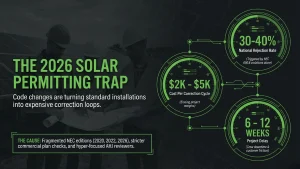
The cost adds up fast. According to EnergyScape Renewables, NEC 690.8 violations alone trigger 30–40% of solar permit rejections nationwide. Moreover, each correction cycle runs $2,000 to $5,000 per project, before crew rescheduling.
The 7 sections every solar permit plan set needs
1. Title page and general notes
Start every sheet with a consistent title block. It needs the project address, APN, designer name and license, date, revision number, and the exact code editions in force. Because missing title-block info ranks among the top five rejection reasons, double-check it. For 2026, name the correct NEC edition for that AHJ, and skip the recycled template.
2. Site plan
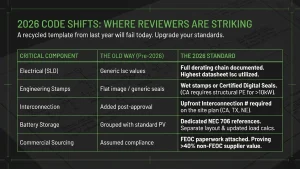
Next comes the site plan. It shows property lines, the building footprint, array location, service equipment, and conduit routing. Mark your fire setbacks clearly, since mismatched setbacks trigger fast rejections. New for 2026: utilities in California, Texas, and New England often want your interconnection number on the set before approval.
3. Roof plan and array layout
Then draw a to-scale roof layout. Show panel rows, spacing, module count, attachment points, and pitch. Also label every obstruction, such as vents, HVAC units, and skylights, to prove your setbacks hold. Reviewers compare this sheet against your structural math, so the module count must match.
4. Single-line diagram (SLD)
Your single-line diagram maps the array, inverter, disconnects, main panel, and meter. Label each part by make, model, and rating. Here, 2026 code bites hardest. You need rapid-shutdown labeling per NEC 690.12, correct conductor sizing, and Isc values that use the highest figure from the module datasheet. So document the full derating chain, and leave reviewers nothing to question.
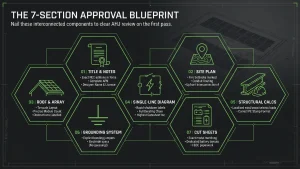
5. Structural plans and calculations
Structural math proves your racking handles wind, snow, and seismic loads for that exact site. Because California seismic rules don’t transfer to Minnesota, keep your calcs local. For 2026, confirm the stamp format too. Some AHJs want a wet stamp, while others accept a certified digital seal — and a flat image of a seal no longer passes. California, for instance, requires a structural PE stamp on rooftop systems above 10 kW.
6. Grounding and bonding
Show your grounding electrode system, bonding jumpers, and equipment grounding clearly. AHJs study this section closely, because weak grounding causes fires and shock hazards. As a result, vague grounding details earn an automatic correction. So spell it out, and don’t make reviewers guess.
7. Equipment cut sheets and labels
Finally, attach spec sheets for every major part — modules, inverters, racking, rapid-shutdown devices, disconnects, and batteries. Each callout must match its cut sheet exactly, because mismatched models draw corrections every time. Two 2026 additions matter here. Battery systems need NEC 706 references plus their own layout and load calcs. Meanwhile, commercial projects carry FEOC paperwork showing at least 40% of product value comes from non-FEOC suppliers.
How much do rejected plan sets cost installers?
Rejections hurt more than your schedule. In fact, permit delays push projects 6 to 12 weeks past their promised dates. With each cycle costing $2,000 to $5,000, a few bounced sets a month quietly erase your margin. By contrast, packages cleared through SolarAPP+ move through permitting and inspection about 14.5 business days faster — but only when the set meets spec the first time.
Get every section right the first time
You know the seven sections now. The hard part is getting all seven right across every AHJ solar plan set requirements you serve. That’s where EnergyScape Renewables comes in. We deliver PE-stamped, AHJ-ready solar permit plan sets in as little as 24 hours, built to the exact NEC edition your jurisdiction enforces, and backed by a 99% approval rate. One partner, all 50 states, and no correction chaos.
And once your set is in, Sunscape keeps it moving. Sunscape tracks every stage — plan sets, permits, AHJ follow-ups, interconnection, and PTO — in one pipeline. So nothing stalls in a correction loop you never saw coming.
In short, stop losing weeks to rejected plan sets. Partner with EnergyScape Renewables for first-pass-ready engineering, then run your projects on Sunscape to keep every approval on track.
Frequently asked questions: AHJ solar plan set requirements
What’s the most common reason a solar permit plan set gets rejected?
Usually it’s a wrong code reference or mismatched data. The top culprits are incorrect Isc calculations under NEC 690.8, incomplete title blocks, and fire setbacks that don’t match local rules.
Does every AHJ solar plan set requirements require the same seven sections?
The seven core sections stay consistent across most US jurisdictions. Still, each AHJ keeps its own checklist and amendments, so confirm the enforced NEC edition and stamp format before you submit.
Do battery storage projects need extra documentation?
Yes. Battery systems need NEC 706 references, a separate layout diagram, and updated load calcs. As a result, residential templates that skip these items get flagged.
What changed for commercial solar plan sets in 2026?
Commercial projects now need FEOC sourcing documentation. They also often require both structural and electrical PE stamps, plus interconnection numbers referenced earlier in the process.
sjayakanth@energyscaperenewables.com