
FCC Inverter Ban 2026: Check Every Inverter Before You File
FCC Inverter Ban 2026: How to Check Every Inverter on Your Plan Set & Interconnection Application
The FCC inverter ban 2026 changed the rules for every grid-tied job you design this year. Picture this. You pick the inverter, finish the plan set, and file the interconnection application. Then your distributor calls with a “newer” model because the original is out of stock. Before July, that swap meant a quick revision. Now, it might mean an inverter nobody can legally sell in the US.
The FCC still hasn’t published a model-by-model list. So, the checking falls on you. This guide gives you a simple 4-Question FCC Inverter Check to run before any inverter reaches a plan set or utility application.
What Is the FCC Inverter Ban?
Short answer: The FCC inverter ban blocks new FCC equipment authorizations for foreign-produced, utility-interactive inverters that can connect remotely. Without that authorization, nobody can import, market, or sell a new model in the US. However, you can still buy, install, and interconnect models that held an FCC grant before July 28, 2026.
The ban doesn’t touch systems already running. You don’t have to pull any installed inverter off a roof.
The supply math explains why this matters. Domestic manufacturers supply only about 7% of the US inverter market. In other words, most inverters you install today come from overseas factories.
FCC Inverter Ban Timeline: Key 2026 Dates
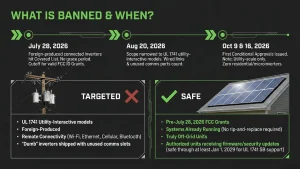
- July 28, 2026: The FCC added foreign-produced connected inverters to its Covered List, with no grace period.
- August 20, 2026: The FCC narrowed the scope to UL 1741 utility-interactive inverters with remote connectivity.
- August 20, 2026: Wired links like Ethernet now count, and so do unused comms ports.
- October 9 and 16, 2026: The first inverter Conditional Approvals went to GE Grid Solutions, Dynapower, and Power Electronics.
- As of October 16, 2026: Every approved model is utility-scale. No residential string inverter or microinverter appears yet.
You can read the full August 20 Public Notice and check the live FCC Covered List for new approvals.
The 4-Question FCC Inverter Check
Run every inverter on your equipment schedule through these four questions, in order.
1. Is It a Utility-Interactive Inverter Under UL 1741?
Grid-tied string inverters, microinverters, and hybrid inverters that export power all meet this test. On the other hand, truly off-grid units fall outside the rule.
2. Can It Connect Remotely, Now or Later?
Wi-Fi, cellular, Bluetooth, and Ethernet all count. A port or slot built to accept a comms module also counts, even with nothing plugged in. As a result, the “ship it dumb, add the radio later” workaround no longer works.
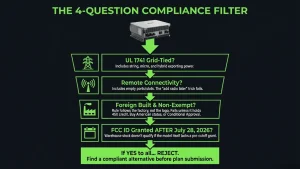
3. Where Was It Built, and Does an Exemption Apply?
The rule follows the factory, not the logo. For example, it still covers a US brand that assembles inverters in Southeast Asia. A foreign-built inverter clears the list in only three ways:
- Eligibility for the Section 45X advanced manufacturing credit.
- Buy American “domestic end product” status. That means US manufacture with over 65% domestic component cost through 2028, and 75% from 2029.
- A Conditional Approval from the Department of War or DHS.
Law firm Troutman Pepper Locke breaks down these three exemption paths in more detail.
4. Did Its FCC ID Get a Grant Before July 28, 2026?
For most residential and small commercial jobs, this question decides it. If the exact model held a valid grant before the cutoff, you can keep using it. Always check the grant date, not the purchase date. Warehouse stock doesn’t qualify if the model itself never received a grant.
How to Look Up an Inverter’s FCC ID and Grant Date
This check takes about five minutes per model.
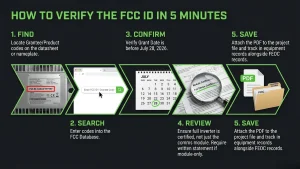
- Find the FCC ID. Look on the datasheet, nameplate label, or install manual. It starts with a grantee code, then a product code.
- Search the FCC database. Enter both codes in the FCC ID Search tool.
- Confirm the grant date. It must fall before July 28, 2026.
- Read what the grant covers. Some makers certified only the comms module, not the full inverter. In that case, get a written statement from the manufacturer.
- Check for Conditional Approval. Newer models must appear on the FCC Covered List approval table.
- Save the grant PDF. Attach it to the project file.
How the FCC Inverter Ban 2026 Hits Plan Sets and Interconnection
The ban won’t show up as a plan check comment. Instead, it shows up as rework.
Your plan set names one inverter in the equipment schedule, single-line diagram, and spec sheets. Likewise, your utility application lists the same make, model, rating, and UL 1741 SB listing. So, an inverter change after submission means a revised plan set and a resubmitted application. On larger projects, a swap can even trigger a material modification review.
The biggest risk right now is the late swap. Distributors are pushing newer SKUs into Q4 schedules. Unfortunately, a newer model is the one most likely to lack a pre-cutoff grant. That’s why one swap can fail both permitting and interconnection, as we showed in Solar Equipment Selection 2026: One Swap, Two Failed Reviews.
The fix is simple. Verify the inverter at design, lock it, and treat any substitution as a brand-new check.
There’s also good news. Previously authorized inverters can keep receiving firmware and security updates through at least January 1, 2029. That matters for the UL 1741 SB grid-support settings your utility may require.
For C&I work facing tax-credit deadlines, our guide to commercial solar interconnection under 48E explains why a lost queue spot costs so much.
Track FCC Inverter Compliance in Your Equipment Records
A check you can’t prove later won’t help much. So, add these fields to every project’s equipment record:
- Inverter FCC ID and grant date
- Country of manufacture
- Exemption path, if any (45X, Buy American, or Conditional Approval)
- Link to the saved grant PDF
Keep this next to your FEOC records, but don’t mix them up. The FCC check and the FEOC tax-credit check are separate gates. In fact, an inverter can pass one and fail the other. Our FEOC documentation checklist covers the tax-credit side. Lease and PPA financiers will ask about both.
FCC inverter ban 2026: Stop Paying for Inverter Rework
The FCC inverter ban rewards installers who verify equipment early. Meanwhile, it punishes those who find out at interconnection.
Energyscape Renewables builds this check into the design stage. Send us your inverter shortlist, and we’ll confirm it before it reaches your plan set. Our team handles plan sets, PE stamping, permitting, interconnection, and PTO nationwide, with a 99% AHJ and utility approval rate. If a distributor swaps your inverter mid-project, we turn the revision fast. Plus, our Professional Consulting team reviews FCC, FEOC, and code compliance in one pass.
Sunscape keeps the proof. Track every project’s inverter model, FCC ID, grant date, and documents in one solar CRM, from site survey to PTO. When a financier or utility asks, the answer is already on file.
Check it once. Record it once. Move on.
Request a quote from Energyscape Renewables or book a Sunscape demo today.
FCC Inverter Ban 2026 FAQs
Can I still install inverters I already have in stock?
Yes, as long as that exact model held an FCC grant before July 28, 2026.
Does the FCC inverter ban affect existing solar systems?
No. It doesn’t require removal of installed inverters or stop existing systems from operating.
Does a US brand make an inverter safe?
Not by itself. The rule looks at where the factory is, not where the brand has its headquarters.
Will the FCC approve more inverters?
Likely. The FCC has updated the list several times since July. So, recheck it each time you add a model to your approved vendor list.
sjayakanth@energyscaperenewables.com