
Back to Blog Page
FEOC Documentation for Solar Installers: What to Collect Before December 31, 2026
Why FEOC Documentation Now Decides Whether Your Solar Project Keeps the Credit
Most installers never signed up to be supply chain auditors. Still, that is the job now. FEOC documentation has quietly become the paperwork that decides whether a project keeps its 48E tax credit or loses it outright. The problem is familiar. Sourcing decisions get made fast, and the paper trail gets built later, if at all. Meanwhile, the IRS wants proof rather than recollection. Prohibited foreign entity records have to match your cost data, purchase orders, and supplier attestations before anyone files a return. Fortunately, the fix is not complicated. Standardize what you collect, apply it to every job, and store it in one system. Here is exactly what to gather before December 31, 2026.
What FEOC Documentation Covers Under Notice 2026-15
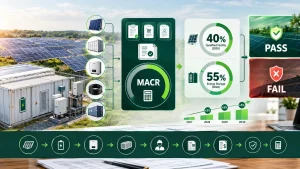
The One Big Beautiful Bill Act added prohibited foreign entity restrictions to Sections 45Y, 48E, and 45X. Those restrictions generally took effect on January 1, 2026. Then Treasury and the IRS filled in the details. Notice 2026-15, issued February 12, 2026, describes the material assistance rules and the safe harbors used to determine the applicable material assistance cost ratio (MACR).
MACR sits at the center of everything. Taxpayers must calculate the percentage of project or product cost attributable to equipment, parts, and materials supplied by prohibited foreign entities. Cross the line, and the facility stops qualifying altogether. In other words, this is pass/fail, not a bonus adder.
Thresholds drive the math. Qualified facilities beginning construction in 2026 face a threshold of at least 40 percent, while storage sits at 55 percent. Both step up roughly five points per year after that.
So FEOC documentation is not filing-cabinet busywork. Rather, it is the evidence behind a number that determines eligibility.
Why December 31, 2026 Belongs on Your FEOC Documentation Calendar
Two deadlines converge at year end.
First, thresholds tighten. Projects that begin construction on or before December 31, 2026 and are placed in service by December 31, 2027 can still use the 2026 thresholds, including the 40 percent MACR. Starts in 2027 face tougher numbers. Five points sounds minor on paper. On a real job, it often means swapping module suppliers under deadline pressure.
Second, the rulebook changes. The OBBBA required Treasury to issue safe harbor tables no later than December 31, 2026. Until those land, interim rules apply. Therefore, your FEOC documentation should capture enough granularity to survive a methodology shift.
The placed-in-service clock adds pressure too. Commercial projects that did not commence construction by July 4, 2026 must be operational by December 31, 2027 to claim the credit at all. Every week spent chasing missing certifications eats into that runway.
FEOC Documentation Checklist for Solar Installers and EPCs

Supplier Certifications and Prohibited Foreign Entity Disclosures
Supplier paperwork carries real weight here. The Certification Safe Harbor lets taxpayers rely on supplier certifications, which must include the supplier’s identification number, be signed under penalties of perjury, and be retained for at least six years.
Collect by SKU, not by vendor:
- Signed certifications for modules, cells, inverters, racking, trackers, and batteries
- Statements confirming whether items are PFE-produced or PFE-sourced
- Ownership, debt, management, and licensing disclosures
- Reseller pass-through records naming the actual manufacturer
Licensing deserves extra attention. Notice 2026-15 confirms that an IP licensing agreement entered into or modified on or after July 4, 2025 with a specified foreign entity counts as effective control on its own.
Cost Data Behind the Material Assistance Cost Ratio
MACR runs on direct costs, so line-item detail beats summary invoices every time. Pull bills of material, purchase orders, freight terms, and vendor quotes for each qualified facility.
Also record which method you used. Notice 2026-15 describes an Identification Safe Harbor, a Cost Percentage Safe Harbor, and a Certification Safe Harbor. Those methodologies can produce different pass/fail results, which makes method choice a substantive tax planning decision. Document the choice, the inputs, and the date.
One structural note matters for EPCs. The ratio gets calculated separately at the level of each qualified facility, meaning each circuit or unit that can be placed in service independently. Portfolio-level math will not hold up.
Begin-Construction and Project Timeline Records
Your FEOC documentation package should prove when work started. Keep dated site photos, signed EPC agreements, notices to proceed, equipment delivery receipts, and continuity evidence. Because thresholds hinge on the construction start year, these files carry as much weight as the sourcing data.
Diligence Files That Show No Reason to Know
Reliance is conditional, not automatic. Taxpayers may rely on supplier certifications only when they neither know nor have reason to know that PFE involvement exists, and red flags in ownership disclosures, financing documents, or sourcing inconsistencies can defeat that reliance. Consequently, save your screening logs, registry checks, and dated correspondence.
FEOC Documentation Mistakes That Put the 48E Tax Credit at Risk

Several patterns show up repeatedly across installer and EPC teams.
Mixing up two different frameworks. Domestic content affects whether a project earns a bonus rate, while FEOC material assistance rules affect whether a project qualifies for the credit at all. Keep separate files.
Requesting certifications after delivery. By then, leverage is gone. Instead, make conforming certification a condition of the purchase order.
Trusting a US-based reseller. Where a direct supplier is merely a reseller, the analysis applies to the entity that mined, produced, or manufactured the material.
Underestimating exposure. The IRS can assess a deficiency tied to a material assistance error within six years of filing, and suppliers who knowingly or negligently provide false certifications face a penalty of generally the greater of 10 percent of the resulting underpayment or $5,000.
How EnergyScape Renewables Supports Your FEOC Documentation Workflow
Clean documentation depends on clean project execution, and that is where EnergyScape Renewables fits in. Our engineering and back-office teams deliver PE-stamped plan sets, permit packages, interconnection applications, and site surveys across all 50 states. Because our deliverables carry consistent equipment schedules, BOM detail, and dated project milestones, your FEOC documentation stays aligned with what actually got installed.
We also help installers standardize intake. Instead of chasing certifications job by job, your team works from one repeatable submission format. For installers who want that discipline built into daily operations, our CRM and project management platform Sunscape keeps equipment records, milestones, and compliance files attached to each project from sale through closeout.
Start your FEOC documentation process now, not in December. Talk to the EnergyScape Renewables team about supporting your 2026 pipeline.

1 Comment
[…] letters, purchase orders, and a safe harbor statement filed with the credit claim. Our FEOC documentation checklist lists what to collect before December 31, […]