
Commercial Solar Interconnection: Beat the 48E Clock in 2026

Commercial Solar Interconnection: Beat the 48E Clock in 2026
Commercial solar interconnection now decides whether your C&I deal keeps its tax credit. If a project didn’t start construction by July 4, 2026, it has to go into service by December 31, 2027 to claim the 48E credit. So the date that matters isn’t install day. It’s PTO.
That leaves about 459 days as of late September 2026. However, many utilities take longer than that to approve a 500 kW job. This guide shows you how to read the clock, run the numbers, and screen every deal before you sign.
What Changed for C&I Solar After July 4, 2026
The One Big Beautiful Bill Act split commercial projects into two groups. First, projects that began construction by July 4, 2026 keep a runway through the end of 2030. Second, every other project, including each deal you sign today, must reach service by the end of 2027.
Still, demand hasn’t disappeared. According to SEIA’s Q3 2026 Solar Market Insight, commercial installs hit 638 MWdc in Q2 2026, up 11% year over year. The work is out there, but every new contract now carries a hard stop.
Why PTO Sets Your Commercial Solar Interconnection Deadline
Under IRS rules, a system counts as placed in service when it’s ready and available for its intended use. Many tax guides read that as installed, inspected, interconnected, and approved to operate. For example, if installation wraps in November but the utility approves in February, February is your date.
However, this point isn’t fully settled. Some practitioners argue PTO isn’t strictly required. Even so, tax equity partners and auditors still expect a dated PTO letter and a signed interconnection agreement. So plan to that conservative standard, and have your client confirm with their tax advisor. Our IRS audit documentation guide covers the full file.
Commercial Solar Interconnection Timelines by State
In September 2026, Lawrence Berkeley National Laboratory published the first national study of distributed energy interconnection. The table shows median months from application to PTO for 50 kW–1 MW projects from 2020 to 2024. These medians include construction and inspection.
| State | Median months to PTO |
|---|---|
| Washington | 6.0 |
| Arizona | 9.4 |
| New York | 16.0 |
| Rhode Island | 16.8 |
| Massachusetts | 18.1 |
Project size matters a lot. From 2020 to 2025, 76% of projects over 100 kW were still in process, compared with just 8% under 100 kW. In addition, 500 kW–1 MW projects carried the highest average upgrade costs in the study, at $221/kW.
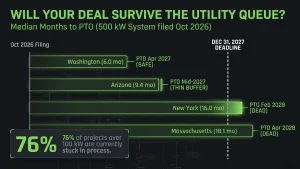
What That Means for a Deal You File in October
Now apply those medians to a 500 kW job that files in October 2026:
- Washington: PTO around April 2027. Safe.
- Arizona: PTO around mid-2027. Safe, with a thin buffer.
- New York: PTO around February 2028. Misses the cliff.
- Massachusetts: PTO around April 2028. Misses the cliff.
The crew and the system are identical in every case. Yet two of the four projects lose the credit.
The Real Cost of a C&I Interconnection Delay
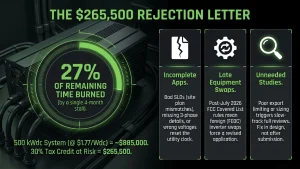
With about 15 months of runway left, a four-month stall burns roughly 27% of your remaining time.
Here’s the math in dollars. SEIA puts commercial pricing at $1.77/Wdc in Q2 2026. At that price, a 500 kWdc system costs about $885,000. As a result, its 30% credit is worth roughly $265,500. One kickback-and-resubmit cycle can put that entire amount at risk.
On top of that, you can’t speed up the utility. In California, a complaint to state regulators found that PG&E and SCE missed required interconnection deadlines up to 73% of the time. What you can control is the package you submit.
Three Ways Installers Lose Months on Commercial Solar Interconnection
1. Incomplete applications. An SLD that doesn’t match the site plan triggers a deficiency notice. Missing three-phase details or the wrong service voltage do the same. At many utilities, each notice resets the review clock. Our three-phase interconnection guide covers what utilities check first.
2. Late equipment swaps. On July 28, 2026, the FCC added foreign-produced power inverters to its Covered List. Because of that, an inverter change after you file often means a revised application. So lock and FEOC-screen your BOM before you submit.
3. Unneeded utility studies. System size, export capacity, and the point of interconnection decide whether you get fast-track review or a full study. For instance, export limiting or right-sizing can often keep a project on the faster path. Therefore, settle those choices during design, not after the utility responds.
A Go/No-Go Screen Before You Sign a C&I Deal
Before you sign, answer these five questions:
- What is this utility’s realistic application-to-PTO time for this project size?
- Did you add 60–90 days of buffer for inspection and one deficiency cycle?
- Does today’s date plus that total land before December 31, 2027?
- Is the BOM final, compliant, and in stock?
- Who owns weekly utility follow-ups?
If the dates don’t work, reprice the deal without the credit. Don’t promise a 30% credit you can’t deliver. After all, SEIA notes that smooth deal execution depends on off-takers understanding tax credit timelines. For more on queue risk, read our solar interconnection critical path guide.
Get Ahead of the 2027 Cliff With EnergyScape Renewables and Sunscape
Your interconnection package is now the most important document in the deal. Energyscape Renewables builds PE-stamped commercial plan sets, SLDs, and interconnection applications designed to clear on the first pass. We also chase the utility through PTO. With 24-hour PE stamping in all 50 states and a 99% AHJ/utility approval rate, your file reaches the utility weeks sooner.
Next, track every job against the deadline. Sunscape, your solar project management platform, lets you date each C&I milestone backward from December 31, 2027: application, study, ISA, install, inspection, and PTO. You’ll see which projects are slipping while there’s still time to act. Plus, your PTO letters and interconnection agreements stay in one place for tax season.
FAQ: Commercial Solar Interconnection
How long does commercial solar interconnection take in 2026?
It depends on the utility and the project size. For 50 kW–1 MW projects, LBNL’s median time to PTO ranged from about 6 months in Washington to 18 months in Massachusetts. Projects over 1 MW often take longer.
Can a commercial solar project still get the 48E credit if it didn’t start construction by July 4, 2026?
Yes, as long as it’s placed in service by December 31, 2027.
Does PTO count as “placed in service”?
The conservative approach, and the one audit files rely on, is to have a PTO letter dated before the deadline. Confirm with a tax professional.
What causes most C&I interconnection delays?
Incomplete applications, equipment changes after submission, and projects that trigger utility studies.
sjayakanth@energyscaperenewables.com