
AI-Assisted Plan Review: Clean Solar Plan Sets in 2026
AI-Assisted Plan Review: Clean Solar Plan Sets in 2026
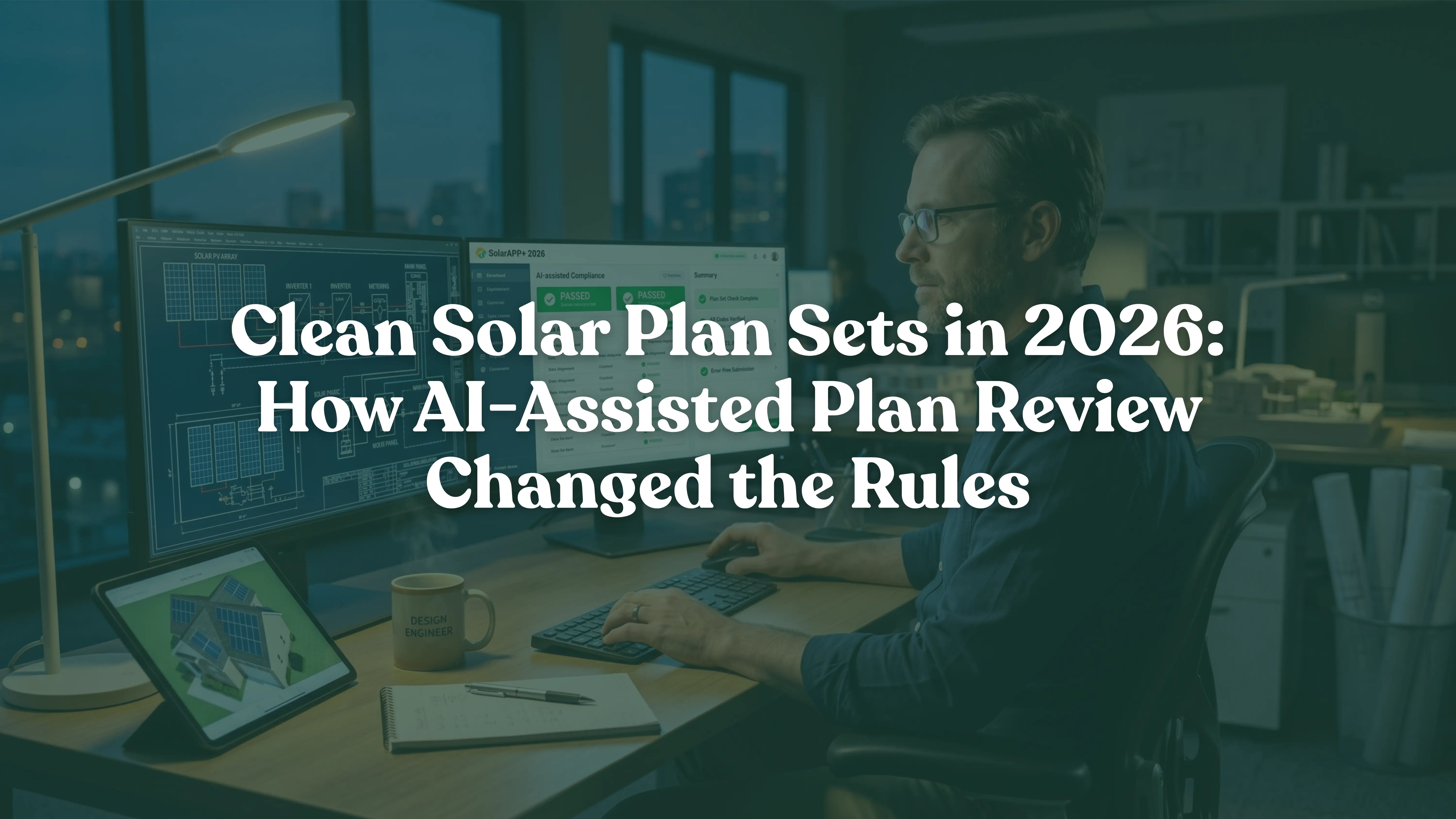
For years, a “clean” solar plan set meant one thing — it looked right. Today, AI-assisted plan review has changed that rule completely. Now software reads your submittal before a human ever opens it. And software does not care how polished your drawings look. Instead, it checks whether your numbers line up.
That shift quietly costs installers and EPCs approvals. Moreover, most teams miss it until the rejection notice lands. In a market this tight on margins, that gap is worth closing fast.
What AI-assisted plan review actually means
AI-assisted plan review happens when software checks a plan set for code compliance and completeness before a human reviewer sees it. On the permitting side, platforms like SolarAPP+ run an instant code check and approve qualifying residential systems in minutes. In fact, more than 450 AHJs across the United States now use SolarAPP+ for residential permits, and instant permitting already covers close to a third of the national market.
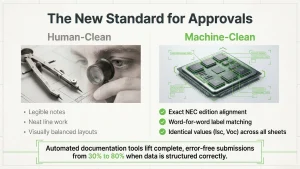
On the documentation side, AI tools scan plan sets and photos for missing data before anything reaches an AHJ. For example, one vendor’s beta lifted complete, error-free submissions from 30 to 80 percent. So the pattern is clear: a machine grades your work first, and it grades literally.
Why clean solar plan sets look different now
Here is the change in plain terms. A plan set can look perfect to a human and still fail an automated check. That happens because “clean” no longer means neat. Instead, it means consistent and structured.
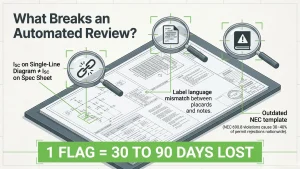
For instance, a machine flags your set when the module Isc reads one way on the single-line diagram and another on the spec sheet. Likewise, it flags a label that uses different wording on the placard than in the notes. It also flags a set built to the wrong NEC edition. None of that shows up to the naked eye. Yet all of it stops an approval cold.
Put simply: clean no longer means “looks right.” It means “parses right.”
What trips up AI-assisted plan review
The rejections are not exotic. Rather, they are small, repeatable data problems. Mislabeled module types, inconsistent roof load calculations, and missing PE stamps all trigger automatic flags. On top of that, watch for these:
- Label language that does not match word-for-word across sheets
- Templates built to an outdated code cycle
- Values that contradict each other from one page to the next
Because any one of these can bounce a package, the cost adds up fast. In fact, a first-submission rejection can push your project back 30 to 90 days once you count the resubmit and the lost queue slot. For the field-side fix, read our guide on solar site assessment mistakes.
Why 2026 is the tipping point
Three things landed at once.
First, automated permitting crossed from pilot to mainstream. Therefore, in high-volume states, machine review is now the likely path.
Second, NEC 2026 enforcement keeps spreading, and it added fresh rules — including the 690.4(G) rounding provision and stricter Isc requirements. On top of that, NEC 690.8 violations cause 30 to 40 percent of solar permit rejections nationwide. As a result, an outdated template is now a direct risk. Our solar permit plan set checklist breaks down every sheet you need.
Third, financing shifted toward third-party ownership. TPO agreements should reach about 64 percent of the US residential market in 2026, up from 43 percent in 2025. Meanwhile, those providers run their own automated document checks before they release payment.
Consequently, a modern installer faces AI gates at the AHJ and at the financier. So “clean” must satisfy both. Get it wrong, and you delay the permit and the payment together.
How to keep your plan sets machine-clean
You will not beat automated review with prettier drawings. Instead, you beat it with discipline:
- Match the code cycle. Build templates to the exact NEC edition your AHJ enforces, then update them the moment it changes.
- Keep every value identical. Your Isc, Voc, string counts, and model numbers must match across the SLD, spec sheets, and site plan.
- Match label language word-for-word across drawings, placards, and notes.
- Confirm PE stamp format per jurisdiction before you submit.
- Track AHJ requirements so your team designs to the right rules first. For the full picture, review our virtual vs. manual review workflow.
Put simply, consistency is the new clean. Above all, the teams winning first-shot approvals share one trait: their data never contradicts itself.
Keep your plan sets — and your pipeline — clean
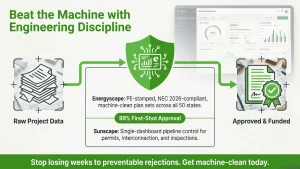
Machine-clean plan sets take engineering discipline, and that is exactly what Energyscape Renewables delivers. Specifically, you get PE-stamped, NEC 2026-compliant plan sets across all 50 states, pre-checked before they ship, with a 99% first-submission approval rate. Clean sets move you through the door faster.
However, faster also means more projects across more AHJs at once. That is where Sunscape keeps you in control, since it tracks permits, AHJ submissions, interconnection, and inspections in one dashboard. Energyscape keeps the set clean. Sunscape keeps the pipeline clean. So book a Sunscape demo or request a plan set today, and stop losing weeks to preventable rejections.
AI-assisted plan review: frequently asked questions
What makes a solar plan set clean in 2026?
A clean plan set stays internally consistent, machine-readable, and current with NEC 2026. In short, matching values, matching labels, and correct PE stamps across every sheet help it clear review the first time.
Why do solar plan sets get rejected by automated permitting?
Usually, small data mismatches cause it. For example, inconsistent equipment values, mismatched labels, the wrong code cycle, or a bad PE stamp format.
Does AI-assisted plan review replace the plan reviewer?
No. AI handles the first-pass compliance check. However, licensed engineers still own the judgment calls, so PE-stamped, human-verified sets still matter.
sjayakanth@energyscaperenewables.com