
TPO Milestone Funding Checklist 2026: NTP, M1, M2 & Clawbacks

TPO Milestone Funding Checklist 2026: What Lease and PPA Financiers Need at NTP, M1 and M2 (and How to Avoid Clawbacks)
You finished the install, and your crew is already on the next roof. Still, the lease money hasn’t hit your account. In 2026, TPO milestone funding decides when residential installers actually get paid. Third-party ownership (TPO) now drives most home solar sales. However, financiers don’t pay for finished work. They pay for approved paperwork.
Quick answer: TPO milestone funding releases installer payments in stages:
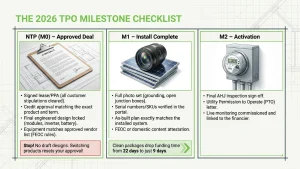
- At NTP, the financier needs a signed contract, cleared credit and a final design.
- At M1, it needs photos, serial numbers and an as-built that match that design.
- At M2, it needs the PTO letter and live monitoring.
If you miss the financier’s aging deadline, it can claw back money it already paid you.
TPO Milestone Funding at a Glance
| Milestone | What it pays on | What it needs |
|---|---|---|
| NTP (M0) | Approved deal | Signed contract, credit, final design |
| M1 | Install complete | Photos, SKUs, as-built, FEOC attestation |
| M2 | Activation | Inspection, PTO letter, live monitoring |
Why TPO Milestone Funding Got Stricter in 2026
The 25D homeowner credit expired at the end of 2025. Leases and PPAs still qualify for the 48E credit, so the market shifted fast. In fact, nearly two-thirds of solar sales companies surveyed by Aurora expect most 2026 projects to be TPO, according to Solar Power World.
Meanwhile, volume is shrinking. The SEIA and Wood Mackenzie Q3 2026 report shows residential installs fell 12% year over year in Q2. Wood Mackenzie also expects the segment to contract 23% this year. As a result, every funded dollar matters more.
Then there’s the calendar. For projects that began construction after July 4, 2026, the system must reach placed-in-service status by December 31, 2027. Otherwise, the financier gets no ITC at all. That ties its tax credit directly to your PTO date. For that reason, funding teams now review harder and chase stalled jobs faster.
Financier risk is real, too. According to Law360, Sunnova fell $367 million behind on contractor payments before its 2025 bankruptcy. Money stuck in milestone limbo isn’t just late. It’s exposed.
One naming note before the checklists. Financiers label milestones differently. For example, the LightReach help center splits guides into NTP (M0), Installation (M1) and Activation (M2). EverBright, on the other hand, uses an M3. So treat these lists as your baseline, and then confirm details in each portal.
NTP Checklist for TPO Milestone Funding
- Signed lease or PPA, with every customer stipulation cleared
- Credit approval tied to the exact product and term
- Complete site survey covering roof, structure, main panel, meter and shading
- Final engineered design with modules, inverter and battery locked
- Equipment checked against the approved vendor list and FEOC rules
Above all, don’t take NTP on a draft design. Enerflo’s GoodLeap guide notes that switching between a lease and a PPA disconnects the existing approval. Changing the battery setup does the same, and neither switch qualifies as a change order. GoodLeap also no longer funds ground mounts under TPO.
Accurate production numbers help here as well. Our guide on how production estimates prevent post-sale redesigns explains why.
M1 Checklist: Pass Lease and PPA Funding Review the First Time
M1 is where most packages bounce. That’s because reviewers compare the roof with the paperwork, line by line.
- Full photo set to the financier’s spec, including grounding, bonding and open junction boxes
- Module, inverter and battery serial numbers or SKUs in the portal
- An as-built plan set that matches the installed system
- Updated production or shade report based on the as-built
- FEOC or domestic content attestation, where required
According to Pipe’s LightReach guide, install photos must match the updated design and its reports before funding. In addition, SubcontractorHub flags “FEOC ineligible” designs as soon as you submit the install package. Our FEOC documentation checklist covers that paperwork in detail.
The usual culprit is a field change. Maybe a crew moved a panel to dodge a vent or swapped an inverter. If the plan set never shows it, the package fails. See how one equipment swap can fail two reviews.
Clean packages pay off fast. Solar Builder reports that standardized milestone forms doubled first-time LightReach approvals. Average funding time also dropped from 22 days to 9.
M2 Checklist: Activation and PTO
- Final AHJ inspection sign-off
- Utility Permission to Operate (PTO) letter
- Monitoring commissioned and linked to the financier
- Final plan set and any rebate filings
- Customer activation tasks completed in the portal
PTO is the gate you control least. That’s exactly why most clawbacks start here. Permit corrections and AHJ delays eat the clock first, so our breakdown of solar permit delays is worth a read.
How Clawbacks Hit TPO Milestone Funding
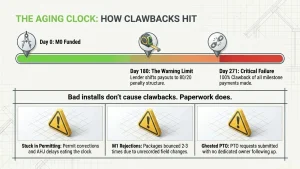
Every financier runs an aging clock. EverBright’s knowledge base explains its M3 setoff. If a job lacks M3 approval by day 271, EverBright can deduct 100% of the payments it made on that job.
Other contracts set similar limits. One lender clause on Law Insider caps installers at 180 days from credit submission to install complete. Another lets the lender shift payouts to 80/20 after quality problems.
In practice, bad installs rarely cause clawbacks. Instead, three things usually do:
- A job stuck in permitting
- An M1 package rejected two or three times
- A PTO request nobody followed up on
A Simple System to Avoid Solar Clawbacks
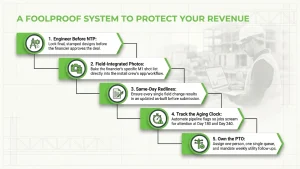
- First, engineer before NTP. Lock a final, stamped design before the financier approves the deal.
- Next, build the photo list into the field. Add each financier’s M1 shot list to your survey and install workflow.
- Then redline the same day. Every field change gets an updated as-built before you submit.
- After that, track days since NTP. Flag jobs at day 180 and again at day 240.
- Finally, give PTO an owner. One person, one queue and a weekly utility follow-up.
Get Paid Faster at Every Milestone
Every gate starts with a design that matches the roof. Energyscape Renewables delivers overnight engineering and 24-hour PE stamping in all 50 states. Our team also handles permits, AHJ follow-ups, interconnection and PTO, backed by a 99% AHJ and utility approval rate. So your NTP stays locked, your M1 matches and your M2 keeps moving.
Meanwhile, Sunscape, your Solar OS, tracks every project from NTP to PTO in one pipeline. As a result, jobs drifting toward a setoff deadline show up before the clawback does.
👉 Get financier-ready plan sets from Energyscape Renewables
👉 See every milestone in one place with Sunscape
Frequently Asked Questions
What’s the difference between M1 and M2 in TPO funding?
M1 pays once installation is complete and fully documented. M2 pays when the system activates with utility PTO and live monitoring.
What triggers a solar milestone clawback?
Usually, a job misses the financier’s aging deadline, such as EverBright’s 271-day M3 window. A funded job that never reaches PTO is the most common case.
Do leased residential systems still get the 48E credit in 2026?
Yes. However, TPO projects that began construction after July 4, 2026 must reach placed-in-service status by December 31, 2027.
How fast can TPO milestone funding be paid?
With complete first-pass packages, installers have seen payments land in about 9 days instead of 22.
sjayakanth@energyscaperenewables.com