
Back to Blog Page
How Accurate Production Estimates Prevent Post-Sale Redesigns
Why Solar Production Estimates Decide the Fate of Every Project
Every solar installer knows the feeling. The contract is signed, the customer is excited, and then the site survey tells a different story. Shading is worse than expected, or the roof can’t hold the planned array. Suddenly, the project needs a redesign. Fortunately, accurate solar production estimates can stop this cycle before it starts. When your pre-sale design uses verified site data, real shade analysis, and correct equipment specs, the system you sell is the system you build. As a result, you protect margins, avoid change orders, and keep customer trust intact.
What Causes Post-Sale Redesigns in Residential and Commercial Solar
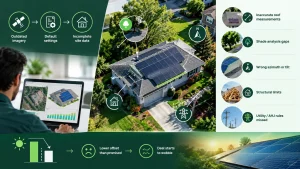
Post-sale redesigns rarely come from one big mistake. Instead, they stack up from small gaps in the sales process. For example, a rep might sketch a layout from outdated satellite imagery. Meanwhile, the proposal software pulls default loss values that don’t match the site.
Common triggers include:
- Inaccurate roof measurements from low-resolution imagery
- Shade analysis that ignores seasonal tree growth or nearby structures
- Wrong azimuth or tilt assumptions
- Structural limits that only show up during the site survey
- Utility interconnection caps or AHJ setback rules missed at the sales stage
Each of these issues changes the final production number. Consequently, the customer sees a lower offset than promised, and the deal starts to wobble.
The Real Cost of Inaccurate Solar Production Estimates

A redesign is never just a new drawing. First, your design team loses hours reworking the plan set. Next, the permit package may need updates, which pushes back the install date. On top of that, sales reps must go back to the homeowner and explain why the numbers changed.
That conversation is tough. Homeowners often read a lower production figure as a broken promise. Some ask for a price cut, while others cancel outright. For EPCs managing large pipelines, even a few cancellations each month can hurt cash flow.
Furthermore, the damage spreads beyond one deal. Unhappy customers leave reviews. In 2026, prospects check Google reviews and AI search summaries before they ever pick up the phone. So reliable solar production estimates protect both your margins and your reputation.
How Accurate Solar Production Estimates Keep Projects on Track
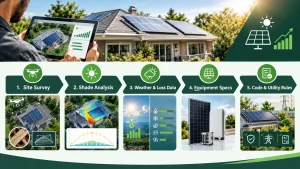
Good estimates start with good data. Therefore, the goal is simple: close the gap between what sales proposes and what engineering can actually build.
Start With a Verified Solar Site Survey
A detailed site survey is the foundation of solar design accuracy. Ideally, your team captures roof dimensions, rafter spacing, obstructions, and main panel details before finalizing the proposal. Drone imagery and LiDAR data add another layer of precision. With this information in hand, designers can place modules where they truly fit.
Run a Real Shade Analysis
Shade is the biggest swing factor in solar energy production. Tools like Solmetric SunEye, Aurora, and HelioScope measure solar access across the full year. As a result, you avoid overselling a roof that loses hours of sun every winter afternoon.
Use the Right Weather and Loss Data
Production modeling depends on location-specific weather files, such as NREL’s TMY datasets. In addition, loss factors for soiling, wiring, inverter clipping, and heat must reflect real conditions. Default settings may look fine on paper. However, they often inflate output in hot or dusty regions like Arizona and Texas.
Match Equipment Specs to the Final Solar Design
Sales tools sometimes rely on generic module and inverter profiles. That shortcut creates trouble later. Instead, lock in the exact equipment your crews will install. That way, the solar production estimates in the proposal line up with what engineering will model.
Check Code and Utility Rules Early
Fire setbacks, AHJ requirements, and utility export limits can all shrink an array. Reviewing them before the contract is signed prevents surprise cuts to system size. It also speeds up permitting, since the design meets code from day one.
Aligning Sales and Engineering to Reduce Solar Redesigns
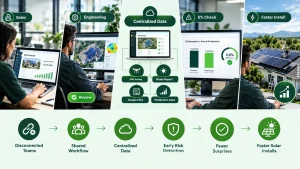
Technology alone won’t fix the problem. Your sales and engineering teams also need a shared workflow. For instance, some installers now require an engineering review before any proposal goes out. Others set a tolerance rule, such as flagging any design where final production drops more than 5% below the proposal.
A centralized platform helps here too. When site survey notes, shade reports, and design files live in one place, nobody works from stale data. Moreover, project managers can spot risk early and fix it before the customer ever notices. In short, better coordination means fewer surprises and faster installs.
FAQs About Solar Production Estimates
How accurate should solar production estimates be?
Most installers aim to keep the final design within a few percent of the proposed production. The tighter the gap, the lower the risk of cancellations and change orders.
Can remote solar design replace a site survey?
Remote design works well for early proposals. However, a physical or drone-based site survey should confirm every detail before permitting.
How EnergyScape Renewables Helps You Get Solar Production Estimates Right
At EnergyScape Renewables, we help US solar installers and EPCs build accurate designs from the very start. Our team handles site surveys, PE-stamped plan sets, permit packages, and interconnection support across all 50 states. Because our engineers check every design against real site data and local code, your proposals hold up long after the contract is signed.
We also support your back office, so your team can stay focused on selling and installing. To keep sales, design, and project data connected in one place, pair our services with Sunscape, a solar CRM and project management platform built for installers and EPCs.
Ready to stop redesigns and protect your margins? Contact EnergyScape Renewables today and give every project an accurate start.

1 Comment
[…] production numbers help here as well. Our guide on how production estimates prevent post-sale redesigns explains […]