
Solar Permit Corrections: Clear Solar Redlines Fast (2026)
Solar Permit Corrections: How to Clear Solar Redlines Fast in 2026
The correction letter just landed. It has twelve comments, three flagged sheets, and a homeowner asking when the crew is coming. However, the first round of AHJ plan check comments isn’t what wrecks your schedule. The second round is.
Each correction cycle costs two to four weeks once you add rework, re-stamping, and re-review. So if you miss one comment, you pay that bill twice. This guide shows US installers and EPCs how to sort a redline fast and clear it in one resubmittal.
Quick answer: To clear AHJ plan check comments fast, sort every comment by category first. Next, fix all items in one clouded revision. Finally, send a numbered response matrix that ties each comment to the sheet you changed. If a comment cites the wrong code edition, push back in writing.
What Are AHJ Plan Check Comments?
AHJ plan check comments are the corrections a building department needs before it issues your solar permit. Some jurisdictions call them a redline, a correction notice, or a hold letter. Either way, your permit stays paused until you answer every item.
How Much Does One Correction Cycle Cost?
The AHJ’s re-review is usually the short part. For example, Washoe County, Nevada gives itself a maximum of seven working days for corrections. Most of the cycle sits on your side: revising sheets, getting a new stamp, and uploading again.
That lost time also turns into lost revenue. According to pv magazine USA, permitting delays drive an estimated 22% of rooftop solar cancellations in New Jersey. Meanwhile, a PIRG Colorado report found that about 16% of projects entering permitting get canceled. It also found that red tape adds about $3,200 to a typical system.
Our post on the top 7 causes of solar permit delays explains where those days go before a redline arrives.
Step 1: How Should You Triage Solar Permit Corrections?
Don’t start redrafting comment number one. Instead, read the whole letter and give every item a category and one owner. Most solar redline corrections fall into five buckets:
| Category | Typical comment | Owner |
|---|---|---|
| Electrical/SLD | Conductor sizing, 120% busbar rule | Designer |
| Code edition | Plan cites NEC 2020; AHJ enforces 2023 | Designer |
| Labels/rapid shutdown | Missing or wrong placards | Designer |
| Structural | Attachment spacing, missing stamp | PE |
| Site plan/documents | Setbacks, fire pathways, spec sheets | Permit coordinator |
This takes about 30 minutes. As a result, you see which comments share a root cause before anyone touches a drawing.

Step 2: Fix Every Comment in One Revision
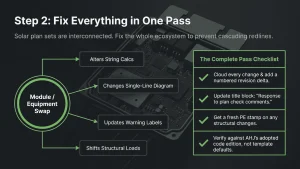
Solar plan sets are connected. A module swap changes your string calcs, single-line diagram, and labels. Sometimes it changes structural loads too. If you fix one sheet alone, you’ll likely create a new comment on another.
Instead, work through the full set in one pass:
- Cloud every change and add a numbered revision delta.
- Update the title block with the date and “Response to plan check comments.”
- Get a fresh PE stamp on any structural change.
- Check the set against the AHJ’s adopted code, not your template’s default.
Not sure which edition your AHJ enforces? Check our 2026 NEC edition map by state. For structural items, see the five triggers that decide a residential PE stamp.
Step 3: Send a Response Matrix, Not an Email
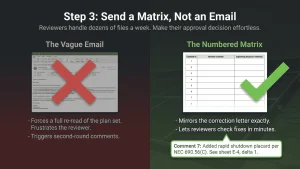
Reviewers handle dozens of solar files each week, so make approval easy. Build a numbered table that mirrors the letter. It should list the comment, your response, and the sheet you fixed.
Here’s an example: “Comment 7: Added rapid shutdown placard per NEC 690.56(C). See sheet E-4, delta 1.” That’s all a reviewer needs.
A clean matrix lets the reviewer check each fix in minutes. In contrast, a vague email forces a full re-read, and that’s where second-round comments come from.
Can You Push Back on AHJ Plan Check Comments?
Yes. Reviewers sometimes cite a code edition the jurisdiction hasn’t adopted. They may also ask for items outside a residential rooftop permit’s scope. In that case, reply politely with the adopted edition and the section that supports your design. Then ask for the code section behind the request. Often, a five-minute call with the plan checker beats a full redesign.
How Do SolarAPP+ Corrections Work?
SolarAPP+ handles corrections differently. Its automated compliance check flags a data field, and you fix that field and resubmit. According to Solar Power World, SolarAPP+ now runs in over 300 jurisdictions across 17 states. Also, the U.S. Department of Energy reports that SolarAPP+ projects finish permitting, install, and inspection about 13 days sooner (32 days vs. 45). Therefore, installers working in both markets need two redline workflows.
Why Do Redlines Cost More in 2026?
- NEC 2026 adoption is uneven. Neighboring AHJs enforce different editions, so “wrong edition” comments keep climbing.
- The 25D credit is gone. Margins are thinner, so every delayed week hurts more.
- Equipment swaps trigger revisions. FEOC-driven substitutions change spec sheets, SLDs, and labels. Our equipment selection guide covers this.
- Storage adds comments. PV-plus-storage jobs bring ESS and interconnection items that PV-only sets rarely got.
Clear Your Redline in 24 Hours
Got a correction letter on your desk? Send it to Energyscape Renewables. Our engineers sort every comment and revise the full plan set. Then we return a stamped set with a ready-to-submit response matrix. You get 24-hour PE stamping in all 50 states and a 99% AHJ and utility approval rate.
Can you see every job stuck in plan check right now? Sunscape shows every project in corrections in one pipeline view. You’ll see who owns each comment, when it’s due, and how long it’s aged. Book a Sunscape demo and find out where your permit days are going.
FAQ: Solar Permit Corrections
How long does it take to clear AHJ plan check comments?
The AHJ re-review often takes one to two weeks. The full cycle, including your rework, usually runs two to four weeks.
What is a solar redline?
A solar redline is a building department’s marked-up list of corrections required before it issues a solar permit.
Can I contest a plan check comment?
Yes. Respond in writing with the adopted code edition and section, and ask the reviewer to cite the requirement.
How do I avoid redlines in the first place?
Confirm the enforced NEC edition before design, and use AHJ-specific templates. Our page-by-page plan set breakdown shows what reviewers expect.
sjayakanth@energyscaperenewables.com