
NEC Edition by State Solar 2026: What Your AHJ Actually Enforces
NEC Edition by State for Solar 2026: What Your AHJ Actually Enforces
NEC edition by state solar 2026. A crew passes inspection in Denver on Tuesday. Two weeks later the same design — same modules, same inverter, same conductor sizing — comes back redlined from a jurisdiction one state over. Nothing was wrong with the electrical work. What was wrong was a section number printed on the label schedule.
That’s the quiet money leak for multi-state installers and EPCs in 2026. It isn’t bad engineering. It’s writing a plan set in the wrong edition of the code.
One national code, fifty different answers
The National Electrical Code is a model code from a private standards body, not federal law. It becomes enforceable only when a state, county, or city adopts it through its own legal process. NFPA published NEC 2026 on October 10, 2025, and state adoption typically runs 1 to 5 years behind release.
Here’s the line most articles skip: in every case, the authority having jurisdiction issuing the permit determines the enforceable code — statewide adoption does not prevent local amendments.
So the map tells you which state. Your inspector tells you which code.

Where the 50 states sit in 2026
Reconciling the major adoption trackers as of July 2026: 7 states on NEC 2026, 35 on NEC 2023, 6 on NEC 2020, one on 2017, one on 2014, and one running a state-specific code.
| Enforced edition | Approximate state count | What it means for your plan set |
|---|---|---|
| NEC 2026 | 7 states | Cite 690.7(D), 690.12(D), 705.10, 705.11(C)(1) |
| NEC 2023 | 35 states | The safest blind guess for a random U.S. job site |
| NEC 2020 | 6 states | Reflective white-on-red rapid shutdown placard still required |
| NEC 2017 | 1 state | Older labeling and disconnect language applies |
| NEC 2014 | 1 state | Verify every citation manually |
| State-specific code | 1 state | Ignore the NEC edition entirely |
The early movers are the usual western and New England states. Colorado, Idaho, Massachusetts, New Hampshire, Oregon, Utah, Vermont, and Washington have completed adoption, with 2026 in effect for new permit applications. Colorado’s electrical board approved the 2026 edition on May 27, 2026, with Denver submittals required to comply.
More is coming fast. Washington is targeting December 31, 2026 to replace its NEC 2023 enforcement, Oregon typically adopts within 12 to 18 months of an NFPA release, and Minnesota has formed an NEC 2026 Adoption Review Committee with no date set.
Now the uncomfortable part: those two counts above don’t match. One tracker says seven states, another lists eight. If the published trackers disagree with each other, a table you bookmarked in March is not a compliance document. Treat any map — including this one — as a starting point with an expiration date.
Local-adoption states break the map entirely
In several states there is no statewide electrical code at all. Each city or county picks its own edition. Arizona, Nevada, and Illinois are the ones that burn crews most often, and some large cities maintain their own electrical code and don’t track the state’s adopted edition at all.
If you’re expanding into one of those markets, the state row on any map is functionally blank. You verify jurisdiction by jurisdiction, or you eat correction cycles.
NEC Edition By State Solar 2026: The real reason plan sets get kicked back
Here’s the insight that saves the most revision time: NEC 2026 mostly moved solar requirements instead of rewriting them.
DC voltage marking consolidates at 690.7(D), rapid-shutdown labeling consolidates at 690.12(D), power source identification centralizes in 705.10, and PV definitions that lived in Article 690 moved to Article 100 — including “PV String Circuit” as a defined term. There are real technical reversals too: NEC 2023 dropped the conductor-length limit on supply-side interconnections, and the 2026 edition puts it back under 705.11(C)(1). On the storage side, 706.15 now points to 705.20 for consistency, and 706.16 disappears in 2026.
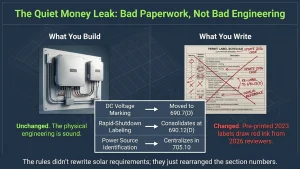
As one technical brief put it: the labels barely changed, the citations did — and pre-printed label stock or plan-set label schedules citing 2023 section numbers will draw red ink from a 2026-edition reviewer.
Older editions carry the same trap in reverse. NEC 2020 required a reflective white-on-red rapid shutdown placard; 2023 relaxed it to any contrasting colors — but most installers still run red and white because inspectors expect it. And 2023 consolidated power source directory requirements into 705.10 and added a requirement for an off-site emergency contact number when a company provides off-site services for the system.
None of that changes what you build. All of it changes what you write.
A six-minute verification you can run on any new jurisdiction
- Start with the statewide baseline. NFPA publishes a state-level enforcement map, but it shows state adoption, not local amendments.
- Call the building or electrical department and ask a specific question: which NEC edition is currently enforced for solar PV. Not “for electrical.” In local-jurisdiction states like Arizona, Nevada, and Illinois, this call is the only reliable answer.
- Read the permit application. Many jurisdictions print the enforced code edition right on the form.
Then do the part almost nobody does: write the answer down on the jurisdiction record in your CRM, with the date you confirmed it. A verified edition that lives in one project manager’s head is a single point of failure. A verified edition on a jurisdiction profile is an asset that every future job in that market inherits.
Your title block is a compliance document
Every sheet needs a consistent title block carrying the project address and APN, designer name and license number, date and revision, the NEC edition the jurisdiction enforces, and the IBC/IRC edition with local amendments — missing title block information is one of the top five reasons AHJs reject solar plan sets.
It looks like paperwork. It functions as a filter.
Why guessing costs more in 2026 than it used to
Four editions are live at once — 2014 through 2026 — which is the widest spread the solar industry has ever had to design against.
Meanwhile the penalty went up. Each correction cycle runs installers and EPCs $2,000 to $5,000 per rejected project, before crew rescheduling and client delay penalties. With the 48E safe-harbor deadline landing July 4, 2026, and commercial systems required from January 2026 to source at least 40% of manufactured product value from non-FEOC suppliers, a two-week revision loop can now threaten credit eligibility, not just your install calendar.
Stop verifying code editions one panicked phone call at a time
Every jurisdiction you enter is a research project you either do once, properly, or repeat forever through rejection cycles.
Energyscape Renewables already maintains the jurisdiction profiles you’d otherwise build through eighteen months of redlines. PE-stamped, code-compliant plan sets in all 50 states, a 99% first-submission approval rate across 188,000+ projects, and an AHJ and utility database that names the portal, the sequence, and the code edition before you submit. Residential turnaround runs 15–24 hours; commercial, 24–48.
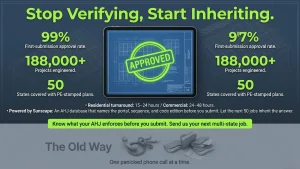
Sunscape keeps that knowledge from evaporating. Store the enforced NEC edition on the jurisdiction record, track every project from site survey through permit, interconnection, inspection, and PTO, and let the next fifty jobs in that market inherit the answer instead of rediscovering it.
Send us your next multi-state job. We’ll tell you which code your AHJ actually enforces — before it costs you a submittal slot.
Quick answers: NEC edition by state solar 2026
Has any state adopted NEC 2026?
Yes — a small group of early adopters, led by Colorado, Idaho, Oregon, Utah, Washington, and several New England states. Most of the country is still on 2023.
Which edition should I assume if I don’t know?
If you had to guess blind for a random U.S. job site today, 2023 is the correct guess — but guessing is what generates redlines.
My state adopted 2023. Can my city enforce something else?
Yes. The office issuing your permit is the office whose interpretation you have to satisfy.
sjayakanth@energyscaperenewables.com