
What’s Inside a Permit-Ready Plan Set: A Page-by-Page Breakdown
Why Solar Permit Plans Decide How Fast You Reach Install Day
Every installer knows this feeling. First, the customer signs. Then the application stalls at the permit counter. Two weeks later, plan check comments land in your inbox. Meanwhile, your crew sits idle while your lender asks about the install date. In most cases, those delays trace back to one thing: incomplete solar permit plans. After all, a thin plan set invites questions, and questions cost weeks.
Here’s the good news, though. AHJ reviewers are not hunting for perfection. Instead, they want proof that the system is safe, code-compliant, and buildable as drawn. So when your drawings answer those questions upfront, approvals move fast. Below, we walk through every page. Also, we explain why each sheet earns its place.
What Reviewers Actually Look For Before They Approve
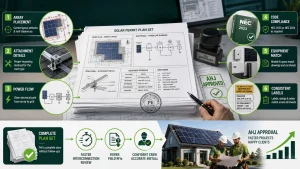
Strong solar permit plans tell a complete story without a single follow-up email. Specifically, they show where the array sits, how it attaches, how power flows, and which code sections back each decision. Furthermore, they match the equipment you truly intend to install. Last quarter’s inverter model will not do.
Meanwhile, reviewers now expect NEC 2023 or NEC 2026 references, depending on the jurisdiction. They also expect consistent labeling from sheet to sheet. As a result, a tight plan set does more than win approval. In addition, it shortens interconnection review, cuts field RFIs, and stops your crew from guessing on the roof.
The Page-by-Page Breakdown
Cover Sheet and Project Summary
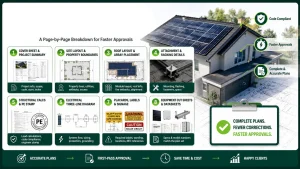
First of all, the cover sheet sets the tone for your solar permit plans. It carries the site address, scope of work, applicable code editions, and the full sheet index. Additionally, it lists DC and AC system size, module and inverter counts, and the design professional’s stamp details.
Because reviewers scan this page first, they use it to gauge how much scrutiny the rest deserves. Therefore, keep it specific. Otherwise, vague scope language invites a closer look at everything else.
Site Layout and Property Boundaries
Next, this sheet shows property lines, the structure, the driveway, and the utility point of connection. It also marks the meter, main service panel, disconnects, and fire access pathways.
Meanwhile, north arrow, scale, and setback dimensions stay non-negotiable. In fact, many AHJs bounce a plan set simply because setbacks were never dimensioned. Clear callouts solve that instantly.
Roof Layout and Array Placement
This page maps every module. For example, it should show rafter direction and spacing, roof pitch, azimuth, existing obstructions, and fire setback zones.
Moreover, it needs attachment spacing and row alignment. Since fire officials review this sheet closely, accuracy matters most in California and other strict-pathway markets. Consequently, precise placement here prevents costly redesigns after approval.
Attachment and Racking Details
Now the drawings get technical. This page documents mounting hardware, flashing method, fastener type, embedment depth, and manufacturer specs.
Above all, the attachment must match the roof type. For instance, a composition shingle detail on a tile roof triggers an instant correction notice. Also, include the racking manufacturer’s engineering letter whenever the AHJ asks for it.
Structural Calculations and the PE Stamp
Structural sheets prove the roof carries the added load. Typically, they include dead and live load math, wind and snow data per ASCE 7, and member capacity checks.
In addition, most jurisdictions require a wet or digital PE stamp from an engineer licensed in that state. As a result, this becomes the usual bottleneck for teams filing solar permit plans outside their home market. Still, nailing it the first time protects your whole schedule.
The Electrical Three-Line Diagram
This diagram sits at the heart of any solar permit plans package. Basically, it traces the electrical path from module to grid. Accordingly, expect string configuration, conductor sizing, conduit fill, overcurrent protection, grounding and bonding, plus the interconnection method.
Busbar math matters enormously on residential retrofits. Specifically, the 120% rule, supply-side taps, and load-side connections all live here. Furthermore, battery systems demand transfer equipment, protected loads panels, and rapid shutdown details. Since utilities review this sheet too, consistency saves you twice.
Placards, Labels, and Signage
Labels look minor until an inspector fails the install over them. Instead of guessing, spell out every required placard, its exact wording, and its mounting location.
Rapid shutdown signage, DC disconnect labels, and warning markings all belong on this page of the plan set. Because requirements shift between code editions, cite the applicable NEC section right on the sheet.
Equipment Cut Sheets and Datasheets
Finally, attach manufacturer specs for modules, inverters, optimizers, racking, batteries, and disconnects. Then highlight the exact model numbers you plan to install.
Reviewers cross-check listing numbers against the three-line diagram. Consequently, a mismatched revision becomes one of the fastest ways to earn a correction letter.
Common Reasons AHJs Send Back Solar Permit Plans
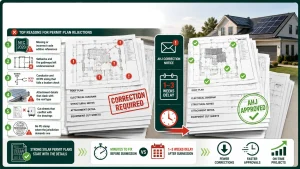
Rejections rarely involve exotic engineering problems. Rather, they follow familiar patterns:
- Missing or incorrect code edition references
- Setbacks and fire pathways left undimensioned
- Conductor and OCPD sizing that fails a busbar check
- Attachment details that clash with the roof type
- Cut sheets that conflict with the drawings
- No PE stamp where the jurisdiction demands one
Each item takes minutes to fix during design. However, each one costs one to three weeks once the file already sits in the queue. In short, that math explains why sharp EPCs invest in stronger solar permit plans upfront.
How EnergyScape Renewables Builds Solar Permit Plans Nationwide
At EnergyScape Renewables, we produce solar permit plans for installers and EPCs across all 50 states. To begin with, our team handles site layouts, structural calculations, three-line diagrams, and PE stamping through a licensed engineer network. Meanwhile, we track AHJ requirements jurisdiction by jurisdiction. Therefore, your plan set arrives formatted the way each reviewer expects.
Beyond drafting, we also support permitting submissions, interconnection applications, and revision responses. In short, we lift the back-office weight so your team can sell and install more.
Of course, the work continues after approval. Managing installs, documents, and milestones still eats hours every week. That is where Sunscape comes in — a purpose-built solar CRM that moves every project from proposal to PTO.
Ready to stop losing weeks at the permit counter? Reach out to EnergyScape Renewables, and let’s get your next submission approved on the first pass.
sjayakanth@energyscaperenewables.com