
Solar Equipment Selection 2026: One Swap, Two Failed Reviews

Solar Equipment Selection 2026: One Swap Can Cost You the Permit and the 30% Credit
Solar equipment selection 2026 is a compliance decision, not a purchasing decision. Two parties review your bill of materials, and they never speak to each other. One is the plan checker at your AHJ. The other is whoever signs the tax return that claims the credit.
Choose a module, inverter, racking system and battery that satisfy both, and the job runs clean. Let a warehouse swap happen after the plan set is stamped, and you can pass inspection and still lose a 30% tax credit.
Here is where the two rulebooks collide, and how to lock a BOM so a substitution cannot quietly wreck your economics.
The two gates behind solar equipment selection in 2026
Gate one is code. Equipment must be listed, listed together where the code requires it, and legal under the NEC edition your jurisdiction enforces. None of that is new. What changed is how tightly it now couples to gate two.
Gate two is the tax credit. Treasury and the IRS released Notice 2026-15 in February 2026. It sets interim rules and safe harbor tables for the material assistance cost ratio (MACR) under Sections 48E, 45Y and 45X. The rules cover facilities and storage that began construction after December 31, 2025, which captures nearly everything you sell today.
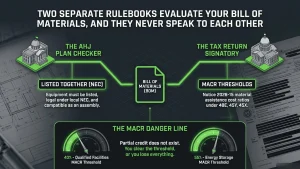
The MACR asks one question: how much of this system’s cost came from a prohibited foreign entity? For calendar year 2026, the threshold sits at 40% non-PFE content for qualified facilities and 55% for energy storage. Eligible-component thresholds vary by component type. Every threshold climbs annually through 2029.
Residential installers are inside this now. Section 25D ended for systems installed after December 31, 2025, so homeowners reach the 30% benefit through third-party ownership under 48E. TPO providers claim that credit directly, which puts their sourcing under the same material assistance rules as any commercial project. Your BOM became their tax exposure.
Our MACR calculation guide walks through the math itself.
Five components where code and credit collide
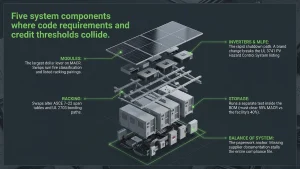
Modules. The largest dollar line, so the largest single lever on your MACR. They also carry a fire classification and a listed pairing with your racking.
Inverters and MLPE. Your rapid shutdown path lives here. Plan reviewers know module-level electronics well, though that approach adds components and connection points on the roof. The alternative is a UL 3741 listed PV hazard control system, and that is where swaps turn dangerous.
Racking. This carries your UL 2703 bonding path and your ASCE 7-22 span tables. Swap racking and you change the structural calculation, not just a part number. Our post on grounding versus bonding covers why anodized frames complicate that listing.
Storage. Batteries answer to a 55% threshold while the facility answers to 40%. A solar-plus-storage job therefore runs two separate tests inside one BOM.
Balance of system. Small money, real paperwork. Missing supplier documentation stalls a compliance file just as effectively as a missing panel certification.
Why late substitutions cause the damage
Few contractors fail because they picked poor equipment on day one. They fail because something got substituted in week six.
On the code side, a swap can break a listed system. UL 3741 evaluates the whole array as one assembly, covering modules, racking and wiring. Every element must belong to the same listing, so a different racking product or a different inverter breaks compliance. Plans using that path must include a PVHCS certificate that itemizes the specific equipment to be installed. Change the equipment and the submitted document is wrong.
One timing note for repowering work: UL 3741 first published in 2020 and received an update in October 2025. The 2023 NEC cycle also moved rapid shutdown marking into 690.12(D). Which section you cite depends on your jurisdiction, and our NEC edition by state guide maps that out.
On the tax side, the swap moves the number. Say a facility’s manufactured products total $150, and $84 of that comes from a prohibited foreign entity. The MACR lands at 44%, which clears the 2026 threshold. That leaves four points of headroom. One inverter brand change erases it.
This test gives no partial credit. You clear the line or you do not.
FEOC and domestic content measure different things
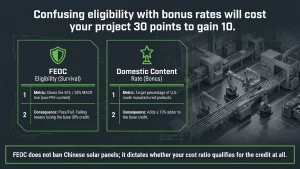
Experienced teams confuse these weekly, so state it plainly. FEOC determines eligibility. Domestic content determines rate.
The 10% domestic content adder rewards a set percentage of U.S.-made panels, inverters and racking. Manufacturers now issue third-party prohibited foreign entity letters to verify sourcing. Chase the adder while ignoring the eligibility test, and a project gains 10 points while losing 30.
SolarEdge’s North America GM framed 2026 as the year domestic content and non-FEOC supply chains shift from incentive to requirement.
Five steps to lock your bill of materials: Solar Equipment Selection 2026.
- Route equipment decisions through design, not procurement. The equipment schedule on your plan set is the controlled document. If it changes, both reviews reopen.
- Collect PFE certification letters before the PO clears. Treasury must publish final safe harbor tables no later than December 31, 2026, so interim rules govern until then. Capture enough detail to survive a methodology change.
- Keep a substitution log. A MACR error carries a six-year statute of limitations. Your records must outlive the crew that built the job.
- Confirm the NEC edition per jurisdiction before you finalize a rapid shutdown path. Adoption varies, and a compliant design in one county fails two counties over.
- Reverse-date from the deadline. Commercial projects that did not commence construction by July 4, 2026 must reach operation by December 31, 2027. A re-permit eats weeks you may not have. Our residential to commercial pivot guide breaks down that clock.
Your Next Step
Send the BOM before the PO clears. Energyscape Renewables checks your equipment selections against the code your AHJ actually enforces and the listings your design depends on, then delivers a plan set that matches what lands on the roof. Licensed nationwide, 24-hour PE stamping, and a 99% AHJ and utility approval rate. When a substitution becomes unavoidable, we turn the redesign fast enough to protect your in-service date.
Request an equipment review →
Then keep the record. Sunscape stores the equipment schedule, supplier letters, substitution approvals and project dates on the job itself. Six years from now, “what did we actually install” takes thirty seconds to answer.
Book a Sunscape demo →
Quick answers on Solar Equipment Selection 2026
Can I swap solar panels after permit approval?
Not freely. When an array relies on a listed system for rapid shutdown, substituting a component outside that listing breaks compliance, and your plan set no longer matches the installation. The swap can also move your MACR below the 2026 threshold.
Does changing inverter brand affect the solar tax credit?
Yes. Inverters count as a major manufactured product in the MACR calculation. A brand change can push non-PFE content under the 40% facility threshold, which removes credit eligibility rather than reducing it.
Does FEOC ban Chinese solar panels?
No. They remain legal to install. They affect whether a project qualifies for the credit, and that outcome turns on the cost ratio, not the country printed on the box.
What documentation proves FEOC compliance?
Supplier PFE certification letters, purchase orders, and a safe harbor statement filed with the credit claim. Our FEOC documentation checklist lists what to collect before December 31, 2026.
Who reviews solar equipment lists for code and FEOC compliance?
Energyscape Renewables reviews equipment schedules against the NEC edition your AHJ enforces, the listings your rapid shutdown path depends on, and the documentation your tax partner needs.
sjayakanth@energyscaperenewables.com