
Residential to Commercial Solar Pivot: What Changes in 2026

Residential to Commercial Solar Pivot: What Changes in 2026
A residential to commercial solar pivot is now a calendar decision, not a strategy debate. The One Big Beautiful Bill Act set a hard begin-construction deadline of July 4, 2026 for the Section 48E tax credit. That date has passed.
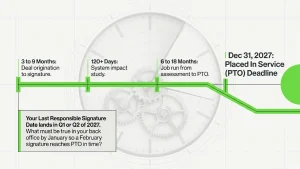
So any commercial project you start today is a Track Two project, meaning a project that began construction after July 4, 2026 and must therefore be placed in service by December 31, 2027 to earn any federal credit. Anything energized in 2028 gets nothing.
That leaves roughly 15 months. Meanwhile, commercial jobs run 6 to 18 months from assessment to permission to operate, and the sales cycle alone eats 3 to 9 months. Therefore the real question is simple: what has to be true in your back office by January so a February signature reaches PTO in time?
Why the Residential to Commercial Solar Pivot Makes Sense Now
The two segments are moving in opposite directions. According to the SEIA and Wood Mackenzie Solar Market Insight Q3 2026 report, residential installed 995 MWdc in Q2 2026, down 12% year over year. Commercial installed 638 MWdc in the same quarter, up 11% year over year.
SEIA and Wood Mackenzie also forecast a 21% residential contraction for 2026, driven by the Section 25D credit ending on a cliff. In addition, more than 100 solar companies have closed or filed for bankruptcy since 2023, including the second-largest national residential installer in April 2026.
Commercial is not booming. It is simply still standing.
What Changes in Sales
The revenue math works in your favor. SEIA and Wood Mackenzie put residential pricing at $3.36/Wdc against $1.77/Wdc for commercial. You sell at roughly half the price per watt, yet one 500 kW job carries the contract value of thirty rooftops.
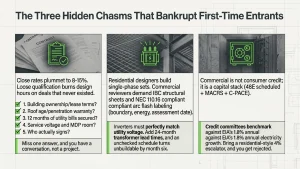
However, conversion works against you. Our own 2026 proposal conversion benchmarks show most EPCs closing 8% to 15% on C&I proposals versus 20% to 30% on residential.
As a result, loose qualification costs far more here than it does in residential. Every weak commercial lead burns design hours on a deal that never existed.
Five Questions Before You Spend Engineering Hours
- Does the customer own the building, or how many years remain on the lease?
- How old is the roof, and what does the warranty say about penetrations?
- Will they hand over 12 months of utility bills?
- What is the service voltage, and how much room is left in the main distribution panel?
- Who signs: an owner, a board, a landlord, or a corporate parent three states away?
Miss one answer and you do not have a project yet. You have a conversation.’
What Changes in Engineering in Residential to Commercial Solar Pivot?
This is where first-time entrants lose the runway. Your residential designer builds single-phase 240V sets against the IRC. Commercial reviewers expect IBC structural sheets, NEC 690 and 705 compliance, and NFPA 70E documentation, as covered in our guide to commercial plan sets for small C&I projects.
Three details catch resi teams repeatedly:
Three-phase configuration. Inverters must match the utility’s exact voltage. Unbalanced legs trip protective relays, and the application restarts. Our three-phase interconnection guide covers the design fix.
Arc flash labeling. Under NEC 110.16, a generic sticker fails. Labels need system voltage, arc flash boundary, incident energy or PPE category, and assessment date.
Point of interconnection. Utilities typically quote 30 to 60 days for initial commercial review. Trigger a system impact study, though, and that stretches past 120 days. On a Track Two project, a four-month study is the gap between 30% and zero.
Add transformer lead times near 24 months in many markets, and a comfortable schedule turns unbuildable by month six.
What Changes in Financing
Residential financing is a consumer credit decision. Commercial financing is a capital stack.
Section 48E still delivers 30% for qualifying projects, stacked with MACRS and bonus depreciation. Yet the credit is no longer something you assume. Now you schedule it.
C-PACE has also become serious money. Morningstar DBRS estimated 2025 PACE originations near $4.5 billion, with C-PACE at over 96% of that volume and up 86% from 2024. More than 35 states plus DC have enabling legislation, though legislation alone does not guarantee an active program.
Finally, watch your escalator. Credit committees benchmark against the EIA Annual Energy Outlook projection of roughly 1.8% annual commercial electricity price growth. Residential-style decks with 4% escalators get rejected.
Residential vs. Commercial Solar at a Glance
| Factor | Residential | Commercial (C&I) |
|---|---|---|
| System price | $3.36/Wdc | $1.77/Wdc |
| Sales cycle | 2–6 weeks | 3–9 months |
| Proposal close rate | 20–30% | 8–15% |
| Electrical design | Single-phase 240V | Three-phase 208/480V |
| Code basis | IRC, NEC 690 | IBC, NEC 690 + 705, NFPA 70E |
| Interconnection review | 15–45 days | 30–120+ days |
| Financing | Consumer loan, TPO | 48E, MACRS, C-PACE, PPA |
| Payment timing | Weeks | Milestone-based, months |
The Honest Case for Waiting
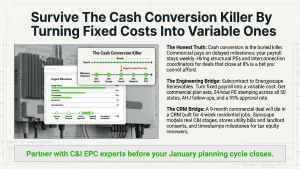
Cash conversion is the buried killer. Residential pays in weeks, but commercial pays on milestones spread across months while payroll stays weekly. Plenty of installers won a first C&I job and folded waiting to get paid for it.
Here is a term worth adopting: your last responsible signature date is the latest day you can sign a C&I contract and still reach PTO before December 31, 2027. Work backward through PTO, inspection, construction, notice to proceed, interconnection, permitting, and engineering. For most installers, that date lands in Q1 or Q2 of 2027.
If you are entering now, subcontracting to an EPC that already established beginning of construction before July 4, 2026 remains the lower-risk route.
Ready to Price Your First C&I Job?
Hiring a structural PE, a three-phase electrical engineer, and an interconnection coordinator to chase deals that close at 8% is a bet most installers cannot make. Energyscape Renewables turns that fixed cost into a variable one: commercial plan sets, 24-hour PE stamping licensed across all 50 states, permit submissions, AHJ follow-ups, interconnection applications, and PTO tracking, backed by a 99% approval rate.
Meanwhile, a nine-month commercial deal will not survive inside a CRM built for four-week residential jobs. Sunscape models real C&I stages, stores the bills and consents every deal drags along, and timestamps each milestone, which is exactly what a tax equity reviewer asks for later.
Request a quote or book a Sunscape demo before your January planning cycle closes.
Frequently Asked Questions: Residential To Commercial Solar Pivot
Is it too late to claim 48E on a new commercial project?
No, but the window is tight. Projects that began construction after July 4, 2026 must be placed in service by December 31, 2027 to qualify. Any commercial system energized in 2028 or later receives no federal investment tax credit at all.
How long does a commercial solar sales cycle take?
Plan on 3 to 9 months from first contact to signed contract. Large C&I deals involving board approvals, landlord consent, and utility interconnection studies commonly run 12 to 18 months, which is why early qualification matters more than proposal polish.
What does “begin construction” mean for solar tax credits?
Begin construction means a taxpayer has either started physical work of a significant nature or incurred a qualifying share of total project cost before the statutory deadline. Both tests are defined in IRS guidance and determine which placed-in-service deadline applies.
What is the biggest engineering difference in commercial plan sets?
Three-phase electrical design, IBC structural requirements, NEC 690 and 705 compliance, compliant arc flash labeling, and a point-of-interconnection strategy built into the drawings rather than added after the utility responds.
sjayakanth@energyscaperenewables.com