Battery Storage Plan Sets: 2026 NEC and NFPA 855 Requirements Explained

Why Battery Plan Sets Get Kicked Back in 2026
A homeowner wants two batteries in the garage. Your crew is booked and the equipment is on the truck, and then the permit comes back with four comments from the fire marshal. Sound familiar? Battery plan sets now sit under two sets of rules that changed in the same cycle: the 2026 National Electrical Code (NEC) and the 2026 edition of NFPA 855. Each rejection costs you a resubmittal, a week or more of schedule, and sometimes the customer’s patience. This guide covers what changed, what reviewers check, where engineering errors creep in, and how to build battery plan sets that clear review the first time.
First, Confirm Which Code Edition Your AHJ Enforces
NFPA has published the 2026 NEC, but it isn’t law everywhere. Adoption is a state or local decision, and it usually trails publication by one to three years. Texas moved first. Starting September 1, 2026, all non-exempt electrical work in the state must follow the 2026 NEC, inside city limits or out in the county. California went the other way. Its electrical code took effect January 1, 2026, and it still builds on the 2023 NEC.
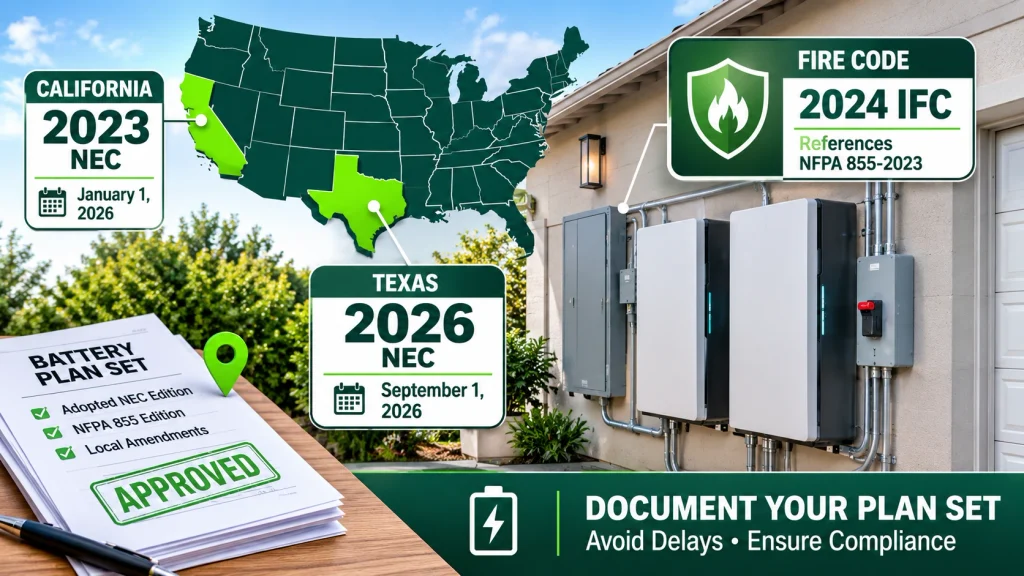
Fire codes add another layer. The 2024 International Fire Code still references NFPA 855-2023, so a jurisdiction can enforce a 2026 electrical code next to a 2023-era fire standard. Put the adopted editions and local amendments on the cover sheet of your battery plan sets. Reviewers look for that block before anything else.
2026 NEC Changes That Affect Battery Plan Sets
Article 706 and the New Article 702 Sizing Path
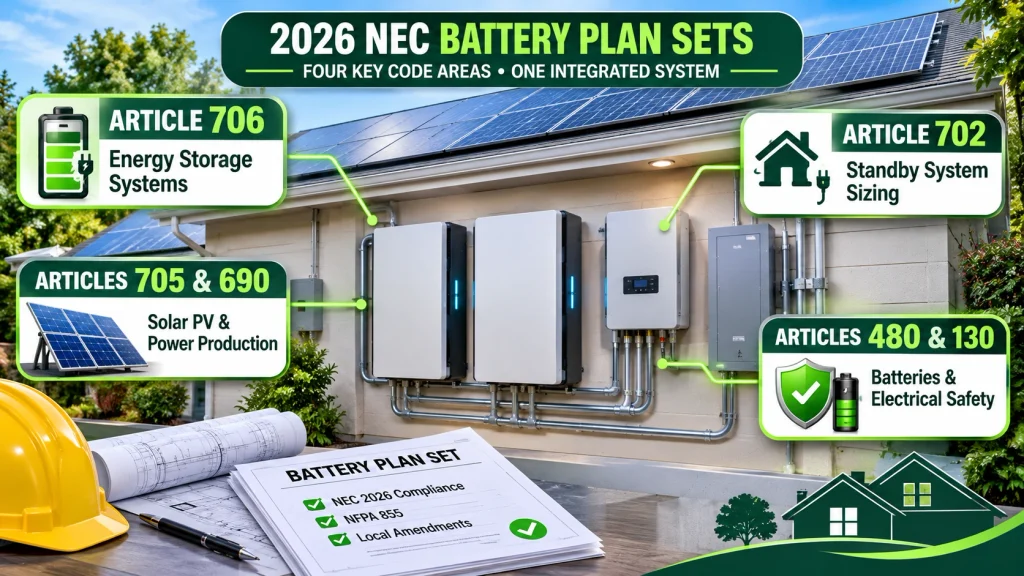
Article 706 got clarifications rather than a rewrite. Two edits still matter on paper. Section 706.16 is gone. In the 2023 code it pointed backup sizing toward the Article 710 approach, and 710 targets systems with no utility connection. Now most grid-tied backup batteries follow the optional standby rules in Article 702.
Section 702.4 gives you three sizing approaches: full load, managed load, and a new option that uses a listed power control system (PCS). That PCS option applies only to one- and two-family dwellings. So your plans should show the multimode inverter listing, the PCS settings, which loads are backed up versus controlled, and the 702.4 option you picked.
Articles 705, 690, 480, and 130
Disconnect rules in 706.15 now point to 705.20, the same place 690.13 points. So PV and ESS disconnects share one rule set. Supply-side connections changed too. Section 705.11(C)(1) brings back conductor length limits inside buildings: 10 feet in dwelling units and 16.5 feet in other buildings.
Article 480 (stationary batteries) and Article 706 also have a cleaner boundary, and energy management systems moved from Article 750 to a new Article 130, which separates EMS from PCS. UL 3141 covers PCS listings.
NFPA 855 2026: What Fire Reviewers Want to See
The 2026 edition of NFPA 855 reorganized the standard and moved general requirements for all ESS into Chapter 4. The bigger shift for commercial work is the Hazard Mitigation Analysis. In 2023, an HMA was usually needed only when a project went past prescriptive limits. Now it is the default for most installations. A new section, 4.3.3, also sets minimum emergency response plan and training requirements, including an annual review and yearly refresher training with the AHJ notified.
Large-scale fire testing is now required alongside UL 9540A. UL published the 6th edition of UL 9540A on March 13, 2026. On the equipment side, every ESS needs a UL 9540 listing, and that listing belongs on your spec sheet page.
Residential Limits Reviewers Check First
Residential battery plan sets get checked against limits drawn from NFPA 855 and IRC R328. Each unit can’t exceed 20 kWh. Aggregate ratings top out at 40 kWh in utility closets, basements, and storage spaces, and at 80 kWh in garages, on exterior walls, and outdoors. Units need 3 feet of separation unless UL 9540A test data supports less.
Local amendments move these numbers. San Francisco allows 100 kWh on or within 3 feet of exterior walls. New York City caps wall-mounted and ground-mounted outdoor systems at 40 kWh per building. Check the local rule before you size anything.
Common AHJ Rejections and How to Fix Them
Most comments we see on battery plan sets trace back to a handful of gaps:
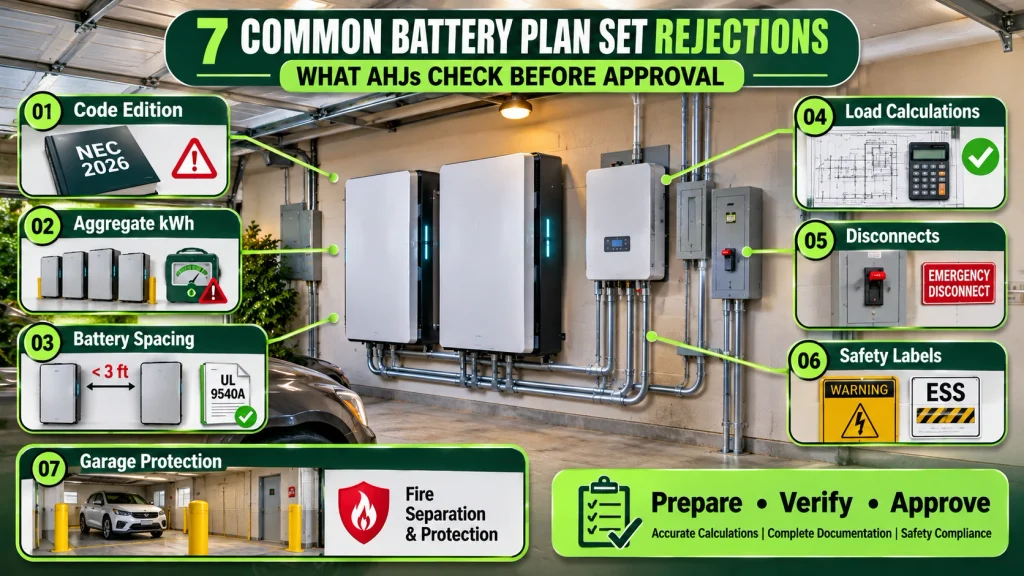
- No code edition block, or the wrong edition listed
- Aggregate kWh over the location limit, often from counting usable capacity instead of nameplate energy
- Unit spacing under 3 feet with no UL 9540A report or manufacturer data to back it up
- No 702.4 sizing method, PCS settings, or backed-up load list
- Disconnect location missing from the site plan, or no exterior emergency shutdown label
- Missing placards, arc-flash labels, or ESS marking details
- Garage installs without vehicle impact protection or fire separation notes
Build an AHJ checklist for every jurisdiction you serve, keep it current, and run each set against it before submittal. Fire departments often publish their own ESS guidelines, and those documents tell you exactly what the reviewer will ask for.
What Complete Battery Plan Sets Include
Strong battery plan sets follow a predictable order. Start with a cover sheet listing code editions and scope, then a site plan that shows the ESS location and its distance to doors, windows, and property lines. After that come the single-line diagram, backup sizing calculations, spec sheets with UL 9540 listings, a labeling sheet, and mounting details. Commercial projects add the HMA, the emergency response plan, and fire suppression or detection details.
Keep three categories separate in your notes. Code requirements are mandatory. Manufacturer instructions become mandatory through the listing, but they don’t override the code. AHJ interpretations vary by county, so record them in writing.
How EnergyScape Renewables Helps Installers Get Approved
EnergyScape Renewables prepares permit-ready plan sets for residential, commercial, and utility-scale solar and storage projects. Its engineers handle structural and electrical PE stamping in all 50 states and build each design to the requirements of the specific AHJ. The team also manages permit submittals and interconnection applications, which takes the back-and-forth off your project managers.
If you’re tracking dozens of storage jobs across different jurisdictions, a solar CRM like Sunscape Solar can keep permit status, AHJ notes, and plan revisions in one place. Send your next storage project to EnergyScape and see how many review comments come back.
Frequently Asked Questions About Battery Plan Sets
Is the 2026 NEC adopted nationwide?
No. Each state or local jurisdiction adopts it on its own schedule. Texas has enforced it statewide since September 1, 2026. California’s current electrical code still builds on the 2023 NEC. Confirm the edition with your AHJ before you design.
What changed for battery backup sizing in the 2026 NEC?
Section 706.16 was deleted. Most grid-tied backup systems now size under 702.4, which offers full-load, managed-load, or listed-PCS options. The PCS option applies only to one- and two-family dwellings.
How many kWh of batteries can I install in a home garage?
Under NFPA 855 and IRC R328, each unit can’t exceed 20 kWh and garages top out at 80 kWh aggregate. Local amendments can raise or lower that limit.
Do residential batteries need 3 feet of spacing?
Yes, unless UL 9540A test data and the manufacturer’s listing support closer spacing. Include that documentation in your battery plan sets.
What is a Hazard Mitigation Analysis under NFPA 855 2026?
An HMA evaluates fire and explosion risks for an ESS installation. The 2026 edition makes it the default for most installations, where the 2023 edition required it mainly when a project went past prescriptive limits.