
Three-Phase Solar System Design: Commercial Install Guide 2026

Three-Phase Solar System Design: Commercial Install Guide 2026
Who this is for: US solar installers and EPCs expanding from residential into commercial and C&I solar projects.
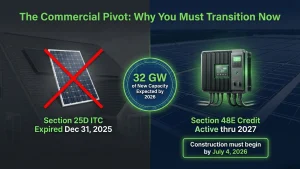
If your pipeline is shifting toward commercial jobs, you already know the residential market changed for good on December 31, 2025. The Section 25D Investment Tax Credit is gone. With tighter residential margins, a growing number of US solar installers and EPCs are pushing into commercial and industrial work — where the Section 48E commercial tax credit still runs through 2027. That is a smart move. But three-phase solar system design is a different discipline than residential single-phase work, and the gap between the two catches a lot of teams off guard.
This guide covers what three-phase commercial solar design actually requires — from inverter configuration and NEC 2026 updates to PE stamp rules and utility interconnection. Read this before you submit your next commercial plan set.
Key Takeaways:
- Three-phase solar systems require three-line diagrams, not single-line diagrams
- NEC 2026 Section 110.16 now mandates arc flash studies on commercial installs
- Most US commercial solar permits require a PE-stamped electrical and structural drawing
- Commercial utility interconnection can take 30 to 120+ days — plan for it upfront
- A solar-specific CRM is what keeps multi-phase commercial projects from stalling between handoffs
What Makes Three-Phase Solar System Design Different
Most US commercial and industrial facilities run on 208V or 480V three-phase electrical service. When you are designing a solar system to interconnect with that service, the engineering complexity goes well beyond a standard 240V residential install.
Here is what changes on every commercial three-phase job:
Inverter selection and phase balancing. Three-phase string inverters or central inverters must match the utility voltage — typically 480V wye or delta. Unbalanced loads across the three legs can trigger protective relay trips and get your interconnection application kicked back. This is not a field fix. It has to be right at the design stage.
Conductor and overcurrent sizing. NEC Article 690 governs PV systems at any scale. On commercial three-phase jobs, Article 705 also applies for interconnected power production sources, and Article 702 comes into play for energy storage backup systems. Getting conductor sizing wrong on a 480V three-phase system means a complete redesign — not a minor correction.
Three-line diagrams. Residential plan sets typically use single-line diagrams. Three-phase commercial systems require three-line diagrams showing individual phase connections, phase-to-phase voltages, and point-of-interconnection details. This is one of the most common plan set deficiencies that AHJs flag when residential-experienced teams submit their first commercial package.
Structural load documentation. A flat TPO roof on a warehouse in Georgia carries different dead load and wind uplift requirements than a standing seam metal roof in Colorado. Your plan set must document both, and in most commercial jurisdictions, a structural PE stamp is mandatory.
NEC 2026 Changes That Hit Commercial Three-Phase Jobs Directly
If your team is still running 2023 NEC templates on commercial work, you are already generating first-submission failures you are not expecting. The 2026 NEC edition introduced three specific changes that affect commercial three-phase solar directly.
Arc flash labeling under Section 110.16. Previously, a generic arc flash hazard label was acceptable. Under NEC 2026, commercial system labels must now include system voltage, arc flash boundary, incident energy or required PPE category, and the date of assessment. In practice, that means most commercial solar jobs now require a formal arc flash study or power system study before the permit package is complete. This adds a real line item to your pre-construction budget — and missing it means an AHJ correction that costs you 7 to 14 days.
Section 705.11 supply-side interconnection updates. The 2026 code further clarified how PV systems connect to the service, directing installers to specific overcurrent protection and disconnecting means requirements. These must appear in the plan set and be confirmed at inspection.
Bi-facial module current calculations (Section 690.8). The 2026 code added a new method for calculating maximum circuit current that uses manufacturer instructions — especially relevant for bi-facial panels now common on commercial rooftops. If you are specifying bi-facial modules, your electrical calculations need to reflect this updated methodology or the plan set will not hold up under review.
AHJs across the country are enforcing these 2026 updates now. Teams using last cycle’s templates are finding out the hard way.

PE Stamp Requirements on Commercial Solar Permits
Here is something that surprises a lot of installers moving up from residential work: most commercial solar permits in the United States require both a structural and an electrical PE stamp. Not every jurisdiction, not every job — but enough that assuming you do not need one is a costly gamble.
Commercial AHJ reviewers expect IBC compliance on structural drawings, NEC 690 and 705 adherence on electrical sets, and NFPA 70E documentation for electrical safety. Additionally, many commercial projects trigger a separate building permit that runs parallel to the electrical permit — something that almost never comes up on residential jobs.
The PE stamp also matters beyond the permit. Bankable commercial projects need engineering documentation that survives lender and insurance underwriter scrutiny. A plan set without a PE stamp can delay financing draws and push your PTO date out by weeks.
EnergyScape Renewables holds PE licenses across all 50 states and delivers PE-stamped commercial plan sets with 24-hour turnaround. Their 99% AHJ first-submission approval rate means the resubmission cycles that eat your timeline stop before they start.
Utility Interconnection: Plan for It Before the Panels Go Up
Commercial utility interconnection is routinely the longest and least predictable part of a three-phase solar project. According to SEIA data, some commercial systems in high-demand grid areas wait over 120 days for interconnection approval. That is revenue sitting idle and clients losing patience.
The triggers for extended timelines are mostly preventable. Incomplete electrical diagrams at the initial application, inverter certifications not aligned with IEEE 1547-2018 utility requirements, and POI selections that force a system impact study are the three biggest culprits.

Under the current OBBBA framework, commercial and C&I solar systems qualify for the Section 48E credit through the end of 2027 — but only if construction begins before July 4, 2026. A 120-day interconnection stall eats directly into that window. The fix is treating interconnection as a design input, not a post-installation checkbox.
EnergyScape Renewables’ interconnection services handle the utility coordination and documentation layer so your team is not navigating it blindly on each new commercial job.
The Workflow Gap That Kills Commercial Project Timelines
Even when the engineering is solid, commercial solar projects stall between phases. Sales closes the deal. Design runs a layout. The files get emailed to engineering. Redlines come back. Someone updates the plan set manually. The permit package gets assembled from a folder full of email attachments. Meanwhile, three other jobs are in flight and nobody knows which one is the priority.
That workflow holds at low volume. At 10 to 20 commercial projects simultaneously, it breaks down fast.
Sunscape Solar is a solar CRM and project management platform built specifically for US installers and EPCs. It tracks every project milestone from site survey through PTO, automates handoff triggers between design, engineering, and permitting, and gives your team a single source of truth on every job in the pipeline — whether it is a 15 kW commercial rooftop or a 500 kW ground mount. When EnergyScape sends back a stamped plan set, it does not sit in an inbox. The next workflow step fires automatically.
According to recent EIA projections, roughly 32 GW of new solar capacity is expected to come online through 2026 — driven by data centers, commercial growth, and industrial electrification. The installers who capture that commercial volume will be the ones who run clean, connected workflows. The ones running commercial jobs on residential spreadsheet systems will absorb the cost of coordination failures until the margin is gone.
Ready to Run Commercial Solar Jobs Without the Engineering Delays?
Three-phase commercial solar is where US market opportunity lives in 2026. But it demands engineering infrastructure that most residential-first operations are not set up for. The right partners close that gap without requiring you to build internal PE capacity in every state you operate.
EnergyScape Renewables — PE-stamped structural and electrical drawings, NEC 2026-compliant commercial plan sets, interconnection packages, and 24-hour turnaround across all 50 states. 99% AHJ first-submission approval rate. 188,520+ projects completed. When your commercial three-phase plan set needs to be right the first time, EnergyScape is the engineering partner that delivers.
👉 Get your commercial plan set quote → energyscaperenewables.com
Sunscape Solar — Solar CRM and project management built for US installers and EPCs running commercial volume. From first site survey through utility PTO, Sunscape tracks every milestone, automates every handoff, and keeps your team on top of every project in the pipeline — without the spreadsheet chaos.
👉 See how Sunscape manages commercial pipelines → sunscape.solar
Frequently Asked Questions: Three-Phase Solar System Design for Commercial Installs
Q: What size commercial solar system requires a three-phase design? A: Most US commercial buildings over 10–15 kW operate on three-phase service. Any solar system designed to interconnect with a three-phase service must use three-phase inverters and three-phase electrical design, regardless of system size. If the building’s utility meter is three-phase, your solar design must match it.
Q: Do I need a PE stamp for a commercial solar installation? A: In most US jurisdictions, yes. Commercial solar permits typically require a licensed professional engineer to stamp both the structural and electrical drawings. Requirements vary by state and AHJ, but submitting without a PE stamp on a commercial job is the most common reason for first-submission failures. When in doubt, stamp it.
Q: What changed in NEC 2026 for commercial solar systems? A: The three changes with the biggest impact on commercial installs are: (1) arc flash labeling under Section 110.16 now requires a formal power study with specific incident energy data, (2) Section 705.11 refined supply-side interconnection requirements, and (3) Section 690.8 added a new current calculation method for bi-facial modules. All three affect plan set documentation directly.
Q: How long does commercial solar utility interconnection take in the US? A: For mid-sized commercial systems, utilities typically estimate 30 to 60 days for initial review. However, if a Point of Interconnection (POI) study or system impact analysis is triggered, that timeline extends to 60 to 120+ days. Submitting complete, compliant documentation on the first application is the single most effective way to stay on the shorter end of that range.
Q: What is the difference between a single-line and a three-line diagram for solar? A: A single-line diagram shows the system’s electrical components and connections in a simplified representation — one line per conductor set. A three-line diagram shows each individual phase conductor separately, including phase-to-phase voltages, current ratings per phase, and protection device details. AHJs reviewing commercial three-phase solar systems require three-line diagrams. Submitting a residential-style single-line on a commercial job is a common correction trigger.
sjayakanth@energyscaperenewables.com