
Solar PE Stamping + CRM: Cut Solar Project Timelines 3 Weeks

PE Stamping + CRM: How Integrated Engineering Services Cut Project Timelines by Up to 3 Weeks
Solar PE stamping CRM integration is the most overlooked speed advantage in the US solar industry today. Most installers fix one side of the equation. They speed up their engineering. Or they buy a CRM. But they rarely connect both — and that gap is exactly where 3 weeks per project silently disappear.
If you’re closing 6 to 8 jobs a month but your pipeline could handle 15, this article is for you. The bottleneck isn’t your crew. It isn’t your sales team. It’s the dead space between when your PE-stamped plan set lands and when your operations team actually knows what to do next.
Let’s fix that.
What Fast PE Stamping Actually Solves (And Doesn’t)
Energyscape Renewables delivers PE-stamped plan sets across all 50 states in 24 to 48 hours. Their AHJ first-submission approval rate sits at 99%, and every deliverable is built to current [NEC 2026 code standards][OL-1]. For a residential project, that drops your engineering cost from $530–$810 per project (in-house) down to $150–$400 (Energyscape Renewables).
That’s a real operational advantage. But it’s only half the picture.
Fast PE stamping compresses the front end of your timeline. This eliminates resubmissions. Then it removes the cost and complexity of maintaining in-house engineering staff who have to keep up with [PE stamp requirements][IL-2] across 20,000+ permitting jurisdictions nationwide. This lets your team use [SolarAPP+][OL-2] or jurisdiction-specific documentation without building that knowledge internally.
What it does not do:
- Trigger your project manager when a stamped set is ready to submit
- Track live AHJ status across all your open projects
- Alert your scheduler when permits clear
- Send automated updates to your customer
- Flag when a project is about to slip its deadline
Fast engineering is a speed tool. Fast engineering inside a solar CRM is a timeline-compression machine. The difference is whether your operations match your engineering.

Why Solar Project Delays Start After Engineering — Not Before
Here’s what most solar installers don’t track: 20% of solar installations in the US experience project delays (Energyscape Renewables). Most of those delays don’t happen on the roof. They happen in the handoff.
Think about the typical sequence. This makes your PE-stamped plan set comes back approved. Then it sits in someone’s inbox for two days. After that, your permit coordinator doesn’t know it arrived. This will result in your installation scheduler not knowing that the permit cleared. Finally, customer is calling the office for an update that nobody can give.
This is a [solar permitting delays][IL-1] problem that better engineering alone can’t solve. You also need a system that catches the ball the moment engineering is done.
One missed handoff costs you days. A resubmission due to missing or incomplete engineering documents costs you 1 to 2 full weeks per project (Energyscape Renewables). Multiply that across your active pipeline, and you’re looking at serious revenue leakage — month after month.
The CRM Layer: Where Speed Becomes a Repeatable System
Solar CRMs can cut project delays by up to 40% through intelligent task sequencing, automated document management, and compliance tracking built for the solar workflow (Energyscape Renewables). However, that number only shows up when the tool was designed for solar — not when you’re running your pipeline through a generic platform that tops out at five deal stages.
A solar project runs 10 to 12 stages between lead capture and Permission to Operate. Site survey. Design approval. PE stamp submission. Permit submitted. Permit approved. Installation scheduled. Inspection passed. PTO issued. Each of those stages carries specific tasks and handoff triggers. When your [solar project management software][IL-3] can’t distinguish “Permit Submitted” from “Permit Approved,” you’re flying blind on your own jobs.
Sunscape Solar was built for exactly this workflow. It’s a project management platform and CRM designed specifically for US solar installers and EPCs. Sunscape connects live project tracking — from lead capture to PTO — with design tool integrations, automated workflow management, and a site survey app that feeds directly into your engineering queue. When Energyscape sends back a stamped plan set, it doesn’t wait in an inbox. It moves through your pipeline and triggers the next action automatically.
The ROI case is well established. CRM systems deliver $8.71 for every dollar spent — but only when the tool fits the business model (Energyscape Renewables). Generic platforms don’t capture that return in solar. Purpose-built ones do.
Together, Energyscape and Sunscape form a closed-loop workflow. Design in Sunscape. Engineer with Energyscape. Permit, track, and close in Sunscape. No manual handoffs, No dropped details, No customers asking where their project stands because your team doesn’t know either.
Where Up to 3 Weeks of Time Savings Originates
The time savings from this model are not the result of one dramatic shortcut. They are the cumulative elimination of small delays that compound across every project in the pipeline.
| Delay Source | Traditional Workflow | Integrated Workflow |
|---|---|---|
| Locating a state-licensed PE | 3 – 7 days | Eliminated — all 50 states covered |
| PE stamp turnaround | 5 – 10 days | 24 hours (residential) |
| AHJ resubmission cycle | 7 – 14 days | Near-eliminated |
| Manual permit tracking | Ongoing admin overhead | CRM-automated |
The resubmission factor deserves particular attention. A 99 percent AHJ first-submission approval rate does not simply save the cost of a revision — it eliminates the 7 to 14 days that a resubmission cycle adds to the project clock. For installers managing 20 to 50 projects per month, that pipeline velocity improvement compounds significantly across the full portfolio.
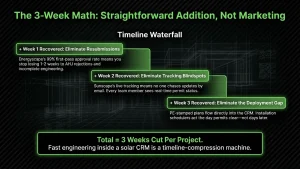
Faster permits mean earlier installation scheduling. Earlier installations mean faster Permission to Operate. Faster PTO means faster payment — and a customer who remains satisfied rather than skeptical of timelines they were promised months earlier.
Why 2026 Is the Year to Fix Both
Five forces are making this urgent right now.
- NEC 2026 enforcement is tightening. Installers using outdated templates are generating first-submission failures they don’t anticipate. Energyscape builds NEC 2026 compliance into every plan set by default.
- IRA incentives are driving volume surges. [IRA solar incentives][OL-3] have pushed project volume to levels that expose every operational gap. Higher volume means every delay costs more.
- Multi-state expansion is a survival strategy. Energyscape holds PE licenses across all 50 states with 24-hour turnaround. Sunscape tracks each project’s AHJ status regardless of state. Together, they let you grow into new markets without building separate engineering infrastructure everywhere you operate.
- Customer expectations have shifted. Solar buyers in 2026 have seen faster timelines from your competitors. Without a CRM delivering proactive updates, trust erodes — and repeat referrals disappear with it.
- The [wet stamp vs. digital PE seal][IL-4] question is active in every state. Enforcement varies. Working with an engineering partner who tracks jurisdiction-specific requirements — and a [solar CRM for installers][IL-5] that documents every submission — protects you from surprises.
Take Control of Your Project Timeline Today
The engineering speed is already available to you. So is the system to track it.
Energyscape Renewables delivers PE-stamped plan sets in 24–48 hours across all 50 states — with a 99% AHJ first-submission approval rate and full NEC 2026 compliance. Stop losing weeks to resubmissions. Get every permit package right the first time.

Sunscape Solar is the project management platform and CRM built specifically for US solar installers and EPCs. Track every project from lead to PTO, automate your handoffs, and never lose a week to untracked permit status again.
Fast engineering. Smart tracking. One connected workflow.
→ Start your next project with Energyscape Renewables → Manage it all in Sunscape Solar
Ready to Cut Up to 3 Weeks from Your Project Timelines?
If permitting delays and engineering coordination are slowing your pipeline, Energyscape Renewables has built the infrastructure to fix it — for installers and EPCs of every size, across all 50 states.
Explore Energyscape’s Full Services →
📞 +1 855-263-0700 ✉️ info@energyscaperenewables.com 🌐 energyscaperenewables.com
Get started today and let Energyscape handle every backend step — so your team stays focused on what it does best: installing solar.
Frequently Asked Questions: Solar PE Stamping
Q: How long does solar PE stamping take? Energyscape Renewables delivers PE-stamped solar plan sets in 24 to 48 hours across all 50 states. Their engineering team covers both structural and electrical stamps with NEC 2026 compliance built in by default.
Q: What causes the most solar permit delays in 2026? The top cause is first-submission rejection due to incomplete or non-PE-stamped engineering documents. A single resubmission adds 1 to 2 weeks to a project. The second most common cause is untracked permit status — when no one on the operations team knows where a permit stands until a customer calls asking.
Q: What is solar PE stamping CRM integration? Solar PE stamping CRM integration means connecting your engineering workflow — where PE-stamped plan sets are created and submitted — directly to your project management system, so every stamped set triggers the right next action automatically. Platforms like Sunscape Solar and engineering services like Energyscape Renewables are built to work together for exactly this purpose.
Q: Do I need a PE stamp for every solar installation? PE stamp requirements vary by state and AHJ. Most commercial systems over 10–15 kW require them nationwide. Residential requirements depend on location — Florida requires them for nearly all installs, while California thresholds vary by system size. Enforcement has tightened significantly in 2025–2026, so when in doubt, stamp it.
Q: What does a solar CRM do that a general CRM doesn’t? A purpose-built solar CRM like Sunscape Solar tracks the 10 to 12 project stages specific to solar — from site survey and design approval through PE stamp submission, permitting, installation, inspection, and PTO. Generic CRMs are built for 3 to 5-stage sales cycles. They treat contract signing as the finish line. In solar, it’s the starting line.
sjayakanth@energyscaperenewables.com