
Solar Plan Set Cost: In-House vs. Outsourced Math (2026)
Solar Plan Set Cost: The True In-House vs. Outsourced Math for 2026
Your solar plan set cost is probably higher than you think. Most installers take a drafter’s salary, divide it by projects, and stop there. However, that quick math hides the expenses that actually shape your margin. So let’s break down the true solar plan set cost for 2026, compare in-house against outsourced, and find the point where each one wins.
What does a solar plan set cost in 2026?
An outsourced, PE-stamped residential plan set runs about $150 to $400 for stamping, or $1,200 to $2,000 for a full permit-ready package. Commercial and ground-mount sets start near $3,700. In-house, the same residential set costs roughly $530 to $810 once you load in every real expense.
Here’s the quick comparison every installer should see first.
| Cost factor | In-house | Outsourced |
|---|---|---|
| Price per residential set | $530–$810 (loaded) | $150–$400 stamp / $1,200–$2,000 full |
| Payment model | Fixed salary, paid monthly | Pay per project |
| Multi-state coverage | One state per PE license | All 50 states |
| Slow-season cost | Full payroll | $0 |
| Typical turnaround | Varies by workload | 24–48 hours |
The sticker price is only half the story. The rest hides behind that in-house number.
The six hidden costs behind your true solar plan set cost
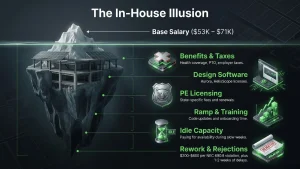
Base salary is the part everyone counts. It’s also the cheap part. A solar designer earns about $53K to $71K in base pay, but the loaded, all-in cost lands closer to $85K to $110K a year. Here’s where the extra money goes:
- Benefits and payroll taxes. Health coverage, PTO, and employer taxes stack on top of salary.
- Design software. Aurora, HelioScope, and similar tools keep climbing as a soft cost.
- PE licensing. Every state license carries its own fee and renewal.
- Ramp and training. A new hire isn’t productive on day one, and code updates never stop.
- Idle capacity. A salaried drafter still gets paid on slow weeks, sick days, and vacations.
- Rework and rejections. This is the cost almost nobody tracks.
That last one hurts. NEC 690.8 violations alone drive roughly 30–40% of solar permit rejections nationwide. Each resubmission adds about $200 to $600 in AHJ fees and rework. Worse, a single rejection can stall a job by one to two weeks. At the top end, a rejected project costs $2,000 to $5,000 once you count admin time, crew rescheduling, and client delays. We break these figures down further in our guide to PE stamp costs for solar projects.
Now divide that real annual cost by the sets your team actually ships. Suddenly your solar design cost per project looks very different.
The break-even point: when does in-house win?
In-house isn’t always the loser. The math simply flips at volume.
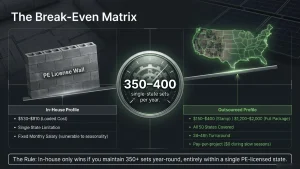
The rough break-even sits at 350 to 400 single-state plan sets per year. Below that line, outsourcing wins on cost alone. Above it, an in-house drafter can pencil out — but only when two things hold true. First, your volume stays steady. Second, it stays inside one state where your PE holds a license. Keep a drafter busy year-round in a single market, and your cost per plan set can drop below the outsourced rate. Most installers, though, don’t get those conditions.
Two variables that break the in-house math
Seasonality. Your January pipeline looks nothing like your June pipeline. Still, a salaried drafter costs the same in both months. So you pay for availability, not output. Outsourced plan sets flex with your workload instead — zero projects means zero engineering cost.
Multi-state work. A PE licensed in Texas can’t stamp plans in Florida or California. The moment you cross state lines, one license becomes a wall. And with over 20,000 permitting jurisdictions nationwide, no in-house team can hold that AHJ knowledge at scale. A nationwide partner stamps in all 50 states without adding a single license to your books. Our solar permitting outsourcing guide digs into how teams manage that jump.
Why 2026 raises the stakes on plan set pricing
Three shifts make this the year to recheck your numbers.
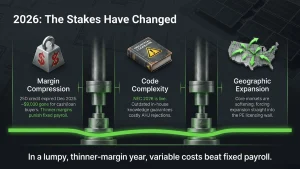
- The 25D residential tax credit expired on December 31, 2025. Cash and loan buyers now get $0 federal credit — about $9,000 gone on a typical $30,000 system. As a result, demand got lumpier and margins got thinner, which punishes fixed payroll.
- NEC 2026 is live. Teams that aren’t current on code trigger more of those costly rejections. Both SEIA and NREL track how rising soft costs squeeze installer P&Ls.
- Installers are expanding. As core markets like California and Texas soften unevenly, more teams cross state lines — straight into the PE licensing wall.
In a lumpy, multi-state, thinner-margin year, a variable solar plan set cost beats a fixed one for most installers.
Run your own numbers — then close the loop
The true solar plan set cost differs for every installer. Still, the pattern holds: if your volume is uneven or you work in more than one state, outsourcing almost always wins on cost and speed.
That’s where Energyscape Renewables fits in. We deliver PE-stamped plan sets, permitting, interconnection, and PTO support in 24–48 hours across all 50 states, with a 99% AHJ first-submission approval rate. In short, you turn engineering into a cost that flexes with your pipeline instead of a salary that runs all year. See how it works at Energyscape Renewables.
Outsourcing only works when you never lose sight of a project, though. So keep every stamped set moving with Sunscape, the CRM and project management platform built for US solar installers and EPCs. Hand off the design, then watch each job advance from lead to PTO on its own — no dropped handoffs, no weeks lost in an inbox. Explore it at Sunscape.
Fast engineering, full visibility, and a solar plan set cost you can finally trust. Start your next project today.
Frequently asked questions
How much does a solar plan set cost?
An outsourced residential set runs about $150–$400 for PE stamping and $1,200–$2,000 for a full permit-ready package. In-house, the loaded cost sits near $530–$810 per project after salary, benefits, software, and idle time.
Is outsourcing solar plan sets worth it for small installers?
Usually yes. Small teams rarely have the steady, single-state volume to justify a full-time drafter. So pay-per-project keeps engineering a cost that moves with revenue.
What’s the hidden cost of an in-house solar drafter?
Idle time and rework. You pay full salary through slow months, and each permit rejection adds $200–$600 in fees and labor before downstream delays.
When does in-house drafting actually pay off?
Around 350–400 single-state sets a year, with steady volume in one PE-licensed state.
sjayakanth@energyscaperenewables.com