
Solar Permit Requirements by State: What Changes in 2026?

Solar Permit Requirements by State 2026: What Changes When You Cross State Lines (And What It’ll Cost You If You Don’t Know)
Solar permit requirements by state in 2026 are more fragmented, more consequential, and more easy to get wrong than at any point in the industry’s history. If you’ve built a solid operation in your home state — clean submissions, consistent AHJ approvals, a crew that runs on schedule — that’s real. But here’s what nobody tells you before your first out-of-state job: the permit package that’s worked a hundred times at home can be the exact thing that gets you rejected two states over.
That rejection doesn’t show up on the install. It doesn’t show up on the sales call. It shows up at the permit desk of a jurisdiction you’ve never touched — three weeks after submission, with your crew sitting idle and your client calling.
This is the most common way growing solar installers and EPCs bleed margin on expansion. And in 2026, the stakes have never been higher.
There Is No Unified Solar Permitting Framework in the US
Before anything else, understand this ground truth: there is no single national solar permitting standard. Each state sets its own baseline, and within each state, individual Authorities Having Jurisdiction (AHJs) — city and county building departments — layer on additional requirements on top of that.
There are over 20,000 permitting jurisdictions across the United States. What passes in Charlotte may get flagged in Raleigh. What sails through Austin can stall in Houston. A plan set that’s clean in Los Angeles means nothing in New York City.
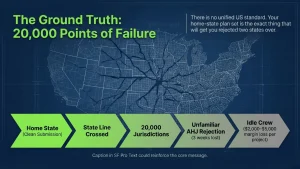
This isn’t an exaggeration. It’s the operating reality every multi-state installer runs into — usually on their second or third out-of-state project, after the first one already hurt.
The 5 Variables That Change When You Cross State Lines
1. PE Stamp Thresholds Vary Dramatically by State
PE licensing is state-specific. A Professional Engineer licensed in Texas cannot legally stamp plans in Florida or California. The moment you expand into a new market, your in-house engineer’s credential no longer applies to that job.
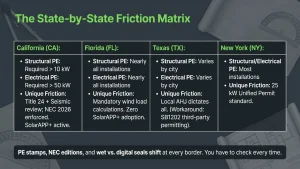
Here’s how dramatically the thresholds shift solar permit requirements by state:
| State | Structural PE Stamp | Electrical PE Stamp | Key Notes |
|---|---|---|---|
| California | Required above 10 kW | Required above 50 kW | Title 24 + seismic review; NEC 2026 enforced |
| Florida | Nearly all installations | Nearly all installations | Wind load calculations mandatory statewide |
| Texas | No statewide standard | No statewide standard | Verify with specific AHJ every single time |
| New York | Most installations | Most installations | Unified Permit covers up to 25 kW DC |
Many installers report rejection costs ranging from $2,000 to $5,000 per project — and that’s before crew rescheduling and client delay penalties enter the picture. The cost of getting this wrong scales fast in unfamiliar markets.
For a deeper breakdown of PE stamp requirements across all 50 states, see EnergyScape’s guide to PE stamp requirements for solar →
2. Wet Stamp vs. Digital PE Seal — The Format Matters
The solar permit process runs more digitally in 2026, and many AHJs now accept — or actively prefer — a certified digital PE seal. But “many” is not “all.” Submit a digital seal to a jurisdiction that still requires a wet stamp and you lose two to three weeks while the submission sits untouched. Submit a wet stamp where the AHJ has moved fully digital, and you create a different kind of friction. You have to know what that specific AHJ expects — not what your home state does.
3. The NEC Edition in Force Isn’t Consistent Across States
This one catches even experienced installers off guard. The 2023 NEC adoption is on indefinite delay statewide in North Carolina, so most AHJs there still reference the 2020 NEC with NC amendments. Meanwhile, California is actively enforcing NEC 2026, and more jurisdictions across the country adopt NEC 2026 solar requirements every month.
That means the same plan set template — built to one NEC edition — can be fully compliant in one state and immediately rejected in the next. There is no shortcut here. You have to check the edition in force for every new jurisdiction you enter, every time.
Read more: What NEC 2026 Means for Your Solar Plan Sets →
4. SolarAPP+ Adoption Is Not Nationwide
California leads the nation in permitting modernization. Jurisdictions including Fresno, San Francisco, and Stockton have deployed SolarAPP+ for instant digital approvals. Cities like Los Angeles, Oakland, Sacramento, and San Jose offer same-day in-person solar permitting under AB 2188, California’s Solar Permitting Efficiency Act.
Outside California, the picture changes sharply. Florida has no SolarAPP+ adoption in any jurisdiction — manual submissions are the statewide standard. If you’ve built your California workflow around instant approvals and then move into a manual-submission state without adjusting your timeline, you’ll miss commitments you’ve already made to clients.
5. State-Specific Regulatory Workarounds You Probably Don’t Know Exist
Texas is the clearest example here. Texas passed SB1202, which lets installers bypass a difficult local AHJ through a third-party permitting pathway. For jurisdictions where standard code requirements create friction, this route is a practical solution — but only if you know it exists. Most out-of-state installers entering Texas for the first time submit directly to the local AHJ, hit resistance, and absorb the delay or walk away from the project.
For the full rundown on how Texas permitting actually works city by city, see EnergyScape’s guide to scaling solar installation across multiple states →
Why 2026 Raises the Stakes Higher Than Any Previous Year
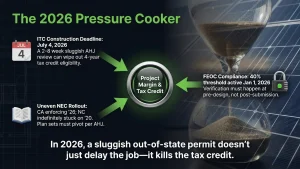
The ITC Construction Deadline. Commercial and industrial EPCs must begin construction by July 4, 2026, to lock in the Investment Tax Credit’s four-year window. AHJ reviews run 2–8 weeks depending on jurisdiction. Add utility interconnection, inspections, and weather delays, and a sluggish permit submission on an out-of-state job can wipe out tax credit eligibility entirely.
Uneven NEC 2026 Rollout. There is no single answer to what NEC edition your target jurisdiction is enforcing. You have to check every time. An installer working confidently with NEC 2023-compliant plan sets may walk into a jurisdiction that’s already on 2026 — or one still on 2020.
FEOC Compliance Is Now a Pre-Design Checkpoint. Starting January 1, 2026, commercial and industrial projects must source at least 40% of manufactured product value from non-FEOC suppliers — a threshold that climbs 5% annually through 2029. If your design uses non-compliant equipment, you lose tax credit eligibility even after AHJ approval. FEOC verification must happen before design finalization, not after the plan set is out the door. Multi-state installers juggling different equipment suppliers across different markets carry the highest exposure here.
The Fix: One Engineering Partner, Licensed Across All 50 States
Solar permit requirements by state:
Every variable described above has the same root cause: fragmented regulatory infrastructure that requires local knowledge to navigate. Every new market you enter means a new engineering relationship to build — unless it doesn’t.
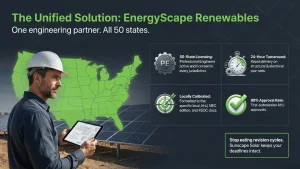
That’s the operational problem EnergyScape Renewables was built to solve. With Professional Engineers licensed and active in all 50 states, EnergyScape delivers PE-stamped structural and electrical plan sets with 24-hour turnaround — already calibrated to the NEC edition in force for the specific AHJ, formatted to what that jurisdiction accepts, and built with FEOC compliance documentation included from the start. A 99% first-submission AHJ approval rate means you’re not eating revision cycles on out-of-state work.
When you’re running jobs across multiple jurisdictions simultaneously, Sunscape Solar keeps your entire pipeline organized — from permit submission tracking to interconnection deadlines to PTO milestones, all in one place. No spreadsheet juggling across three states. No missed deadlines.
One engineering partner. One project management platform. One operational foundation — built for the way US solar businesses actually grow.
Book A Demo With Energyscape Renewables >
Frequently Asked Questions: Solar Permit Requirements by State 2026
Does Florida require a PE stamp for solar installations?
Yes. Florida requires PE stamps on virtually all solar installations, with wind load calculations mandatory due to hurricane zone regulations. There are no size-based exemptions — assume a PE stamp is required on every Florida job.
Does Texas require a PE stamp for solar?
Texas has no statewide PE stamp requirement for solar. Requirements vary city by city. Major metros like Houston and Dallas typically require PE stamps for commercial projects, while requirements in other areas differ. Verify with the specific AHJ on every Texas job before submission.
What NEC edition is North Carolina using for solar in 2026?
Most North Carolina AHJs still reference the 2020 NEC with NC amendments. The 2023 NEC adoption is on indefinite delay statewide. Do not assume NEC 2026 or 2023 compliance will be accepted without confirming with the specific jurisdiction.
What is SolarAPP+, and which states have adopted it?
SolarAPP+ is an automated permit approval tool developed by the US Department of Energy’s NREL that issues instant permits for eligible residential solar systems. California leads adoption, with cities including Fresno, San Francisco, Stockton, Los Angeles, and Oakland deployed or piloting. Most other states, including Florida, have not adopted it.
How much does a solar permit rejection typically cost?
Solar permit rejections typically cost between $2,000 and $5,000 per project in revision fees, administrative time, and crew rescheduling — not including client relationship damage or schedule delays.
What is Texas SB1202?
Texas SB1202 allows solar installers to bypass a difficult local AHJ by using a state-approved third-party permitting pathway. It’s a practical workaround for high-friction jurisdictions, but most out-of-state installers aren’t aware it exists.
sjayakanth@energyscaperenewables.com