
Solar Permitting in 2026: What’s Changed & What Every Installer Needs to Do?
Solar Permitting in 2026 Changed the Rules — Are You Keeping Up?
Your permit packages are taking longer. Your AHJ is asking questions it never asked before. And your equipment list may now be a compliance liability. Solar permitting in 2026 sits at the center of all three problems — and missing the shifts underneath them can cost your business weeks, clients, and tax credit eligibility. Fortunately, the installers who adapt fast are already cutting approval times and protecting margins. So, this guide breaks down every major change in the solar permit process and tells you exactly what to do about each one.
NEC 2026 Solar Updates Are Now the Standard — Know What Changed
The 2026 National Electrical Code rolled out real, field-level changes that affect every plan set you submit. As a result, more AHJs across the country now adopt NEC 2026 solar requirements every month. Catch up now, or face revision cycles that cost you weeks.
Section 690.4(G): The Rounding Rule That Speeds Up Approvals
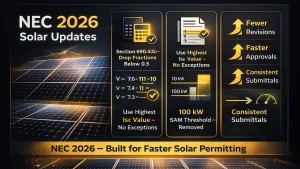
NEC 2026 added Section 690.4(G) — a rounding rule for PV system calculations. Simply put, drop fractions below 0.5 from final voltage and amperage values. Before this rule, ambiguous rounding triggered revision requests even on sound designs. Now, however, your team and the plan reviewer share the same code reference. Consequently, you get fewer debates and faster solar permit approval.
Short-Circuit Current Calculations Got Stricter
NEC 2026 requires engineers to use the highest Isc value from the datasheet or installation manual — no exceptions. Previously, some teams used lower values to size conductors more leniently. That flexibility is now gone. As a result, expect slightly higher design costs on select systems. On the upside, though, your submittals come out cleaner and draw far less scrutiny from plan reviewers.
The 100 kW Threshold for SAM Modeling No Longer Applies
Previously, only projects above 100 kW could calculate PV source circuit currents using modeling tools like SAM. NEC 2026 removes that minimum entirely. Therefore, small and mid-sized commercial projects now access the same streamlined solar permitting for installers pathway that larger projects have used for years. As a result, plan submittals become more consistent and jurisdictional friction during review drops significantly.
FEOC Rules Are Affecting Solar Permitting — Here’s the Direct Connection
Most installers think of FEOC as a procurement problem. In reality, it’s also a solar permit process problem. Starting January 1, 2026, commercial and industrial projects must source at least 40% of manufactured product value from non-FEOC suppliers. Moreover, that threshold climbs 5% annually, hitting 60% by 2029. For batteries, the requirement already starts at 55% non-FEOC content this year.
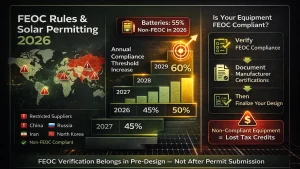
Here’s where solar permitting in 2026 gets even more complicated. If your design reflects non-compliant equipment, you lose tax credit eligibility — even after the AHJ approves the permit. Therefore, FEOC verification must happen before design finalization, not after. Specifically, build it into your pre-design checklist and document manufacturer certifications. In short, get this right before the plan set exists, not after it goes out the door.
The July 4, 2026 Construction Deadline Creates a Permitting Bottleneck
Commercial and industrial EPCs must begin construction by July 4, 2026, to lock in the ITC four-year window. Otherwise, projects must reach energization by December 31, 2027. That gives you under 18 months from contract signing to PTO — with zero buffer for permitting delays.
Meanwhile, AHJ reviews run 2–8 weeks depending on jurisdiction. Add utility interconnection, inspections, and weather delays, and a sluggish permit submission can wipe out credit eligibility entirely. For that reason, treat your solar permit approval submission as a critical-path item — not an administrative step. In fact, incomplete packages, wrong equipment specs, and missing PE stamps drive the top three rejection reasons. Each rejection costs $2,000–$5,000 before crew rescheduling even factors in.
Digital PE Stamps vs. Wet Stamps: Verify What Your AHJ Accepts
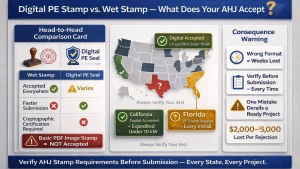
The solar permit process runs more digitally in 2026, but acceptance rules still differ by jurisdiction. In many cases, AHJs now accept — and some actively prefer — a certified digital PE seal. However, the key word here is certified. A basic image of a stamp dropped onto a PDF simply does not meet the standard most jurisdictions require.
For example, California accepts digital PE seals across most jurisdictions and even offers expedited permitting for systems under 10 kW. Florida, on the other hand, requires PE stamps on virtually every installation. Texas has no statewide framework at all — meaning requirements shift city to city. Therefore, for high-volume EPCs working across multiple states, verifying AHJ-specific requirements before submission is non-negotiable. Submit the wrong format and you lose weeks on a project that was otherwise ready to go.
What Winning Installers Do Differently in the 2026 Solar Permit Process
The top performers in the current solar permitting for installers environment share a few clear habits. First, they verify FEOC-compliant equipment before design finalization — not during it. Second, they run LiDAR-quality site data instead of satellite estimates, which cuts revision cycles and gives AHJs accurate geometry, pitch, and shading from day one. Additionally, they submit NEC 2026-compliant plan sets with PE stamps built in from the start — not retrofitted to meet the code later.

As a direct result, fewer revision cycles lead to faster permit approvals. Faster approvals, in turn, mean faster installations. And faster installations ultimately mean healthier margins. In 2026, speed in solar permitting connects directly to your business health — and that connection is only getting stronger.
How EnergyScape Renewables Helps Installers Stay Ahead of Solar Permitting in 2026
Navigating solar permitting in 2026 demands an engineering partner already built around the new rules — not one scrambling to catch up. That’s precisely where EnergyScape Renewables steps in.
EnergyScape delivers PE-stamped structural and electrical drawings, NEC 2026-compliant plan sets, and complete permitting packages for solar installers and EPCs across all 50 states. Furthermore, their engineers build FEOC compliance documentation directly into every design package. As a result, your submittals go to the AHJ ready to approve — not ready to revise. With 24-hour turnaround on plan sets and a multi-state PE licensing network, EnergyScape eliminates the local-engineer search every time you enter a new market.
In addition, for installers who want to manage the full project lifecycle — from proposal to permit tracking to PTO — Sunscape Solar connects directly to your engineering workflow and keeps every deadline, document, and project status organized in one place.
Ultimately, the installers moving fast on solar permit approval in 2026 aren’t cutting corners. Instead, they’re working with partners who already know the rules — and that makes all the difference.
sjayakanth@energyscaperenewables.com