
Solar Permit Rejections: Fix Incomplete Electrical Diagrams in 2026
Solar Permit Rejected for Incomplete Electrical Diagrams? Here’s Exactly Why — and How to Fix It
You put in the site survey. You ordered the equipment. Your crew is lined up — and then the rejection notice lands. Reason: solar permit rejected for incomplete electrical diagrams. If that scenario sounds familiar, you are not alone, and you are not out of options.
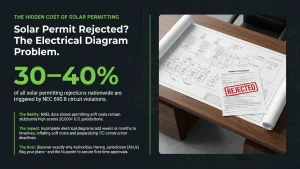
Electrical diagram deficiencies are one of the most common permit rejection triggers across U.S. jurisdictions. According to industry permitting data, NEC 690.8 circuit violations account for an estimated 30–40% of all solar permitting rejections nationwide. The frustrating part is that most of these rejections are completely preventable.
Your local Authority Having Jurisdiction (AHJ) is not trying to slow you down. They are reviewing your plan set against NEC Article 690 and local code amendments. When your diagrams do not meet those standards, the permit does not move. This guide explains the specific diagram deficiencies that trigger rejections, what NEC Article 690 requires, and how to get first-time AHJ approval on every project.
Why Electrical Diagrams Trigger Solar Permit Rejections Most Often
Every permit package you submit includes a site plan, structural calculations, equipment cut sheets, and electrical diagrams. Of all these documents, electrical diagrams receive the most scrutiny from plan reviewers.
The reason is straightforward. Diagrams are how the AHJ verifies electrical safety before a single wire gets pulled. Reviewers trace the full power path — from PV modules through the inverter, disconnects, and conductors, all the way to the utility interconnection point — and cross-check every callout against NEC requirements and submitted calculations.
When data conflicts — when a breaker size on your one-line does not match the OCPD calculation, or the inverter model shown does not match the cut sheet — the application gets returned. Even small mismatches trigger plan review comments and slow down approvals. Each revision cycle adds weeks to your timeline, costs you crew scheduling, and chips away at your customer’s confidence.
Also worth noting: NREL’s analysis of over 200,000 solar projects found that permitting soft costs remain stubbornly high across the U.S., with review and approval processes across 20,000 distinct jurisdictions adding weeks or months to installation timelines. Incomplete electrical diagrams are a direct driver of that problem.
Related Reading: Solar Site Survey Best Practices to Avoid Delays | How to Get a Permit-Ready Solar Plan Set in 24 Hours Without Hiring In-House EngineersNEC 2023 Solar Code Updates: What Changed for Installers
The 6 Most Common Electrical Diagram Deficiencies That Cause Solar Permit Rejections
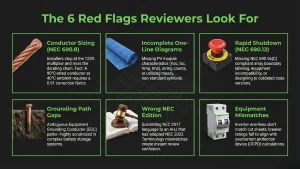
Understanding the specific triggers helps you build diagrams that pass on the first submission. Here are the six issues that show up most often.
1. Incorrect or Missing Conductor Sizing Under NEC 690.8
NEC 690.8 requires conductor ampacity to start from the module’s short-circuit current (Isc), then apply a 125% continuous current multiplier — and that is only step one. You must still apply ambient temperature correction factors and conduit fill derating on top of that. Many installers stop at the 125% multiplier and skip the derating chain. The resulting conductor callout on the diagram is undersized, and reviewers catch it. At 40°C ambient, a 90°C-rated conductor needs a 0.91 correction factor. At 50°C, that drops to 0.82. Those numbers matter on your diagrams.
2. An Incomplete Solar One-Line Diagram
Your solar one-line diagram (SLD) is the electrical roadmap of the entire system. It must show PV modules with string counts and electrical characteristics (Voc, Isc, Vmp, Imp), inverter ratings, all disconnecting means, overcurrent protection devices, conductor sizes, grounding details, and the point of interconnection at the main service panel. Errors or omissions in the SLD are a leading cause for permit rejection. Non-standard symbols, vague string labeling, or hand-drawn diagrams that are messy or hard to read can also trigger a rejection on their own.
3. Missing Rapid Shutdown Documentation
NEC 690.12 rapid shutdown requirements have been in place since the 2014 code cycle, with major updates through the 2020 and 2023 editions. Your diagrams must show the RSD system, include NEC 690.56(C)-compliant labeling that identifies array boundaries, and specify the equipment used. The most common RSD-related permit rejection triggers include equipment compatibility issues, designing to an outdated NEC version, and inadequate or ambiguous labeling on the one-line diagram.
4. Incomplete Grounding Details
A clear equipment grounding conductor (EGC) path and grounding electrode system connection must appear on your diagrams. An ambiguous or missing grounding path is a consistent AHJ flag — especially on battery storage systems where grounding methods are more complex.
5. Wrong NEC Edition for the AHJ
NEC adoption varies significantly by state. Some AHJs are still on NEC 2017 while others have moved to NEC 2023. If your plan set references a different code version than the one the AHJ has adopted, you can expect review comments. NEC 2023 made changes throughout Article 690, including updated scope language and reorganized subparagraphs. Inconsistent terminology between your drawings, placards, and installation notes creates confusion during review, even when the design itself is code-correct.
6. Equipment Mismatches Across the Plan Set
Every equipment callout must be consistent across the full plan set. The inverter on your one-line must match the cut sheet. The battery on the electrical sheet must match the equipment schedule. Breaker ratings must align with OCPD calculations. These mismatches happen when design files are updated without syncing every document in the package — and reviewers are trained to catch them.
What NEC Article 690 Requires on Your Electrical Diagrams
NEC Article 690 covers installation and safety requirements for solar PV systems, defining how circuits must be sized, protected, grounded, and labeled for both stand-alone and utility-interactive systems. Here is what reviewers are checking section by section:
- NEC 690.7(D): Maximum DC voltage marking must appear at the disconnect, the inverter, or associated distribution equipment.
- NEC 690.8: Conductor and OCPD sizing must document the full derating chain — Isc × 125%, plus temperature correction and conduit fill.
- NEC 690.12: Rapid shutdown system, equipment, and compliance method must be fully specified.
- NEC 690.15: All disconnecting means must be clearly shown and labeled.
- Article 705.12: Load-side interconnection must document the backfeed breaker rating and the 120% busbar rule calculation.
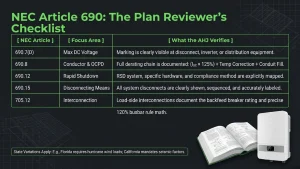
Permit requirements also vary by state. In Florida, plan sets must account for hurricane-force wind loads. In California, seismic factors affect structural and electrical documentation. Massachusetts has specific local amendments that differ from the NEC baseline. Solar engineering firms that work across all 50 states maintain current knowledge of these state-level variations — which is exactly the kind of jurisdiction-specific expertise that separates first-time approvals from repeat rejections.
How to Prevent Solar Permit Rejections Before You Submit
Every diagram deficiency listed above is fixable before the package leaves your office. Here is what the best-run solar installation companies do consistently:
Update your templates to current NEC language. Mixing 2017 and 2023 terminology in the same plan set creates confusion and slows review. Audit your standard templates against the NEC edition your target jurisdictions have adopted.
Run the complete derating chain, not just the 125% multiplier. Document ambient temperature correction factors and conduit fill derating directly on the diagram so reviewers can verify your math without asking questions.
Cross-reference equipment across every document before submitting. The one-line diagram, equipment schedule, and cut sheets must all agree on every model number, rating, and specification.

Know the AHJ before you design. Requirements differ between neighboring jurisdictions. Some AHJs have specific solar forms; others use general electrical permits, and using the wrong one wastes weeks. Build jurisdiction-specific notes into your templates.
Get a PE stamp when the AHJ requires it. Commercial systems over 25 kW typically require an electrical engineering PE stamp on wiring diagrams and interconnection details. Missing a required PE stamp causes an immediate rejection.
Why Licensed Electrical Engineers Produce Diagrams That Pass
There is a clear difference between a diagram that looks complete and one reviewed by a licensed electrical engineer who knows NEC Article 690 in detail. AHJ reviewers recognize that difference quickly.
Professional engineering services ensure permit applications include code-compliant designs, PE-stamped calculations, electrical diagrams meeting current NEC standards, and jurisdiction-specific documentation — preventing the permit rejections and redesigns that commonly delay projects by six to twelve weeks in complex jurisdictions.
That is not just a quality point. On projects tied to financing timelines or the ITC construction deadline, a diagram-level permit rejection has real financial consequences. First-time AHJ approval protects your project schedule, your margins, and your reputation with customers.
Stop Losing Projects to Avoidable Solar Permit Rejections
Incomplete electrical diagrams should not be the reason your project stalls in the permitting queue. EnergyScape Renewables designs PE-stamped, NEC-compliant electrical diagrams built for first-time AHJ approval — across all 50 states, for residential, commercial, and utility-scale PV projects. Licensed electrical engineers handle your one-line diagrams, full permit-ready plan sets, and jurisdiction-specific documentation so your crews can stay focused on installation.

→ Get electrical diagrams that meet NEC standards the first time: energyscaperenewables.com
Managing permit status, revision cycles, and AHJ communication across a full project pipeline is its own job. Sunscape Solar gives solar installers and EPCs a purpose-built CRM platform to track every project from lead to PTO in one place — less chasing paperwork, more closed permits.
→ Manage your full permitting workflow in one place: sunscape.solar
Frequently Asked Questions: Solar Permit Rejections
Why do solar permits get rejected for incomplete electrical diagrams? Solar permits get rejected for incomplete electrical diagrams when the plan set does not meet NEC Article 690 requirements. The most common reasons include incorrect conductor sizing under NEC 690.8, missing rapid shutdown documentation, incomplete one-line diagrams, grounding path gaps, and equipment mismatches between the diagram and cut sheets.
What must a solar one-line diagram include for AHJ approval? A solar one-line diagram must include PV module electrical characteristics (Voc, Isc, Vmp, Imp), string counts, inverter ratings, all disconnects and overcurrent protection devices, conductor sizes, grounding details, rapid shutdown equipment, and the point of interconnection at the main service panel. Every component must use current NEC code language and match the equipment schedule exactly.
What does NEC 690.8 require for solar conductor sizing? NEC 690.8 requires solar conductors to be sized starting from the module’s short-circuit current (Isc), multiplied by 125% for continuous current, then further derated for ambient temperature and conduit fill. All correction factors must be documented on the diagram. Skipping any part of the derating chain is one of the most common causes of solar permit rejection.
Does conductor sizing affect solar permit approval? Yes. Incorrect conductor sizing under NEC 690.8 is the leading NEC-specific rejection trigger, estimated to account for 30–40% of all solar permit rejections nationally. AHJ reviewers verify conductor ampacity calculations as a standard part of electrical plan review.
Do solar electrical diagrams need a PE stamp? It depends on the jurisdiction and system size. Most commercial PV systems over 25 kW require an electrical engineering PE stamp on wiring diagrams and interconnection details. Some states require PE stamps on residential projects as well. Always confirm PE stamp requirements with the specific AHJ before submitting a permit package.
sjayakanth@energyscaperenewables.com