
Solar Math 2026: OBBBA Compliance & FEOC Requirements

Solar Math 2026: The Survival Equation Every US Solar Installer Must Master
Introduction: Why Solar Math 2026 Separates Winners from Closures
Solar math 2026 isn’t about basic ROI calculations anymore. It’s the precise financial engineering that determines whether your solar installation company survives the next 12 months. As a US solar installer or EPC, you’re facing an unprecedented challenge: 157 days until July 4, 2026, impossible compliance requirements, and margin compression that’s already bankrupted major players like Sunnova and Solar Mosaic.
The companies still standing next year will master three critical calculations: timeline compliance to the day, FEOC requirements to the percentage point, and project economics to the penny. Therefore, this guide breaks down exactly what you need to know.

What Changed on July 4, 2025: The OBBBA Solar Deadline
The One Big Beautiful Bill Act fundamentally altered solar project economics. Consequently, understanding these changes isn’t optional—it’s survival insurance.
The July 4, 2026 Construction Deadline Explained
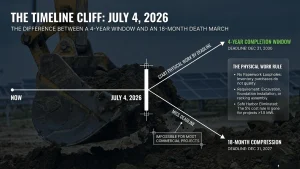
You must demonstrate physical work of significant nature by July 4, 2026. Moreover, “physical work” means actual construction—excavation, foundation installation, or racking assembly. However, simple paperwork or equipment purchases don’t qualify.
Miss this deadline, and your project must be fully energized by December 31, 2027. That’s an 18-month window for installations typically requiring 12-18 months. The math simply doesn’t work.
Start construction before July 4, 2026, and you gain a four-year completion window. For instance, begin construction in early 2026, and you have until December 31, 2030. Therefore, the difference between these timelines determines project viability.
The 5% Safe Harbor Elimination
For projects exceeding 1.5 MW (AC), the 5% cost safe harbor was eliminated on September 2, 2025. Previously, spending 5% of project costs qualified as “beginning of construction.” Now, the Physical Work Test is your only option—and it requires verifiable construction activity.
Small-scale solar projects under 1.5 MW can still use the 5% safe harbor. However, most commercial installations exceed this threshold.
Understanding FEOC Compliance: The 40% Rule That Determines Tax Credit Eligibility
Solar math 2026 includes mastering Foreign Entity of Concern (FEOC) compliance. Starting January 1, 2026, these requirements fundamentally changed commercial solar economics.
What FEOC Requirements Mean for Your Projects
For solar projects beginning construction in 2026, at least 40% of manufactured products must come from non-Prohibited Foreign Entity (non-PFE) sources. Additionally, this percentage increases annually:
- 2026: 40% non-PFE requirement
- 2027: 45% non-PFE requirement
- 2028: 50% non-PFE requirement
- 2029: 55% non-PFE requirement
- 2030+: 60% non-PFE requirement
Calculating Your Material Assistance Cost Ratio (MACR)
The Material Assistance Cost Ratio determines FEOC compliance. Here’s the solar math:
MACR Formula:
(Total manufactured product costs – PFE product costs) ÷ Total manufactured product costs = MACR percentage
Your MACR percentage must meet or exceed the annual threshold. For example, on a $500,000 project in 2026, you need at least $200,000 (40%) from non-PFE sources.
Furthermore, where equipment is assembled doesn’t matter. If a component is assembled in the United States but the manufacturer is owned by entities from China, Russia, Iran, or North Korea, that component counts against your threshold.
View SEIA’s latest solar market analysis including FEOC impact projections
Read about: Build an FEOC Compliance Solar Supply Chain: 2026 Guide

The Domestic Content Bonus: 10% That Could Save Your Margins
While managing FEOC requirements, smart installers are calculating domestic content bonuses. For projects beginning construction after June 16, 2025, you need specific domestic content percentages:
- 2026: 50% domestic content required
- 2027: 55% domestic content required
- Beyond 2027: Percentage continues increasing
That 10% bonus can determine project viability. In today’s market, with compressed margins and elevated equipment costs, this bonus represents real money:
- $500,000 commercial installation = $50,000 bonus
- $2 million utility-scale project = $200,000 bonus
Therefore, these aren’t rounding errors—they’re the difference between winning bids and losing them.
Timeline Compression: Your Biggest Unpriced Risk
Solar math 2026 requires precise timeline management. Most commercial solar projects need 12-18 months from contract to energization:
- Engineering and design: 4-8 weeks
- Permitting and AHJ approval: 8-16 weeks
- Equipment procurement: 12-20 weeks (FEOC-compliant sourcing)
- Construction and installation: 8-16 weeks
- Inspection and interconnection: 4-12 weeks
An 18-month window for 12-18 month projects is aggressive. Moreover, every permitting delay or inspection revision risks project economics. Consequently, engineering expertise becomes survival insurance.
The Continuity Requirement: Documentation From Day One
Starting construction by July 4, 2026, isn’t sufficient alone. You must demonstrate continuous progress until completion. The IRS provides a Continuity Safe Harbor: if your project is placed in service within four calendar years of the construction start year, continuity is automatically satisfied.
However, if unforeseen events delay your project beyond four years, you need documented excusable delays. That documentation starts when you begin construction, not when you need to prove continuity.
What Winning Solar Installers Are Doing Differently in 2026
The solar installers and EPCs thriving in 2026 share these characteristics:
1. They Engineer for Compliance First
FEOC compliance, domestic content calculations, and timeline requirements are integrated into initial project design. Equipment specifications include verified non-PFE certifications before contract finalization.
2. They Document Beginning of Construction
Physical work milestones are photographed, time-stamped, and tied to specific contract deliverables. Tax equity markets are drawing their own lines on “beginning of construction”—having engineering documentation is non-negotiable.
3. They Partner With Precision Engineering Teams
Projects can’t afford permitting delays, design revisions, or compliance failures. Therefore, working with engineering partners who provide PE-stamped designs and FEOC compliance verification isn’t optional.
Your 157-Day Action Plan for July 4, 2026
You have 157 days until July 4th. Here’s the solar math that matters:
Week 1-2: Audit Your Pipeline
Identify which projects can realistically begin physical construction by July 4. Additionally, determine which projects need energization by December 31, 2027.
Week 3-4: Verify FEOC Compliance
Get manufacturer certifications. Calculate Material Assistance Cost Ratios. Furthermore, identify which projects hit the 40% threshold with current equipment specifications.
Week 5-8: Accelerate Engineering
Fast-track PE-stamped designs for priority projects. Submit permit applications. Moreover, identify critical path bottlenecks.
Week 9-12: Document Construction Start
Schedule physical work meeting the Physical Work Test. Photograph excavation, foundation work, or racking installation. Additionally, tie documentation to binding written contracts.

Final Solar Math Calculations
In 2026, the solar industry rewards precision over volume. The installers who can calculate project economics to the penny, timeline compliance to the day, and risk exposure to the percentage point are building sustainable businesses.
The math isn’t changing. The deadlines aren’t moving. Therefore, the only variable you control is adaptation speed.
Work With Solar Math Experts Who Understand 2026 Compliance
You need perfect engineering AND perfect execution. Missing one deadline by a day, miscalculating one percentage by a point, or failing one inspection collapses your entire project economics.
EnergyScape Renewables provides precision engineering that keeps projects on schedule and compliant. Our PE-stamped designs meet exact timeline requirements. Our permitting expertise shaves weeks off critical paths. Furthermore, our engineering calculations prove FEOC compliance and domestic content percentages—giving you documentation before equipment procurement begins.
Visit EnergyScape Renewables to work with engineers who understand that every deadline matters and every percentage point counts.
Sunscape Solar gives you operational control for flawless execution. Track every deadline (December 31, July 4, December 31, 2027). Monitor automated compliance documentation for FEOC and domestic content. Model financial scenarios without tax credit assumptions. Additionally, manage timelines preventing the 18-month construction cliff.
Visit Sunscape Solar to see how project management software built for the post-OBBBA world keeps installers compliant and profitable.
Solar math 2026 is unforgiving. However, with the right engineering partner and operations platform, you can engineer projects that work—and build a business that survives.

Frequently Asked Questions About Solar Math 2026
What happens if I miss the July 4, 2026 deadline?
Projects starting construction after July 4, 2026, must be placed in service by December 31, 2027. This creates an 18-month maximum timeline that’s extremely challenging for most commercial installations.
Can I still use the 5% safe harbor for small projects?
Yes, solar facilities with maximum net output of 1.5 MW or less can still use the 5% safe harbor. However, most commercial installations exceed this threshold and must use the Physical Work Test.
How do I calculate my Material Assistance Cost Ratio?
MACR = (Total manufactured product costs – PFE product costs) ÷ Total manufactured product costs. Your result must meet or exceed 40% in 2026.
What qualifies as “physical work of significant nature”?
Physical work includes on-site excavation, foundation installation, and racking assembly. It also includes off-site work under binding written contracts for project-specific components. However, inventory purchases don’t qualify.
sjayakanth@energyscaperenewables.com