
Build an FEOC Compliance Solar Supply Chain: 2026 Guide

FEOC Compliance Solar: Your Complete 2026 Guide to Protecting Federal Tax Credits
What Is FEOC Compliance Solar and Why It Matters Now
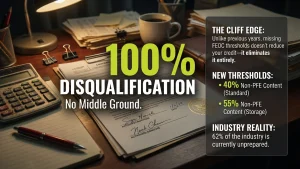
FEOC compliance solar regulations are reshaping how U.S. installers source equipment in 2026. If you’re still purchasing panels the way you did in 2024, you’re risking complete loss of federal tax credits—not a partial reduction, but 100% disqualification.
The One Big Beautiful Bill Act (OBBBA), signed July 4, 2025, introduced Prohibited Foreign Entity (PFE) restrictions that determine whether your solar projects qualify for §48E and §45Y tax credits. Combined with aggressive UFLPA enforcement—which has detained over $3.4 billion in shipments since 2022—installers must now verify both equipment origin and supplier ownership structures.
Here’s what changed: Starting January 1, 2026, your projects must meet material assistance thresholds of 40% non-PFE manufactured products for standard installations and 55% for energy storage. Miss these numbers, and the IRS denies your entire credit claim.
Understanding FEOC Compliance Solar Requirements for Solar Installers
FEOC stands for Foreign Entity of Concern. Under 2026 regulations, it’s now called Prohibited Foreign Entity. Think of it as a two-tier screening system:
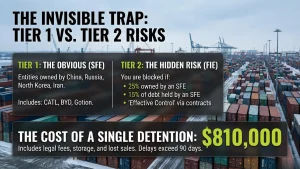
Tier 1 – Specified Foreign Entities (SFE) includes entities 50%+ owned by governments from China, Russia, North Korea, or Iran. It also covers specifically named battery manufacturers: CATL, BYD, Gotion, EVE Energy, and Hithium.
Tier 2 – Foreign-Influenced Entities (FIE) is where most installers get caught. An entity qualifies as FIE if:
- 25% or more is owned by an SFE
- 40% combined ownership by multiple SFEs
- 15% of debt is held by SFE entities
- SFE has “effective control” through contracts or licensing
According to SEIA’s Q4 2025 market insight report, only 38% of solar firms describe themselves as “fully prepared” for FEOC compliance solar requirements. That means 62% of the industry is at risk right now.
The Real Financial Impact of Non-Compliance
Let’s talk dollars. CBP enforcement under UFLPA has become relentless. In 2024, detention rates jumped 25% versus 2023, with 428 shipments detained monthly on average. Electronics—primarily solar equipment—comprised 64% of all detentions.
A single detention case costs up to $810,000 when you factor in:
- Legal fees and CBP protest filings
- Storage and demurrage charges
- Lost sales and project delays
- Customer churn and reputational damage
Moreover, average detention periods exceed 90 days. Some shipments sit for six months or longer. According to DOE’s Foreign Entity of Concern guidance, 47% of detained shipments were ultimately denied U.S. entry.
For utility-scale projects, the impact is devastating. Solar installations declined 23% in 2022 compared to 2021 due to supply chain constraints. Utility-scale solar dropped 40% to only 10.3 GW installed—the lowest since 2018.
FEOC Compliance Documentation Requirements
Here’s where most installers fail: incomplete documentation. FEOC compliance solar projects require complete traceability from raw material to finished product.
Critical Documentation Includes:
- Quartzite mining records with country of origin
- Polysilicon reactor numbers and batch separation data
- Manufacturing Execution System (MES) tracking for wafers and cells
- Serial numbers traceable to all upstream components
- Flow charts of entire production processes
- Time-stamped facility photos
- Affidavits attesting to Xinjiang-free sourcing
Per CBP’s UFLPA guidance, you must retain import records for minimum five years. Supporting documentation for UFLPA submissions should be kept indefinitely.
Learn about FEOC Compliance Solar Installers: Your Complete Checklist Before January 2026 here.
Questions to Ask Suppliers for FEOC Compliance Solar Projects
Stop accepting generic compliance certificates. Start asking specific questions that reveal real compliance status:
For FEOC Compliance:
- Who are your corporate shareholders and controlling entities?
- Are any executives or board members nationals of covered nations?
- Is any portion funded by or controlled by foreign governments?
- Do you have contracts with “effective control” provisions with PFEs?
- What is your IP licensing structure?
For UFLPA Compliance:
- Where specifically is your polysilicon sourced? (Demand supplier names)
- Can you provide complete supply chain mapping from quartzite to module?
- Have any of your shipments been detained by CBP? What was the outcome?
- Do you have third-party traceability audits available?
- Are you certified under SEIA Standard 101 or SSI standards?
If your supplier hesitates or provides vague answers, that’s your red flag to find alternative sources.
The Price of FEOC Compliance Equipment
Compliance comes with cost implications. U.S.-made panels run approximately $0.31 per watt versus $0.11 per watt for pre-2025 imports. That’s a 180-200% premium you’re passing to customers.
Add the new reciprocal tariffs effective April 2025:
- Vietnam: 46%
- Thailand: 36%
- Cambodia: 49%
- Malaysia: 24%
Plus anti-dumping/countervailing duties reaching up to 3,521% for some Cambodian manufacturers. Wholesale prices for imports increased 20-40% in 2025 alone.
However, projects that fail FEOC compliance solar requirements lose 100% of federal tax credits. That makes the equipment premium a fraction of the risk cost.
Building Your FEOC Compliance Solar Strategy
Smart installers are implementing these strategies now:
1. Dual-Source Your Supply Chain Maintain both FEOC-compliant and alternative options. Don’t rely on single suppliers when detention risk is high.
2. Lock in Compliant Cell Capacity Early Demand for compliant cells exceeds supply. Secure contracts now before prices increase further.
3. Track Everything Systematically Use centralized platforms to manage tariff exemption certificates, country-of-origin documentation, and supplier attestations. When the IRS audits your tax credit claims, you’ll need complete records.
4. Build Compliance into Your Workflow Don’t make FEOC compliance solar verification an afterthought. Require supplier compliance documentation before advancing project stages.
5. Partner with Engineering Experts A 99% first-time AHJ approval rate demonstrates documentation rigor needed for compliance-sensitive projects. The same attention to detail that satisfies building departments ensures equipment specifications and supplier certifications are properly documented.
With overnight engineering capabilities and next-day permit submission, you accelerate project completion in margin-compressed environments. Every day counts when working with higher-cost compliant equipment.

Your Competitive Advantage: FEOC Compliance Mastery
While 62% of the solar industry scrambles to understand FEOC compliance solar requirements, you can offer projects that actually qualify for tax credits. Projects with proper documentation, compliant supply chains, and zero recapture risk become your sales differentiator.
Homeowners and commercial clients are becoming aware of compliance requirements. When competitors can’t guarantee tax credit eligibility, your documented compliance wins deals.
The question isn’t whether you’ll adapt to FEOC compliance solar regulations. The question is how quickly—and whether you’ll do it before your competition does.
Protect Your Tax Credits with Expert Partners
Don’t navigate FEOC compliance solar alone. Sunscape’s solar CRM platform tracks supplier documentation, compliance certificates, and audit trails from proposal to PTO. Store every affidavit, traceability audit, and equipment specification in one centralized system—so when regulators request documentation, you’re ready in minutes, not weeks.
Need engineering that ensures first-time approval? EnergyScape Renewables delivers PE-stamped plans with 99% first-time AHJ approval across all 50 states. Our overnight engineering service accelerates project timelines while maintaining the compliance rigor your 2026 FEOC projects demand. From equipment specification to permit submission, we handle the documentation complexity so you can focus on closing deals.
The 2026 compliance deadline is here. Protect your federal tax credits now.
Frequently Asked Questions: FEOC Compliance
Q: What happens if my project fails FEOC compliance solar requirements? A: Complete disqualification from federal tax credits—you lose 100%, not a partial amount. Plus 10-year recapture risk on §48E credits.
Q: Are projects started before December 31, 2025, exempt? A: Yes, through safe harbor provisions. But that window closed. Projects starting in 2026 face full material assistance requirements.
Q: How often do FEOC compliance solar rules change? A: Material assistance thresholds increase annually. Treasury guidance expected Q1 2026 may modify specific requirements. Monitor updates quarterly.
Q: Can I use Chinese-made panels if they’re assembled in the U.S.? A: Maybe. Depends on cell sourcing and ownership structures. If cells trace to PFE-controlled manufacturers, they may trigger disqualification.
Q: Where can I verify FEOC compliance solar manufacturer status? A: Check CBP’s UFLPA Entity List, review manufacturer affidavits, and request third-party audit reports.
sjayakanth@energyscaperenewables.com