
Solar Glare Study FAA, DOT & AHJ Rules: 2026 Guide

Solar Glare Study FAA, DOT & AHJ Rules: A 2026 Guide for Installers
A solar glare study FAA reviewers will accept can decide whether your next airport-adjacent project gets built or stalls for months. Here’s the catch most installers miss in 2026: the FAA loosened its paperwork, but it quietly shifted the risk onto you. So knowing how today’s rules work is now a real edge, not just a box to check.
This guide breaks down what a glare study covers, what changed at the federal level, and how to keep FAA, DOT, and AHJ approvals from slowing your pipeline.
What is a solar glint and glare study?
A glint and glare study models how sunlight bounces off your panels and where those reflections land. Glint is a quick flash. Glare is a longer, sustained reflection. The analysis maps your array’s geometry, tilt, and azimuth against the sun’s yearly path. Then it checks whether those reflections reach sensitive spots, like a control tower, a flight approach path, or a sun-facing road.
For aviation, the FAA keeps the standard simple. A hazard is any glare event that could cause a temporary after-image or loss of sight for a pilot during a critical phase of flight. That’s the bar your project must clear.
Did the FAA change the solar glare study rules?
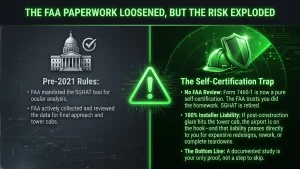
Yes, and this is exactly where installers get tripped up. Back in 2013, the FAA’s interim policy made federally obligated airports run an ocular analysis with one required tool and send the report to the agency. It covered both pilots on final approach and the control tower.
The 2021 final policy still stands in 2026, and it rewrote the playbook in three ways:
- First, the FAA narrowed the scope to the air traffic control tower (ATCT) cab at towered, federally obligated airports. The agency decided final-approach glare looks a lot like what pilots already see off water, glass buildings, and parking lots.
- Next, airports no longer send glare results to the FAA. Instead, they self-certify on Form 7460-1 that the project creates no ocular impact to the tower cab.
- Finally, the FAA dropped SGHAT, the tool it once required.
So no, the FAA did not kill the glare study. It simply stopped collecting the homework and now trusts you to do it right.
Solar glare study FAA liability: who’s on the hook?
Here’s the part that should change how you bid airport work. When an airport signs that 7460-1, it vouches that someone ran the analysis. If glare turns up after construction, the airport must fix it at its own cost. On top of that, it can face compliance action for an unaddressed safety hazard.
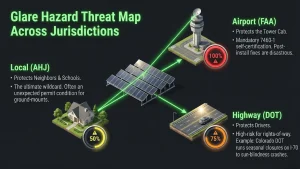
That risk runs straight back to the team that designed and built the array. So a signature with no solid study behind it is not “easier.” Instead, it’s open exposure that can turn into rework, redesign, or even a teardown. In short, a documented analysis now works as your proof, not a step you skip.
Do DOT and AHJ rules require a glare study?
No single federal rule forces a glare study for highway solar the way one does for airports. Still, that doesn’t let you off the hook.
State DOTs and the Federal Highway Administration both treat driver glare as a real concern when solar sits in or near the right-of-way. As a result, they expect a site evaluation and impact study first. Sun glare is also a documented crash factor. Colorado DOT, for example, runs seasonal safety closures on I-70 when low-angle sun blinds drivers. So add a reflective array near a spot like that, and a reviewer will ask hard questions.
That’s why the AHJ layer matters most. Many local building and zoning offices now ask for a glare analysis as a permit condition for ground-mount near roads, schools, or neighbors. Because the rule isn’t uniform, the smart move is checking each jurisdiction before you submit, not after a rejection.
Which tool do you use for a glare analysis?
With SGHAT retired, ForgeSolar’s GlareGauge has become the working standard. It models reflection intensity and duration at set observer points, like a tower cab or an approach path. Then it produces the report that backs up a 7460-1 statement or satisfies an AHJ.
Still, the tool is only half the job. The real value comes from setting up the model correctly and turning the output into a stamped, submission-ready package a reviewer accepts the first time.
How should installers handle a solar glare study in 2026?
Keep it simple and get ahead of it:
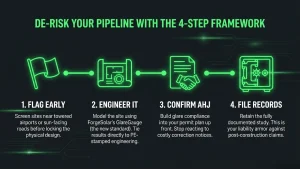
- Flag glare risk early. When a site sits near a towered airport, under an approach path, or faces a sun-facing road, screen it before you lock the design.
- Tie the study to stamped engineering. A licensed PE behind the analysis makes it defensible. EnergyScape handles this through nationwide PE stamping and engineering.
- Confirm the AHJ’s stance up front. Build the requirement into your permit plan instead of reacting to a correction notice.
- Keep the records. The study protects you, so file it with the project.
Handled this way, a glare study stops being a surprise that stalls a job. Instead, it turns into a quick, routine step in your workflow.
Take the glare study off your plate
At EnergyScape Renewables, glint and glare analysis fits right into the engineering we already handle for installers and EPCs across all 50 states. We run everything the right way, tie it to stamped PE drawings, and hand you a submission-ready report that holds up with the FAA, DOT reviewers, and local AHJs. Plus, with a 99% AHJ approval rate, we help you clear permitting without the back-and-forth.
Once the study is done, Sunscape keeps it from slipping through the cracks. Our solar project management platform captures the site data that feeds your glare model. It also tracks every permit milestone, 7460-1 status, and AHJ condition in one place, so nothing quietly stalls your pipeline. Book a demo with Sunscape and run your projects on a system built for solar.
Frequently asked questions
Does every solar project near an airport need a glare study?
Not every one. However, any project on or near a towered, federally obligated airport should have one. It supports the required 7460-1 self-certification and protects you from post-construction liability.
Is a glare study required for residential rooftop solar?
You rarely need one. It mostly applies to larger ground-mount and commercial arrays near airports, highways, or other sensitive sightlines.
Who pays if glare causes a problem after install?
For airport projects, the airport sponsor must fix it at its own expense. In practice, that exposure usually passes back to the project’s designer and installer.
sjayakanth@energyscaperenewables.com