
Why Your Plan Set Template Is Now a Compliance Liability and How to Fix It

Your Solar Plan Set Template Is a Growing Compliance Risk
Here’s the uncomfortable truth heading into permit season. First, that trusted plan set template you’ve reused for years may now cost you approvals. Meanwhile, code cycles have splintered across the country. As a result, AHJ reviewers keep flagging packages that looked perfectly fine just eighteen months ago. Basically, one frozen file cannot match three different National Electrical Code editions at once. Fortunately, the fix is just as clear. So you audit your permit drawings, version them by jurisdiction, and lean on engineering support. Below, we break down why your PV plan set keeps drawing redlines and how to stop it fast.
Why One Template No Longer Works Across States
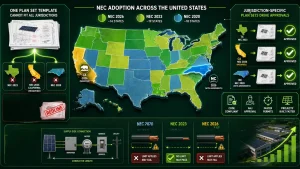
Currently, the NEC adoption map is a patchwork. To begin with, NFPA published NEC 2026 in October 2025. So far, roughly 14 states have adopted it. Meanwhile, about 19 states still run NEC 2023, and another 18 sit on NEC 2020. Naturally, California enforces its own modified 2026 code right now. By contrast, North Carolina delayed 2023 adoption and still references NEC 2020 with amendments.
Now picture a single plan set template in that environment. For example, a design that passes in Texas under NEC 2023 can fail next door under NEC 2020. As a result, the code references won’t match. Likewise, the labels won’t match. Ultimately, the reviewer won’t budge.
Consider NEC 705.11 supply-side conductor length limits. Notably, NEC 2023 dropped that restriction. However, NEC 2020 and NEC 2026 both bring it back. So if you build supply-side taps from one old solar plan set, you pass in some states and fail in others. Furthermore, supply-side connections keep growing in popularity. Consequently, more of your projects fall under this rule than ever before.
The Real Cost of an Outdated Plan Set Template
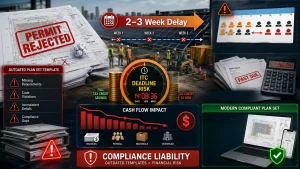
Clearly, every rejection now hurts more than it used to. In fact, a single kickback adds two to three weeks, minimum. Worse, that delay often lands at the worst moment. After all, commercial ITC deadlines under the OBBBA leave almost no slack. So if you miss a safe-harbor window, the project economics shift overnight. Besides tax credits, rejections wreck crew scheduling and squeeze cash flow. In short, an outdated plan set template is no longer a minor annoyance. Instead, it sits on your balance sheet as a real compliance liability.
How to Fix Your Permit Compliance Gaps Fast
Here’s the good news. Basically, you can fix this without rebuilding your whole workflow. So start with four practical moves.
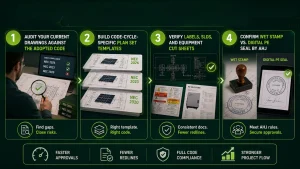
1. Audit Your Current Drawings Against the Adopted Code
First, confirm which NEC edition each target AHJ actually enforces. Importantly, never assume your home-state cycle travels with you. Next, pull your most-used plan set template and review it line by line. Then compare code references, labels, and conductor notes against the enforced edition. After that, flag every mismatch you find. Ultimately, this one audit surfaces most of your hidden rejection risk.
2. Build Code-Cycle-Specific Plan Set Templates
Frankly, a single master file simply won’t cut it anymore. Instead, maintain a separate version for each code cycle you serve. Specifically, keep a 2020 set, a 2023 set, and a 2026 set ready to deploy. Then map each version to the states and AHJs that enforce it. As a result, your team pulls the correct drawings on the first try, not the third.
3. Verify Labels, SLDs, and Equipment Cut Sheets
To begin with, NEC 2023 tightened labeling rules for rapid shutdown, back-fed breaker ampacity, and conductor sizing. Therefore, your single-line diagram must reflect current code, not last year’s defaults. In addition, include manufacturer cut sheets for every major component. Increasingly, AHJs in California, Texas, and Florida request FEOC documentation for battery equipment too. So check those items before you ever hit submit.
4. Confirm Wet Stamp vs. Digital PE Seal by AHJ
Today, permitting runs far more digitally. Still, “many” jurisdictions is not “all” jurisdictions. For instance, some AHJs gladly accept a certified digital PE seal. Others, however, stubbornly demand a wet stamp on paper. So if you submit the wrong format, your package sits untouched for weeks. Therefore, verify the requirement with each AHJ before your engineer signs.
Make Permit Compliance a Process, Not a Template
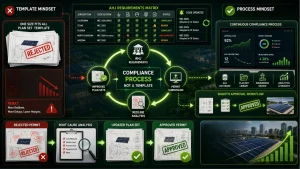
Now for the real mindset shift. Essentially, a plan set template is a starting point, never a guarantee. Instead, the strongest installers treat compliance as a living process. For example, they keep an AHJ requirements matrix. Likewise, they log every rejection and its root cause. Then they feed those lessons straight back into their files. Over time, that feedback loop turns painful redlines into a competitive edge. Indeed, your fastest competitors already operate this way.
Plan Set Compliance FAQ
Which NEC edition should my drawings follow?
Always build to the edition your local AHJ enforces. Because adoption varies widely, confirm the jurisdiction before you design.
How often should I update my plan set template?
Review it after every code-cycle change and any major rejection. Generally, a quarterly check keeps each plan set template current and audit-ready.
Does one plan set template work for all 50 states?
No. Since different states enforce different NEC editions and local amendments, you need code-cycle-specific versions.
How Energyscape Renewables Keeps Your Packages Compliant
Frankly, managing all of this across 50 states is a heavy lift for any in-house team. Therefore, that’s exactly where Energyscape Renewables helps. Specifically, we deliver code-current plan sets, PE stamping, permitting, interconnection support, and site surveys nationwide. Moreover, our engineers track NEC adoption jurisdiction by jurisdiction. As a result, your drawings match the code your AHJ truly enforces. In turn, you cut rejections, protect ITC deadlines, and keep crews productive. So explore our plan set and permitting services at Energyscape Renewables. In addition, if you want to manage AHJ requirements, log rejections, and run projects in one place, pair your engineering with a purpose-built solar CRM like Sunscape. Ultimately, the lesson is straightforward. So stop letting an aging plan set template threaten your approvals. Finally, fix the file once, and protect every project that follows.
sjayakanth@energyscaperenewables.com