
Do You Need a New PE Stamp After a Post-Permit Equipment Swap?

Do You Need One After a Post-Permit Equipment Swap?
Equipment swaps happen on almost every solar project. A module supplier discontinues a panel. An inverter runs out of stock. A distributor substitutes one racking SKU for another. When that happens after your permit already has approval, the question is simple: do you need a PE stamp revision, or can you install as-is? The honest answer depends on what changed. But ignoring the question is never the safe move. A last-minute component substitution, or engineering re-review of your plan set, can go two ways. It either sails through with a quick amendment, or it triggers a full resubmission that stalls your crew for weeks. This guide breaks down when you need a stamp update. It also covers what it costs and how you can build a permitting process that survives supply chain surprises.
The Post-Permit Equipment Swap Problem Every Installer Faces
You submitted a clean plan set. The AHJ approved it. Then your distributor called with bad news: your specified module won’t arrive for six weeks. So you swap in a comparable panel and move forward, right? Not so fast. Your PE stamp certifies the exact equipment on the plan set, not a general category of “solar panel.” Swap the make or model without updating that certification, and your permit no longer matches what’s on the roof. Inspectors catch this more often than installers expect. Skipping a proactive PE stamp revision now often costs you a failed final inspection later.
What Triggers a PE Stamp Revision After Permitting?

Not every substitution requires new engineering. However, several changes almost always do. Here’s what typically forces a stamp amendment:
- Module swaps that change panel weight, dimensions, or wind and snow load values
- Inverter changes, especially string-to-microinverter conversions or different output ratings
- Racking or mounting system substitutions from a different manufacturer
- Battery storage additions made after your original PV-only permit approval
- FEOC-related component substitutions, which have become more common as manufacturers phase out restricted equipment under IRA rules
Some AHJs accept a simple equivalency letter instead of a full re-stamp, but only when the new equipment shares identical specs, dimensions, and certifications with the original. That said, don’t assume this without checking first. Jurisdictions interpret “equivalent” differently. Guessing wrong is how rejections happen.
Structural vs. Electrical: Which PE Stamp Amendment Applies?
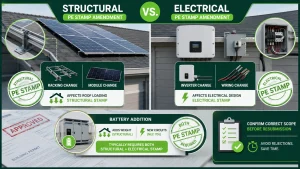
Solar permits typically separate structural and electrical review. Your equipment swap usually only touches one side. A racking or module change generally affects the structural stamp, since it alters roof loading calculations. An inverter or wiring change, on the other hand, usually falls under the electrical stamp. Battery additions frequently need both. Storage adds structural weight and new circuit considerations under NEC 706. Sending the wrong stamp type — or only one when the AHJ expects both — wastes a queue slot. Confirming the correct scope before resubmission saves you a second trip through the queue.
Cost and Timeline Impact of a Post-Permit Equipment Change
A PE stamp revision after permitting rarely costs as much as starting over. It’s not free, either. Most engineering firms charge a reduced fee for an amendment versus a fresh plan set, since only the affected sheets need updated calculations. Expect turnaround anywhere from same-day to a few business days. The exact timeline depends on how complex the change is and how busy the AHJ’s queue runs. Skip the revision entirely, though, and the math flips fast. A failed inspection or a utility rejection at interconnection typically costs more than the original amendment ever would have. Think rescheduling fees, idle crew time, and a frustrated client. In states like Florida, New York, and California, AHJs enforce structural and electrical review strictly. An unstamped substitution is one of the fastest ways to lose your install date there.
How to Avoid a PE Stamp Revision Before It Happens

The best way to handle a mid-project equipment swap is to plan for one before it happens.
Lock Equipment Specs Before Submission
Confirm inventory availability with your distributor before your plan set goes to the AHJ. A five-minute stock check prevents a two-week engineering delay later.
Build a Substitution Buffer Into Your Plan Set
Ask your engineering partner whether your plan set can list an approved alternate module or inverter upfront. Some AHJs accept pre-approved equivalents. That means a future substitution won’t need a fresh PE stamp revision at all.
Keep a Direct Line to Your Engineering Partner
When a swap does happen, speed matters most. A firm that turns around a stamp amendment in a day or two, rather than a week, keeps your crew on schedule. Nobody wants a crew standing around a job site.
State-by-State Notes on Equipment Substitution
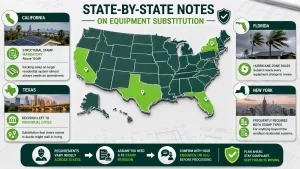
Requirements vary widely across the country. California treats structural stamps as mandatory above 10 kW. A racking swap on a larger residential system there almost always needs an amendment. Florida’s hurricane-zone rules subject nearly every equipment change to review. Texas leaves the decision to individual cities. A substitution that clears review in Austin might stall in Irving. New York frequently requires both stamp types for anything beyond the smallest residential systems. The pattern holds nationwide: assume you need a PE stamp revision until your engineer or AHJ confirms otherwise.
Getting Your PE Stamp Revision Handled Fast
Equipment swaps aren’t going away. Supply chains stay unpredictable, and manufacturers phase out FEOC-restricted components more often each quarter, which drives more mid-project substitutions. What separates installers who keep their schedules on track from those who don’t is simple. It comes down to how quickly they can get a compliant stamp update back in hand.
EnergyScape Renewables specializes in exactly this. Their engineering team delivers structural and electrical PE stamp revisions across all 50 states. Turnaround times fit post-permit equipment changes specifically, so a module or inverter swap doesn’t turn into a lost install date. Every amendment matches the correct stamp type and follows your AHJ’s current code edition. That keeps your resubmission clean the first time, not the third.
Once your revised stamp is in hand, staying organized matters just as much. Sunscape Solar gives your team a single place to track permit status, resubmission deadlines, and every equipment change across your active pipeline. Nothing slips through when a swap happens mid-project. Together, a fast engineering partner and a clear pipeline view mean equipment changes cost you days, not weeks.
sjayakanth@energyscaperenewables.com