
Commercial Plan Sets: What EPCs Must Know in 2026
Commercial Solar Plan Sets: What’s Different from Residential — And Why It Matters for Permitting in 2026
If you just landed your first 50 kW commercial job after years of residential work, here is something you need to know before you pull permits: commercial solar plan sets are not residential permit packages with bigger numbers.
That assumption gets installers burned every week. Rejected submissions. Correction cycles. Blown-out timelines. And in 2026, with the Section 48E ITC construction deadline closing on July 4, a kicked-back commercial plan set is not just frustrating — it is a direct financial risk to your customer’s tax credit.
This guide breaks down exactly what changes between residential and commercial solar plan sets, what NEC 2026 demands, and what you need in place to keep commercial projects moving on time.
Why Residential Installers Are Moving into Commercial Right Now
The residential 25D solar tax credit expired on December 31, 2025 with no phase-out. Residential pipeline volume is softening fast. Meanwhile, the Section 48E commercial ITC is still at 30%, with stacked bonus adders for domestic content and energy community location pushing eligible projects to 40% or higher.
However, that commercial window has a hard deadline. Under the One Big Beautiful Bill Act (signed July 2025), commercial projects must begin construction by July 4, 2026 to lock in the full 30% ITC. Miss that date, and the project must be fully placed in service by December 31, 2027 to qualify for any credit at all. That compressed timeline is driving a surge of commercial work right now — and a lot of residential-trained installers crossing over without realizing how different the permitting landscape is. Learn more about state-specific timelines in our solar permitting guide for EPCs.
The 25 kW Line: Where Plan Set Requirements Change Category
Below 25 kW, most AHJs treat a solar permit like an oversized residential job. A single-line diagram, basic load calculations, string layout, and a PE stamp where required — and you’re generally through without much friction.
Cross into 25 kW and above, and everything changes. You are now working with full three-phase electrical design, detailed inverter configuration documentation, transformer sizing, utility point-of-interconnection specs, switchgear callouts, and protection relay coordination. That is a fundamentally different document from a residential permit package.
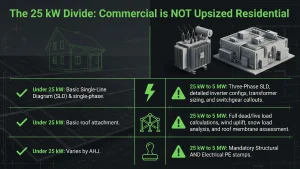
The structural side is equally demanding. A commercial solar permit package must include:
- Dead load and live load calculations covering racking and module weight
- Wind uplift and snow load analysis specific to the building location and roof type
- Roof membrane compatibility assessment
- For ground mounts: geotechnical soil boring reports and foundation design
None of that appears in a typical residential solar permit submission. For the full list, review our solar permit plan set checklist for 2026.
Commercial vs. Residential Solar Plan Sets: A Side-by-Side Comparison
| Element | Residential Solar | Commercial Solar |
|---|---|---|
| System size typical | 3–15 kW | 25 kW – 5 MW |
| Electrical diagram | Basic SLD, single-phase | Three-phase SLD, inverter configs, transformer sizing |
| Structural calcs | Basic roof attachment | Full dead/live load, wind uplift, membrane assessment |
| PE stamp required | Varies by AHJ | Structural AND electrical stamps usually required |
| NEC requirements | 690 basics | 690, 705, NFPA 70E, IBC structural compliance |
| Building permit | Rarely triggered | Often runs parallel to electrical permit |
| FEOC documentation | Not required | Required for ITC eligibility from January 2026 |
| AHJ review category | Standard | Elevated — full engineering review |
What NEC 2026 Changed — And Why Commercial Teams Get Hit Harder
Two NEC 2026 changes hit commercial solar plan sets harder than residential work.
First: the Isc rule now has no exceptions. NEC 690.8(A)(1) requires using the highest short-circuit current value from the module datasheet — no flexibility, no lower estimates. For bifacial modules, both front and rear irradiance conditions factor into the calculation. On a commercial project with dozens of strings, this changes conductor sizing math and directly affects material costs.

Second: Section 690.4(G) rounding is now mandatory. Calculations that previously rounded down to a cheaper conductor size may no longer comply. At commercial scale, that difference translates into resubmission fees and real cost.
The bigger problem is that NEC 2026 adoption is uneven across states. California enforces it statewide. Most North Carolina jurisdictions still reference NEC 2020. Submitting a plan set built against the wrong code edition for a given AHJ is one of the fastest ways to generate a first-submission rejection — and NEC code mismatches account for roughly 30–40% of solar permit rejections nationwide.
PE Stamps: What Commercial Requires That Residential Doesn’t
Most commercial solar jobs require both a structural PE stamp and an electrical PE stamp — separate certifications from separately licensed engineers. Sending only one, or the wrong type, wastes your AHJ queue slot entirely.
Here is how requirements break down across key US markets:
- California — Structural PE stamps required above 10 kW; electrical stamps above 50 kW; NEC 2026 active statewide
- Florida — PE stamp on virtually every installation; mandatory wind load calculations
- Texas — No statewide framework; requirements shift city by city
- New York — PE stamps required for most commercial systems; interconnection in Con Edison and NYSEG territories adds significant schedule buffer
For multi-state EPCs, this means finding a licensed local PE every time you enter a new market — unless your engineering partner is already licensed everywhere. Review the full breakdown in our state-by-state solar PE stamp guide.
FEOC Compliance and the Real Cost of Getting It Wrong
Starting January 2026, commercial solar systems claiming ITC incentives must source at least 40% of manufactured product value from non-FEOC (Foreign Entity of Concern) suppliers. Panels, inverters, and battery equipment all fall under this rule. AHJs in California, Texas, and Florida are already requiring FEOC compliance documentation as part of the commercial permit submittal package — making it a pre-design checklist item, not an afterthought.
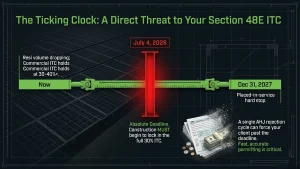
And if you do get it wrong? Solar permit rejections typically cost between $2,000 and $5,000 in revision fees, admin time, and crew rescheduling — not counting schedule delay or client relationship damage. On a commercial job chasing the July 4 ITC deadline, that correction cycle can cost your customer the tax credit entirely.
How EnergyScape Renewables and Sunscape Solve This Together
EnergyScape Renewables delivers PE-stamped commercial solar plan sets from 10 kW to 5 MW — no handoff to a separate commercial team, no searching for a local PE per state. Their engineers hold active licenses in all 50 states with 24–48 hour turnaround, NEC 2026 compliance built in, and a 99% AHJ first-submission approval rate across 280,000+ completed projects. Three-phase SLDs, structural and electrical PE stamps, FEOC documentation, interconnection packages — all in one workflow.
Sunscape Solar keeps your commercial pipeline from turning into spreadsheet chaos. When EnergyScape sends back a stamped plan set, the next workflow step fires automatically — permit submission trigger, AHJ follow-up scheduling, interconnection milestone tracking — all in one dashboard built for US installers and EPCs running commercial volume.
Together, they cover the engineering complexity and the pipeline visibility so your team can focus on closing and installing.
Get Your Commercial Plan Sets Right — Before the Deadline
👉 Request a commercial plan set at EnergyScape Renewables — PE-stamped, NEC 2026-compliant, and AHJ-ready in 24–48 hours across all 50 states. 99% first-submission approval rate. 280,000+ projects completed.
👉 Manage your entire commercial pipeline at Sunscape Solar — the solar CRM built for US installers and EPCs scaling into commercial volume. From site survey through PTO, every milestone tracked automatically.
Your customers are racing the July 4 deadline. Make sure your plan sets — and your operations — are built to match that pace.
Frequently Asked Questions
What is a commercial solar plan set?
A commercial solar plan set is a permit-ready engineering package for solar systems above 25 kW. It includes three-phase single-line diagrams, structural load calculations, PE-stamped drawings, FEOC documentation, and AHJ-specific details — substantially more complex than a residential permit package.
Do commercial solar projects require a PE stamp?
Yes, in most US jurisdictions. Commercial projects typically require both a structural and an electrical PE stamp. These are separate certifications. Requirements vary by state — California and Florida have specific system-size thresholds; Texas requirements shift by city.
What does NEC 2026 change for commercial solar plan sets?
NEC 2026 tightened the short-circuit current rule under 690.8(A)(1) with no exceptions, and made Section 690.4(G) rounding mandatory. Both changes affect conductor sizing and raise the first-submission bar for commercial plan sets across AHJs enforcing the updated code.
When does construction need to begin for the Section 48E ITC?
Construction must begin by July 4, 2026 to lock in the full 30% ITC under Section 48E. Projects starting after that date must be fully placed in service by December 31, 2027 to qualify for any credit. This makes fast, accurate permitting critical for every commercial job in the current pipeline.
sjayakanth@energyscaperenewables.com