
Residential Solar PE Stamp: 5 Triggers That Decide in 2026
Residential Solar PE Stamp: The 5 Triggers That Actually Decide in 2026
Ask ten installers when a residential solar PE stamp is required, and you’ll hear ten different kilowatt numbers. Ten kW. Fifteen. “Anything with a battery.” However, none of those are rules. They’re one AHJ’s habit, repeated until it sounded like code. Meanwhile, the same house with the same array can need a stamp in one ZIP code and clear plan review without one a county over. This guide replaces the kW myth with five triggers you can check in about a minute per job.
There Is No National kW Cutoff
No federal rule mandates PE stamps on residential solar. Instead, each state sets its own baseline, and local AHJs amend on top of that.
Underneath all of it sits the real legal hinge: IRC Section R324.4.1. The roof carrying your array must either meet the prescriptive framing provisions of Chapter 8, or be analyzed and approved by an engineer. Notice what that sentence leaves out. It never mentions kilowatts. Therefore, the trigger is whether your structure can be shown to comply without analysis. That’s a geometry question, not a size question.
Trigger 1: Your Submittal Path
Your submittal path decides a lot before anyone looks at the roof.
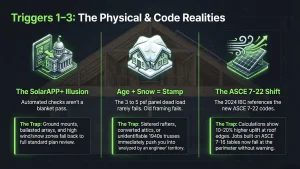
SolarAPP+ runs automated code-compliance checks for qualifying residential solar and storage projects. As a result, participating jurisdictions can issue permits fast without requiring a project-specific stamp on every qualifying system. Still, it isn’t a blanket exemption. Ground mounts, ballasted arrays, non-prescriptive attachments and high wind or snow exposure all fall back into full plan review — usually after you’ve promised the homeowner an install date.
So ask two questions. Does this AHJ offer an instant or standard-plan path? And does this job actually fit inside it? For market-level detail, see our breakdown of where instant permitting works today, and check the official eligibility checklist before you commit.
Trigger 2: The Existing Roof
Here’s where retrofits get expensive, and it’s rarely about panel weight.
A typical array adds roughly 3 to 5 psf of dead load. That alone seldom fails. Instead, the framing fails. When upgrades get required, it’s usually because an old and often modified roof can’t be proven to carry even the minimum design snow load. Sistered rafters, a second reroof layer, a converted attic, an unidentifiable 1940s truss — any of these push you out of prescriptive territory and straight into “analyzed by an engineer.”
Consequently, older housing stock plus snow country is the highest-probability stamp combination in the country. At any system size.
Trigger 3: Your Racking Span Table
Most ops teams miss this one, and it quietly changed in 2026.
A racking manufacturer’s stamped span table is engineering. It’s pre-approved, it covers standard installs, and it saves you a project-specific seal. Then your site’s wind or snow exposure falls outside the table. At that moment, you need a sealed design regardless of array size.
Why does that matter more now? Because the 2024 IBC references ASCE 7-22, while the 2021 IBC references ASCE 7-16. ASCE 7-22 added dedicated rooftop provisions in Section 29.4.4 and Table 29.4-2. In practice, edge and corner panels see 10 to 20 percent higher calculated uplift under ASCE 7-22, while interior panels can drop 5 to 15 percent.
For your designers, that means span tables built on 7-16 go out of range at the perimeter first. Jobs that were prescriptive last year now need a residential solar PE stamp — with no rule change and no warning. Florida already enforces ASCE 7-22, and more states keep moving to the 2024 I-codes on their own timelines. Our guide to ASCE 7-22 load calculations covers the math, and the ASCE Hazard Tool gives you site-specific values.
Trigger 4: Everything Else on the Plan Set
Certain scope items pull in a PE no matter how small the array:
- Battery storage and ESS retrofits
- Supply-side taps, main panel upgrades, derated busbars
- Ground mounts, carports, ballasted or non-penetrating racking
- Any attachment method outside the manufacturer’s listing
Storage keeps growing, too. The national solar-plus-storage attach rate hit 45% in Q1 2026, up from 38% a year earlier. In other words, more jobs now cross this trigger by default.
Trigger 5: Who Can Seal It — and Who’s Asking
This trigger has two halves.
Licensure. Your engineer must hold an active license in that state, and the AHJ must accept the seal format, wet or digital. For a multi-state EPC opening a new market, this is the gate that stalls a pipeline for two weeks. It also pairs with which NEC edition your AHJ actually enforces, since both have to match on the same sheet.
The owner. This part is new. The One Big Beautiful Bill Act ended the residential 25D credit for systems installed after December 31, 2025. As a result, third-party-ownership deals are projected to make up 65% of solar reps’ books in 2026, up from 44% in 2025. TPO financiers and their insurers carry their own engineering standards. So they can demand a stamp the AHJ never asked for. That’s new volume created by financing, not by code.

Your 60-Second Residential Solar PE Stamp Check
- Does this AHJ offer an instant or standard-plan path, and does this job qualify?
- Can the existing framing be shown prescriptive, or does it need analysis?
- Is the site inside your racking span table — under the ASCE 7 edition this AHJ enforces?
- Does the scope include storage, a service upgrade, or a non-listed attachment?
- Who can legally seal this here, in the format this AHJ accepts?
Any “no” or “not sure” means stamp it. After all, a rejected permit typically costs a US installer $2,000 to $5,000 once you count rework, resubmission fees and crew rescheduling. With residential installs forecast down 18% to 21% in 2026, fewer jobs remain to absorb that hit. For the full picture, read our breakdown of the seven causes of permit delays.
Stop Guessing on Stamps: Residential Solar PE Stamp
Five triggers take a minute. Running them across twelve AHJs, three ASCE editions and two financiers takes a department.
Energyscape Renewables keeps Professional Engineers licensed in all 50 states, delivering PE stamping and plan sets in as little as 24 hours. Every package matches the code edition your AHJ enforces and the seal format it accepts. That’s how Energyscape Renewables holds a 99% AHJ approval rate across 280,000+ projects.
Then let Sunscape make sure you answer the stamp question only once. Record the requirement on the AHJ, track stamp status as a real milestone between plan set and submittal, and keep every job moving to PTO.

Residential Solar PE Stamp FAQ
Does residential solar need a PE stamp?
Sometimes. No national rule and no universal kW threshold exists. It depends on your submittal path, the existing roof, your racking letter’s range, the scope, and state licensure.
Is there a kW cutoff for a PE stamp?
Not nationally. Some states and AHJs use size thresholds as internal policy, but size is a proxy. It isn’t the underlying code trigger.
Do I still need a stamp in a SolarAPP+ city?
Not for qualifying systems. However, ground mounts, ballast, non-prescriptive attachments and high wind or snow exposure still need sealed engineering.
Structural or electrical stamp?
Structural covers loads and attachment. Electrical covers NEC compliance, conductor sizing and interconnection. Larger systems, storage and supply-side connections often need both.
sjayakanth@energyscaperenewables.com