
Solar Structural Calculations: ASCE 7-22 Loads for 2026 Permits
Solar Structural Calculations: ASCE 7-22 Loads for 2026 Permits
Solar structural calculations prove that a roof or ground mount can safely carry a PV system under the loads it faces: dead, live, wind, and snow. In 2026, the ASCE 7-22 standard governs those numbers. And if you get them wrong, your plan set bounces and the install stalls.
So if you install or run EPC projects across several states, watch out. Right now, jurisdictions don’t all enforce the same code. Below, we’ll cover what changed, why it matters, and how to keep your permits moving.
Why solar structural calculations matter more in 2026
ASCE 7 sets the minimum loads a structure must resist. Then the International Building Code (IBC) adopts it, and your local Authority Having Jurisdiction (AHJ) enforces it. Here’s where 2026 gets tricky:
- The 2021 IBC references ASCE 7-16.
- The 2024 IBC references ASCE 7-22.
Most AHJs still run the 2021 IBC, so they expect 7-16. However, many states are moving fast. California, New York, Texas, Georgia, Colorado, Oregon, Nevada, and Utah are all adopting the 2024 IBC, while Florida already enforces 7-22.
For one state, that’s easy. For a multi-market EPC, it’s a moving target. Submit 7-16 calcs to a 7-22 AHJ, and the plan set bounces. In fact, missing or incorrect ASCE 7 load data is a leading cause of structural plan rejection, and every rejection pushes back PTO.
The four loads in every solar structural calculation
Whatever edition applies, your structural package must address four load types. So let’s break them down.
Dead load
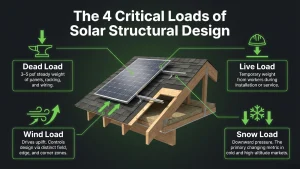
First, the dead load. This is the steady weight of panels, racking, and wiring resting on the roof. For most residential rooftop arrays, that adds roughly 3 to 5 psf. Therefore, your calcs must show the structure carries the combined total.
Live load
Next, the live load. This covers temporary weight, mainly a worker walking the array during install or service. ASCE 7 also tells you when to model it, based on how high the system sits above the roof.
Wind load
Wind drives uplift, so it often controls the design. ASCE 7-22 divides each roof into field, edge, and corner zones. Because edges and corners see much higher pressure, panels there need tighter spacing and stronger fastening.
Snow load
Finally, snow. In cold or high-altitude markets, snow usually governs instead of wind. And this is exactly where 7-22 changed the most.
What ASCE 7-22 changed for solar
Here are the updates that hit installers hardest:
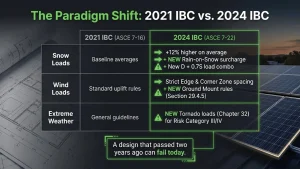
- Snow loads rose. New ground snow loads run about 12% higher on average, and some northern or mountain regions climb much higher. As a result, lighter rail that passed under 7-16 may fail under 7-22.
- The code now requires a rain-on-snow surcharge. Specifically, it adds weight for rain falling on heavy snow, which caused several roof failures in recent winters.
- Ground mounts finally have rules. For example, new Section 29.4.5 adds wind provisions for fixed-tilt ground-mount systems.
- ASCE 7-22 also added a load combination, D + 0.7S, which eases some snow-driven designs, though not back to 7-16 levels.
- Tornado loads (Chapter 32) now apply to certain Risk Category III and IV structures in tornado-prone areas.
In short, a design that passed two years ago can fail today, especially in snow country.
Why plan sets get rejected (and how to pass first time)
Most rejections come from a few avoidable mistakes:
- Wrong code edition. Confirm the adopted IBC before you calculate.
- Generic load values. Because ASCE 7 is site-specific, pull the real wind speed, exposure category, ground snow load, and risk category for that exact address.
- Skipped edge and corner zones. Uniform spacing across the array invites a redline.
- Missing PE stamp. Most AHJs require a professional engineer’s seal.
The fix is simple discipline. First, verify the code. Next, pull site data from the free ASCE Hazard Tool. Then design to the right zones, and finally get a PE seal before you submit. For submittal details, see our guide to single-line diagram (SLD) requirements for AHJ review.
Keep your permits moving with the right partner
Tracking which AHJ wants which code edition, across every market you serve, drains your back office and slows throughput. So that’s where the Energyscape and Sunscape ecosystem helps.
Energyscape Renewables delivers PE-stamped, code-correct plan sets with 24-hour turnaround across all 50 states. Better still, every set matches the exact ASCE 7 edition your AHJ enforces, so your structural package passes review the first time.
Meanwhile, Sunscape, your solar OS, keeps every AHJ requirement, plan-set status, and permit in one place. As a result, nothing slips between site survey and PTO.
So stop guessing on code editions. Engineer it right, track it tight, and reach PTO faster.
Frequently asked questions
Which ASCE 7 edition does my solar project need?
It depends on the IBC edition your AHJ adopted. The 2021 IBC points to ASCE 7-16, while the 2024 IBC points to ASCE 7-22. So always confirm with the local building department first.
Do all solar installs need structural calculations?
For permitting, yes, in almost every case. Nearly every AHJ wants proof under ASCE 7 that the structure carries the system, and many also require a PE stamp.
How much weight does a rooftop solar system add?
A typical residential array adds about 3 to 5 psf of dead load, before snow and other loads combine on top.
Did ASCE 7-22 make solar harder to permit?
In snow-heavy regions, often yes. Higher snow loads and the new rain-on-snow surcharge can push you toward sturdier racking and updated span tables.
sjayakanth@energyscaperenewables.com