
Solar Site Survey Checklist: Fully Optimized Draft 2026

Solar Site Survey Checklist 2026: Cut Change Orders Before They Cost You a Truck Roll
Solar Site Survey Checklist: A tech rolls out at 7 a.m. He spends two hours on a roof, drives back, and three weeks later your crew finds a 100A panel where the design assumed 200A. Now you eat a service upgrade, a redesign, a resubmittal, and a second truck roll.
That single miss costs roughly $1,200 before you count the delay. Across forty jobs a month, it becomes a real hole in your margin.
Here’s the part most shops miss: the problem usually isn’t the survey method. It’s that nobody wrote down what the survey was supposed to capture. This solar site survey checklist 2026 fixes that gap for installers and EPCs.
Why the solar site survey checklist 2026 matters more than ever
The economics shifted underneath everyone this year.
Section 25D was repealed under the One Big Beautiful Bill Act. As a result, any homeowner-owned system placed in service after December 31, 2025 gets zero federal credit — no phase-down, no transition window. You can confirm the current status directly on the IRS Residential Clean Energy Credit page.
Meanwhile, residential installs are forecast down 18–21% for 2026, and customer acquisition cost climbed about 40% to roughly $0.84 per watt, according to SEIA and Wood Mackenzie market data.
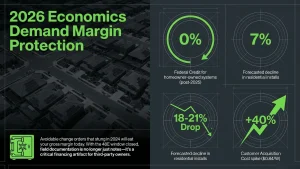
So you’re spending more to win each job and earning less on it. An avoidable change order that stung in 2024 now eats a serious slice of gross margin.
There’s a second pressure too. Because the 48E begin-construction window closed on July 4, 2026, more residential volume runs through leases and PPAs. Third-party owners underwrite these systems as long-term assets, which means your field documentation is now a financing artifact — not an internal note.
A site survey is a data spec, not a visit
Most checklists get organized by what you look at: roof, electrical, shading. That’s backwards.
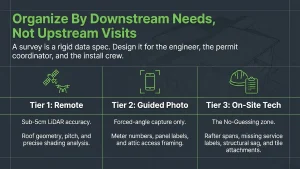
Instead, organize yours by who needs the field downstream. The engineer needs specific inputs to build a stamped plan set without firing back an RFI. Then your permit coordinator needs specific photos to satisfy the AHJ. Your crew needs specific measurements to avoid surprises on install day.
Once you define that schema, the remote-versus-on-site debate mostly settles itself. Both approaches simply fill the same fields.
The three-tier solar site survey checklist 2026
Tier 1 — Remote-satisfiable fields
- Roof planes, dimensions, azimuth, usable area
- Roof pitch, where LiDAR coverage exists
- Obstructions: vents, chimneys, skylights, dormers
- Tree canopy and neighboring structure shading
- Fire-code setbacks and pathway modeling
- Site access and equipment staging
Solar shading assessment tools have genuinely closed the accuracy gap. LiDAR point clouds reach sub-5cm horizontal accuracy versus 30–100cm for standard satellite imagery, as covered in our breakdown of LiDAR solar design accuracy. Precision matters here because 10% partial shading on one module can cut string output 25–50% once bypass diodes activate.
Tier 2 — Guided photo capture
- Utility meter, meter number, service entrance
- Main panel label plate, bus rating, main breaker rating
- Full breaker layout with open positions visible
- Existing PV, EV charger, or battery equipment
- Attic access point and visible framing
- Proposed inverter and conduit routing
Freeform photo requests fail constantly. Guided capture that forces the angle works. That difference alone separates a usable field from a wasted round trip.
Tier 3 — Requires a tech on-site
- Rafter or truss size, spacing, and span
- Roof covering material, layers, and condition
- Service capacity when the label is missing or unreadable
- Tile or metal roof attachment method
- Grounding and bonding conditions
- Structural concerns: sag, prior repairs, water damage
Anything in Tier 3 that gets guessed becomes a change order later.
Remote solar site survey vs. on-site: field by field
| Data field | Remote capture | On-site required |
|---|---|---|
| Roof geometry & azimuth | ✅ Reliable | Optional |
| Roof pitch | ✅ With LiDAR | If no LiDAR coverage |
| Shading analysis | ✅ Best method | Rarely needed |
| Panel label & bus rating | ⚠️ Photo only | If unreadable |
| Rafter spacing | ❌ | ✅ Always |
| Roof material & condition | ⚠️ Partial | ✅ Tile / metal |
| Battery siting | ❌ | ✅ Always |
For the deeper cost comparison, see our post on remote vs. on-site solar surveys.
The dispatch rule your coordinator can actually follow
Stop debating job by job. Write the trigger list once, then let ops apply it.
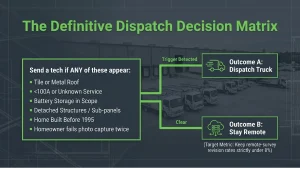
Send a tech whenever any of these appear:
- Tile or metal roof
- 100A service, or unknown service rating
- Battery storage in scope
- Detached structures or sub-panels
- Home built before 1995
- Homeowner can’t produce usable photos after two attempts
Everything else runs remote. That single rule cuts truck rolls sharply at most residential shops, and it ends the constant back-and-forth between sales and operations.
Track revision rate by survey type
You can’t manage what you never count. Tag every project with its survey method, then measure how many needed a design revision after submittal.
Keep remote-surveyed jobs under roughly 8%. Above that, your capture standard is the problem — not the decision to survey remotely. Tighten Tier 2 photo requirements before dispatching more trucks.
Incomplete data also fails you later. Our post on solar site survey errors that fail AHJ inspections walks through what inspectors catch most often.
Where the survey data has to land
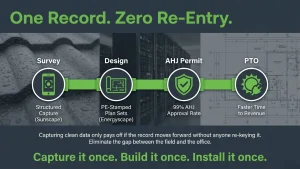
Capturing clean data and then burying it in a text thread defeats the purpose. Single-pass field data capture only pays off when the record moves forward — survey to design to permit to PTO — without anyone re-keying it.
That’s the gap most installers still carry. Techs capture well, but the office rebuilds the same information three separate times. See how structured field data flows straight into a solar permit package.
Put the checklist to work
A checklist helps only when it lives inside your workflow. Sunscape gives your team structured site survey capture plus full pipeline visibility from first appointment through PTO — one record, no re-entry, nothing lost between field and office. Book a Sunscape demo.
Then, when that data is ready to become a permit package, Energyscape Renewables turns it into PE-stamped plan sets across all 50 states with 24-hour engineering turnaround and a 99% AHJ approval rate. Clean field data in, permit-ready plan set out.
Capture it once. Build it once. Install it once.
Frequently asked questions
What should a solar site survey checklist 2026 include?
It should include roof geometry and shading, electrical service details with legible panel labels, structural framing data, obstruction locations, and equipment placement — organized by who needs each field downstream.
Is a remote solar site survey accurate enough for residential jobs?
Yes, for most standard residential work. Aerial imagery and LiDAR now handle roof geometry and shading reliably. However, structural framing, service verification, and unusual roof materials still require a tech on-site.
How do you avoid change orders on solar site surveys?
Define required data fields before the survey, use guided photo capture instead of freeform requests, apply a written dispatch rule for high-risk sites, and track revision rate by survey method.
Does site survey quality affect permit turnaround time?
Directly. Incomplete field data triggers engineering RFIs, and every RFI resets the clock before your plan set ever reaches the AHJ.
sjayakanth@energyscaperenewables.com