
Remote vs On-Site Solar Surveys in 2026: When Each One Actually Wins

Why Remote Solar Surveys Are Changing the Math for Installers in 2026
Every installer knows the sting. A truck rolls out at 7 a.m., a tech spends two hours measuring a roof, and the deal dies in financing eight days later. Multiply that by forty jobs a month and you have a real hole in your margin. Remote solar surveys close a big part of that gap. Instead of dispatching a crew first, ops teams now pull aerial imagery, homeowner photos, and utility records before anyone leaves the shop. Virtual site assessments have finally gotten accurate enough to carry most residential work. Still, they cannot carry every job. Below, we break down where each method wins and how to build a triage rule your team can actually follow.
What a Remote Solar Survey Covers Today
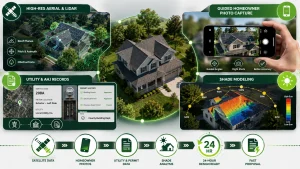
The 2026 version of a remote solar survey looks nothing like the shaky homeowner selfies of 2019. A modern workflow stacks four data layers:
- High-resolution aerial and LiDAR imagery for roof planes, pitch, azimuth, and obstructions
- Guided homeowner photo capture through a mobile app that forces the right angles
- Utility and AHJ records covering service size, meter location, and past permits
- Shade modeling tied to the same imagery your designer uses
Because the app prompts for specific shots, you stop chasing blurry photos of a panel schedule. Most residential jobs now clear design with a 24-hour turnaround. That speed matters. Speed-to-proposal remains one of the strongest predictors of close rate in US residential solar.
Where On-Site Solar Site Surveys Still Win
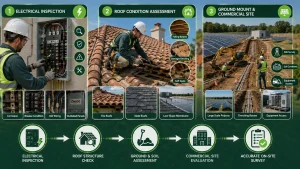
A tech on the ground still beats imagery in several situations, and pretending otherwise gets expensive.
Electrical work you cannot see from space
Main panel upgrades top the list. You cannot read bus bar ratings, breaker condition, or corrosion from a satellite tile. Derate calculations depend on details that only a person can verify. Similarly, older homes with cloth wiring, subpanels in crawl spaces, or Zinsco and Federal Pacific panels demand eyes on site.
Roofs that hide their problems
Tile, slate, and low-slope membrane roofs deserve a physical visit. Decking condition, rafter spacing, and soft spots simply do not show up in imagery. For example, a Spanish tile roof in Arizona may look clean overhead while the battens underneath are failing.
Ground mounts and commercial sites
Soil conditions, trenching runs, and equipment access drive the whole design. Consequently, most EPCs still require a physical walk for anything above 100 kW.
Cost, Speed, and Accuracy: The Honest Comparison
Here is how the two approaches stack up in practice.

The cost difference looks obvious. However, the real number is not the survey cost. It is the change-order rate. A remote survey that misses a service upgrade can cost you a $1,200 truck roll plus a delayed install. Therefore, track your revision rate by survey type. If remote jobs generate revisions above roughly eight percent, your capture standards need work, not your survey method.
The Hybrid Model Most Profitable EPCs Now Run
Very few high-volume companies choose one lane. Instead, they triage. Remote solar surveys handle the standard work, while techs get dispatched only where risk justifies the drive time.
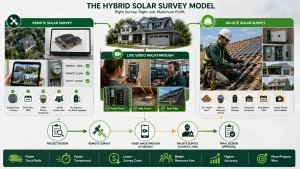
A simple triage rule you can copy
Send it remote when the job meets all of these:
- Composition shingle roof, single or two-story
- Home built after 1995
- 200A service confirmed on the meter photo
- System size under 12 kW
- No battery or main panel upgrade in scope
Send a tech when any of these appear: tile or metal roof, 100A or unknown service, battery storage, detached structures, or a home older than 1995. Also dispatch when the homeowner cannot supply usable photos after two attempts. That rule alone cuts truck rolls by half at most residential shops.
Meanwhile, some teams run a middle option: a live video walkthrough with the homeowner. A trained coordinator guides the phone camera through the panel, attic, and roof edge. It costs almost nothing and catches most of what a photo package misses.
Permitting, AHJ Review, and Documentation Risk
Plan sets live or die on survey quality. A missing panel photo means a rejected permit, and a rejected permit means two more weeks. Consequently, your survey standard should map directly to what your AHJ asks for. Many jurisdictions now accept remote solar surveys as the basis for stamped plan sets, provided the documentation package is complete and legible.
Structural stamps deserve extra care. Some PEs will stamp from remote data with attic photos and a rafter measurement. Others require a site visit, especially in high-wind or high-snow zones. Confirm this with your engineering partner before you scale a remote-first process. Otherwise, you will hit resistance halfway through your busiest quarter.
Finally, keep your survey data in one system. Scattered photos across text threads and email create the same rework you were trying to avoid. A CRM built for solar workflows, like Sunscape Solar, keeps survey packages, design files, and permit documents attached to the project record instead of someone’s phone.
Building the Right Survey Mix With Energyscape Renewables
Choosing between remote and on-site work is really a question of process design. That is where Energyscape Renewables fits in.
We support US installers and EPCs across all 50 states with the back-office layer that makes either survey method work. Our team handles site surveys, PE-stamped plan sets, permit packages, interconnection applications, and structural and electrical engineering. In practice, that means you can send us a remote survey package and receive a permit-ready plan set without hiring in-house engineers. When a job needs boots on the ground, we coordinate field surveys too.
Because we work across many jurisdictions, we already know which AHJs accept remote solar surveys and which ones push back. That knowledge saves you the trial-and-error cycle. As a result, our partners typically cut design turnaround times and reduce permit rejections without adding headcount.
Ready to tighten your survey process before the next installation season? Reach out to Energyscape Renewables and let’s map your workflow together.
sjayakanth@energyscaperenewables.com