
Solar Single-Line Diagram Checklist: AHJ Approval in 2026
Solar Single-Line Diagram Checklist: What AHJ Reviewers Check First in 2026
Your solar single-line diagram is the first page an AHJ reviewer opens, and often the reason a permit gets rejected. For installers and EPCs, that one drawing decides whether a project moves or stalls. So when the rejection email lands after your crew is already booked, it usually traces back to the same place. Below, you’ll find what reviewers check first and a 2026 checklist to run before you submit.
Key takeaways
- A solar single-line diagram (SLD) maps a PV system’s full power path on one page, so AHJ reviewers trust it more than any other sheet.
- NEC 690.8 conductor-sizing errors cause an estimated 30–40% of solar permit rejections.
- Each rejection cycle costs roughly $2,000–$5,000 and adds days to your schedule.
- Reviewers scan the title block, the power path, and cross-document consistency first.
- In 2026, your code edition, interconnection number, and battery details matter more than ever.
Why your solar single-line diagram makes or breaks the permit
A single-line diagram is the electrical roadmap of a PV system. It shows the full power path on one page, from the modules through the inverter and disconnects to the point of interconnection. Reviewers lean on it because it proves electrical safety before anyone pulls a wire.
So they trace that path and check every callout against the National Electrical Code. When a number on the page doesn’t match your calculations, the permit stops.
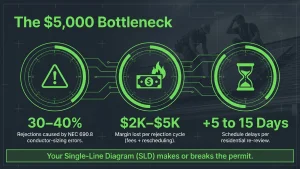
The stakes are real. Industry permitting data ties 30–40% of solar permit rejections to NEC 690.8 conductor-sizing violations, and those errors live on the SLD. Because each rejection cycle runs $2,000–$5,000 once you add revision fees and crew rescheduling, a clean diagram protects your margin. Residential re-reviews can also add 5 to 15 business days each.
What AHJ reviewers check first on a single-line diagram
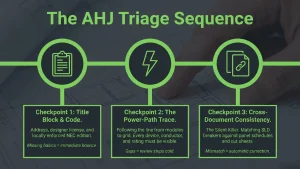
Most reviewers triage a plan set in a predictable order. Once you know that order, you know where to focus.
Title block and NEC edition
First, reviewers confirm the basics: project address, designer name and license, revision number, and the code editions in force. Missing title-block details rank among the top five reasons packages bounce. Your SLD also has to cite the NEC edition your AHJ actually enforces, not last year’s template.
The power-path trace
Next, reviewers follow the line from the modules to the grid. They check that every device, conductor, and rating shows up and reads clearly. A gap in the path or a missing disconnect stops the review cold.
Cross-document consistency
This step is the silent killer. For example, if your SLD shows a 200A main breaker but the panel schedule says 225A, that mismatch is an automatic correction. So reviewers cross-check the diagram against the equipment schedule and the cut sheets every time.
Your 2026 single-line diagram checklist
Run this list before you submit. Each item is something reviewers look for on the page.
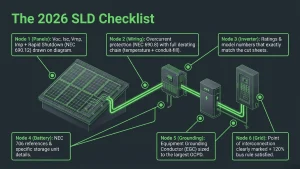
- Module characteristics: Voc, Isc, Vmp, and Imp, plus string counts and configuration.
- Inverter ratings and model numbers that match the cut sheet exactly.
- Overcurrent protection per NEC 690.8, with the full derating chain shown. The 125% multiplier is easy; installers often skip the temperature and conduit-fill corrections.
- Conductor sizes for every DC and AC segment, with ampacity after corrections.
- All disconnects and locations, including the AC disconnect at the service.
- Grounding and bonding, with the equipment grounding conductor sized to the largest OCPD in the circuit.
- Rapid shutdown equipment and labeling per NEC 690.12, drawn on the diagram instead of buried in a note.
- Point of interconnection at the main panel, with back-fed breaker ampacity and the 120% bus rule satisfied.
- Battery details and NEC 706 references when the project includes storage.
What changed for single-line diagrams in 2026
A few shifts make this year different.
Code is in transition. NEC 2026 arrived in October 2025, but most states still run NEC 2023, and some stay on NEC 2020. A handful have started the move to 2026. Because designing to the wrong edition is a preventable rejection, confirm the adopted cycle for each jurisdiction first.
Interconnection moved up. Utilities in California, Texas, and New England now want the interconnection application number on the plan set before the AHJ signs off.
Storage is standard. More projects ship with batteries, so plan sets need separate battery details, updated load calculations, and NEC 706 callouts.
Automated permitting raises the bar. SolarAPP+, backed by NREL, has processed over 100,000 permits across 520+ jurisdictions. These platforms hold your SLD to their own spec, so a single miss can cost your queue slot.
For a wider view, see our complete 2026 plan set checklist and the common electrical diagram mistakes that trigger rejections.
Pass plan review the first time
A clean single-line diagram is the difference between a permit that moves and a project that stalls. At Energyscape Renewables, licensed engineers build PE-stamped, NEC-compliant plan sets for first-time AHJ approval across all 50 states, with 24-hour PE stamping and a 99% approval rate. Your crews stay on the roof while we handle the code.
Still, getting the drawing right is only half the job. Sunscape, your solar OS, tracks every permit, revision, and AHJ comment in one place, so a returned diagram never quietly stalls a project. Get the engineering right with Energyscape, then keep your pipeline moving with Sunscape.
Ready to stop chasing rejections? Talk to Energyscape Renewables about your next plan set, and book a Sunscape demo today.
Solar single-line diagram FAQs
What is a solar single-line diagram?
A solar single-line diagram is a one-page drawing of a PV system’s power path. It shows the modules, inverter, disconnects, conductors, overcurrent protection, grounding, and the point of interconnection, each labeled with make, model, and ratings for AHJ review.
Why do single-line diagrams get rejected?
The top causes are NEC 690.8 conductor-sizing errors, missing rapid shutdown labeling, undocumented grounding, wrong NEC edition references, and mismatches between the diagram, the schedule, and the cut sheets.
Does my SLD need a PE stamp?
It depends on the AHJ and the system size. Most commercial projects need an electrical PE stamp, and many states require one on residential systems too. So confirm the local rule before you submit.
sjayakanth@energyscaperenewables.com