
Solar Sales Cycle Optimization: Cut 7 Days Fast

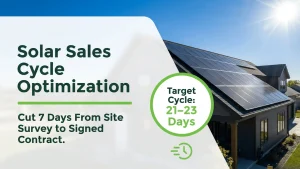
Solar Sales Cycle Optimization: Cut 7 Days From Site Survey to Signed Contract
Solar Sales Cycle Optimization: Every extra day in your solar sales cycle costs real money. Specifically, for a sales rep earning $150,000 annually, each wasted day represents approximately $2,100 in lost productivity. Therefore, for a five-person team, that’s $73,500 evaporating monthly—or $882,000 annually—into administrative delays, engineering backlogs, and permit revisions.
However, solar sales cycle optimization isn’t about working harder. Instead, it’s about eliminating the “dead zones” where deals stall, customers develop cold feet, and competitors swoop in with faster proposals. Moreover, with the 30% federal solar tax credit now expired and the market shifting from urgency-driven to value-driven sales, installers who close faster gain the critical competitive edge.
Why Does Solar Sales Cycle Optimization Matter More in 2026?
The solar industry just crossed a major threshold. December 31, 2025 wasn’t merely another tax deadline—it marked a complete market reset. Consequently, customers who “missed” the 2025 rush remain interested in solar, but they’re no longer operating under artificial deadlines.
According to the Solar Energy Industries Association, residential solar close rates drop by 3-5% for every day of delay. Furthermore, when customers contact three to four competitors on average, the first proposal to arrive wins 68% of the time. Additionally, engineering bottlenecks alone cause 23% of lost deals.

The Real Cost of Slow Solar Sales Processes
Customer acquisition costs increased 35-50% in 2026 as post-tax credit competition intensified. Therefore, you literally cannot afford to lose deals to slow processes anymore. Each lost deal represents not only missing revenue, but also wasted marketing spend of $500-$2,000 per lead.
Meanwhile, smaller installers face consolidation pressure from well-funded national players. As a result, the only way to compete isn’t matching their advertising budgets—it’s outmaneuvering them on speed and service quality.
How Can You Eliminate the Site Survey Bottleneck? (Days 1-2 Saved)
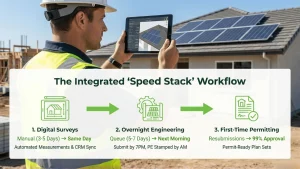
Traditional site surveys create massive time sinks. First, you’re scheduling in-person visits. Then, you’re collecting data with tape measures and clipboards. Next, you’re transcribing handwritten notes. Finally, you’re manually uploading photos while hoping nothing gets lost. This process typically requires 3-5 days from initial scheduling to usable data.
Digital Site Survey Solutions
Digital site survey applications transform this process entirely. Instead of multi-day delays, same-day surveys become standard with:
- Automated measurements and instant calculations
- GPS-tagged photo documentation
- Direct CRM integration eliminating data re-entry
- Standardized checklists ensuring complete data capture
- Real-time cloud syncing across your team
The key difference lies in standardization. When every surveyor uses identical digital checklists, captures required photos consistently, and follows the same workflow, you eliminate back-and-forth. Moreover, there are no return trips or missing electrical panel photos discovered three days later.
According to National Renewable Energy Laboratory research, digital survey tools reduce field time by 90% while maintaining accuracy. Consequently, this means moving from “interested homeowner” to “proposal-ready data” in hours instead of days.
How Does Overnight Engineering Cut 3-4 Days From Your Sales Cycle?
Traditional engineering workflows create the biggest bottleneck. Typically, you submit a request, wait 5-7 days for your queue position, then handle multiple revision rounds when designs don’t match local codes or utility requirements.
The Overnight Engineering Breakthrough
Professional solar engineering services now offer overnight turnaround with proper expertise. Specifically, submit a complete site survey by 7 PM and receive fully engineered designs by the next morning. This isn’t corner-cutting—rather, it’s specialized teams working exclusively on solar projects who:
- Understand code requirements across all 50 states
- Maintain up-to-date AHJ relationship databases
- Use proven systems to deliver consistent quality at speed
- Provide licensed PE stamps from appropriate state engineers
Key benefit: When site survey data arrives in standardized formats (thanks to digital survey apps), engineers spend less time deciphering information and more time on actual design work.
| Traditional Engineering | Overnight Engineering |
|---|---|
| 5-7 day queue wait | Next-morning delivery |
| Multiple revision cycles | First-time accuracy |
| Generic code knowledge | State-specific expertise |
| Manual data interpretation | Automated intake processing |
What Eliminates Permit Resubmission Delays? (Days 5-7 Saved)
Permit resubmissions kill deals. Industry data from SolarAPP+ research shows 25-35% of permit applications require at least one resubmission due to code errors, missing documentation, or utility interconnection issues. Each resubmission adds 1-2 weeks to your timeline.
Achieving First-Time Permit Approval
The solution isn’t faster permitting—it’s getting permits right the first time. Professional engineering services that achieve 99% first-time approval rates share these characteristics:
- Active AHJ relationships across multiple states
- Current code compliance knowledge updates
- Licensed PE stamps from appropriate state engineers
- Permit-ready plan sets meeting jurisdiction-specific requirements
- Utility coordination expertise for interconnection applications
This matters more in 2026 because permitting timelines are already stretched. Furthermore, with 275 jurisdictions now using automated platforms like SolarAPP+ for instant approvals, installers submitting permit-ready applications gain massive advantages. Meanwhile, competitors struggling with resubmissions add weeks to timelines that could measure in days.
The Integrated Workflow Advantage for Solar Sales Cycle Optimization
Most installers miss this crucial point: these time savings aren’t merely additive—they’re multiplicative. When your site survey data flows directly into engineering requests, which generate permit-ready plan sets automatically, you’re not just saving days. Instead, you’re eliminating entire error categories occurring during handoffs.
Manual Workflow Problems
Consider typical manual workflows:
- Surveyor takes photos on personal phone
- Uploads photos to Dropbox
- Emails link to designer
- Designer downloads and attaches to project folder
- Emails specifications to engineering team
- Engineering requests missing information
- Process repeats with delays
At each step, there’s opportunity for miscommunication, missing files, or outdated information.
Integrated System Benefits
Compare that to integrated systems where:
- Site survey apps capture all required data automatically
- Data syncs directly to your CRM instantly
- System triggers automated engineering requests with attached documentation
- Proposals generate with pre-filled customer information, system specifications, and financial projections
Consequently, the difference isn’t just 7 days—it’s the elimination of errors causing downstream delays.
What’s Your Bottom Line Impact From Solar Sales Cycle Optimization?
Let’s translate time savings into revenue impact. If your average sales cycle is 30 days and you cut it to 23 days, each sales rep can close 5.2 additional deals annually. Therefore, for a five-person team with average residential project profit of $8,000-$12,000, that’s 26 additional deals—representing $208,000 to $312,000 in additional annual profit.
However, the real value extends beyond more closed deals. It’s about higher close rates. When you deliver proposals while competitors still schedule site surveys, you establish yourself as the responsive, professional installer. Moreover, customers perceive speed as competence, and in markets where trust and credibility matter most, that perception translates directly to signed contracts.
How Should You Start Your Solar Sales Cycle Optimization Journey?
You don’t need to overhaul everything tomorrow. Instead, pick your biggest bottleneck—usually site surveys or engineering—and fix that first. The momentum builds from there.
Phase 1: Digital Site Survey Implementation
Digital site survey tools are the easiest starting point because they:
- Require minimal training investment
- Provide immediate measurable value
- Create data foundations for downstream improvements
- Standardize team workflows instantly
Phase 2: Engineering Service Partnership
Engineering services become your second priority because they’re typically your longest wait time and highest frustration point. Moving from 5-7 day queues to overnight turnaround changes how you quote timelines to customers. Additionally, it eliminates anxiety about when completed designs will arrive.
Phase 3: Permitting Optimization
Permitting optimization comes third, but proper engineering really pays off here. When your plan sets consistently pass first-time review, you stop thinking about permits as bottlenecks. Instead, you treat them as predictable three-week timelines rather than unpredictable one-to-three-month nightmares.
Start Your Solar Sales Cycle Optimization Today
Your competitors are already moving faster. Consequently, don’t let slow site surveys, engineering backlogs, or permit delays cost you another deal.
Sunscape gives your team digital tools to capture perfect site survey data, automate proposal generation, and keep deals moving through your CRM—all in one connected platform. Therefore, stop losing days to manual processes and start closing deals while your competition still schedules follow-ups.
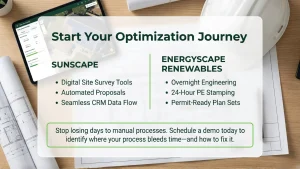
EnergyScape Renewables delivers overnight engineering, 24-hour PE stamping, and permit-ready plan sets eliminating your longest bottlenecks. With 99% first-time AHJ approval rates and comprehensive permitting support across all 50 states, we’re the engineering partner keeping your installations moving forward.
Together, they form the complete speed stack cutting days from your sales cycle and adding dollars to your bottom line. Schedule a demo today and discover exactly where your current process bleeds time—and how to fix it.
Frequently Asked Questions About Solar Sales Cycle Optimization
How long does the average solar sales cycle take?
The average solar sales cycle takes 28-45 days from first contact to signed contract. However, installers implementing solar sales cycle optimization can reduce this to 21-23 days by eliminating site survey delays, engineering bottlenecks, and permit resubmissions.
What causes the biggest delays in solar sales?
The three main causes are: (1) Manual site surveys taking 3-5 days, (2) Engineering queues requiring 5-7 day turnaround, and (3) Permit resubmissions adding 14-21 days per rejection. Addressing these bottlenecks creates the most significant time savings.
Can you really get overnight engineering for solar projects?
Yes, specialized solar engineering services now offer next-morning delivery when you submit complete site surveys by 7 PM. These teams work exclusively on solar projects, understand code requirements across all 50 states, and deliver consistent quality through proven systems.
What’s the ROI of faster solar sales cycles?
For a five-person sales team, cutting 7 days from your sales cycle enables 26 additional deals annually. At $8,000-$12,000 profit per residential project, that’s $208,000-$312,000 in additional annual profit. Additionally, faster cycles improve close rates by reducing customer decision paralysis.
How do I achieve 99% first-time permit approval?
Partner with engineering services that maintain active AHJ relationships, stay current on code compliance, provide licensed PE stamps from appropriate state engineers, and deliver permit-ready plan sets meeting jurisdiction-specific requirements.
sjayakanth@energyscaperenewables.com