
Wet Stamp vs. Digital PE Seal for Solar: What AHJs Accept in 2026

The Permit Rejection Nobody Sees Coming — Until It Happens
Your design is solid. Your client is eager to move forward. However, one stamping issue can send the entire permit package back to square one. For solar installers and EPCs, understanding wet stamp solar documentation versus a digital PE seal is no longer optional. In fact, in 2026, it directly controls your project timeline and your margins. Fortunately, the fix is straightforward — once you know where to look. This guide breaks down both options clearly. It also shows you exactly what to check before you submit anything to your AHJ.
What Is a Wet Stamp Solar Document — and Why It Still Matters in 2026
Simply put, a wet stamp solar plan set carries a physical inked or embossed PE seal on paper drawings. A licensed Professional Engineer reviews the design first. Then, they apply their seal alongside an original handwritten signature and date. That combination is what AHJs have trusted for decades.
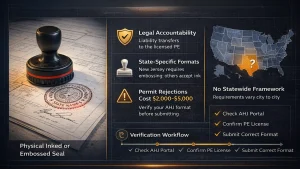
Moreover, a wet stamp carries real legal weight. It places professional responsibility directly on the engineer who signed it. As a result, permit reviewers, utilities, and inspectors give those documents high credibility. This is especially true in jurisdictions that haven’t yet adopted digital verification systems.
However, requirements aren’t uniform across the country. For instance, New Jersey specifically mandates an embossing seal. Other states accept inked wet stamps as the default. Therefore, your engineering partner must confirm the exact local format before anything goes out the door.
For installers working across multiple states, this verification step is critical. Texas, for example, has no statewide PE stamp framework. Consequently, requirements shift city to city. Skipping the confirmation call is one of the most expensive mistakes you can make. In fact, permit rejections cost anywhere from $2,000 to $5,000 per project. That’s before crew rescheduling and client delays are factored in.
The Rise of the Digital PE Seal Solar Submission
Meanwhile, more jurisdictions are accepting a digital PE seal solar submission every year. Some now actively prefer it. A digital seal is the engineer’s stamp applied electronically to a PDF. It includes an electronic signature and date. However, not all digital stamps work the same way — and that distinction is important.
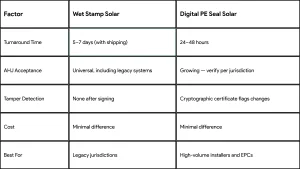
Specifically, a basic electronic stamp is simply a digital image of the traditional seal placed on the file. A certified digital seal, on the other hand, uses a cryptographic certificate tied to the engineer’s verified identity. Consequently, if anyone modifies the document after sealing, the certificate immediately becomes invalid. That change is visible to the reviewer right away. This built-in tamper detection is precisely why AHJs are opening up to digital workflows.
Furthermore, the time savings are significant. Traditional wet stamp solar packages can take 5 to 7 days. That includes physical preparation and shipping. In contrast, a digital PE seal solar submission typically arrives in 24 to 48 hours. Therefore, for high-volume EPCs managing multiple projects at once, the difference compounds quickly. As a result, more companies are making the shift to digital-first workflows wherever their AHJs allow it.
Electronic PE Stamp AHJ Acceptance: The 2026 State-by-State Breakdown
Understanding electronic PE stamp AHJ requirements means looking at each state individually. That’s because there is no single national standard. Here’s where the major markets currently stand.
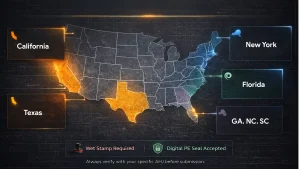
California, for instance, generally accepts digital PE seals across most jurisdictions. Additionally, expedited permitting is available for systems under 10 kW. Structural PE stamps are required for commercial rooftop systems over 10 kW. Similarly, electrical stamps apply above 50 kW. Notably, the 2025 Title 24 standards are now in full effect for commercial projects statewide.
Florida, on the other hand, requires PE stamps for virtually all solar installations. Hurricane zone regulations drive that mandate specifically. Moreover, site-specific wind load calculations are required regardless of the submission format. Most Florida jurisdictions do accept digital seals. Nevertheless, always confirm before submitting.
Texas remains the most unpredictable market of all. Some municipalities still require physical wet stamps. Others, however, have gone fully digital. There is simply no way to assume — you must verify with the specific AHJ every single time.
New York, meanwhile, has streamlined approvals through its Unified Solar Permit for systems under 25 kW. Consequently, electronic PE stamp AHJ submissions are widely accepted across the state. Similarly, Georgia, North Carolina, and South Carolina require PE review for most commercial systems. Still, the accepted submission format varies by local jurisdiction.
Overall, digital acceptance is growing nationwide. Yet assuming your AHJ has kept pace without checking remains a costly risk.
Wet Stamp vs. Digital PE Seal: Quick Comparison for Solar Installers
How to Verify What Your AHJ Accepts Before You Submit
Instead of guessing, use this simple four-step workflow.
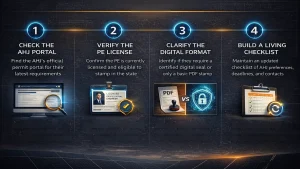
Step 1 — Check the portal first. Visit the AHJ’s official permit portal. If the answer isn’t clear there, call the building department directly. Ask specifically whether they accept digital PE seals or require wet stamps. Ideally, get the confirmation in writing.
Step 2 — Verify your engineer’s license. Confirm that your engineering partner holds a valid PE license in the project’s state. Otherwise, the stamp will be rejected immediately. This applies equally to wet and digital submissions.
Step 3 — Clarify the digital format. If submitting digitally, ask whether the AHJ requires a basic electronic stamp or a certified digital seal with cryptographic verification. Those are two distinct things. Confusing them, unfortunately, causes unnecessary rejections.
Step 4 — Build a living checklist. Maintain a market-by-market checklist for every jurisdiction you operate in. Additionally, review it quarterly. AHJ requirements shift regularly as states update their NEC adoption cycles.
How EnergyScape Renewables Takes the Guesswork Out of PE Stamping
Whether your next project needs a traditional wet stamp solar package or a certified digital PE seal solar submission, EnergyScape Renewables handles it from start to finish. Their licensed engineers are credentialed across all 50 states. Moreover, they work with AHJs nationwide on a daily basis. As a result, they already know what your specific jurisdiction requires before you even ask.
EnergyScape provides both structural and electrical PE stamps. Residential turnaround runs as fast as 15 to 24 hours. Similarly, commercial packages are delivered within 24 to 48 hours. Their engineers also specialize exclusively in solar. Therefore, they understand your design language without lengthy explanations.
For EPCs managing projects across multiple states, EnergyScape’s multi-state licensing network eliminates the search for a new local PE every time. Instead, you have one trusted engineering partner covering every jurisdiction you work in.
Additionally, once your stamped plans are ready, Sunscape Solar connects them directly to your project workflow. It integrates permit tracking, site surveys, and CRM into one platform. Consequently, your stamped plans move straight into installation scheduling. No manual handoffs. No dropped details.
Stop letting stamping confusion delay your projects. With the right engineering partner and the right tools, every permit package goes out correctly — the first time.
sjayakanth@energyscaperenewables.com