
Texas Solar License: SB 1036 Guide For Installers In 2026
Texas Solar License: SB 1036 Registration Guide for Solar Retailers and EPCs
If you sell residential solar in Texas, a Texas solar license is no longer optional. Senate Bill 1036 — officially the Residential Solar Retailer Regulatory Act — passed on June 20, 2025, and it changes how every solar retailer, salesperson, and EPC operates in the state. Whether you’re based in Houston, Dallas, San Antonio, or Austin, this law directly affects your business. Registration with the Texas Department of Licensing and Regulation (TDLR) becomes mandatory by September 1, 2026. If you’re not registered by then, you risk civil penalties, voided contracts, and forced customer refunds.
This guide breaks down exactly what SB 1036 requires, why it was passed, and how to get your business ready — without the legal jargon.
What Is Texas SB 1036?
Texas SB 1036 creates Chapter 1806 under the Texas Occupations Code (outbound link). State Senator Judith Zaffirini sponsored the bill after consumer complaints about solar scams surged by over 800% between 2018 and 2023, according to the Texas Attorney General. Texas rooftop solar installations also grew from approximately 1,300 systems in 2010 to nearly 270,000 by 2023. That kind of explosive growth, without a matching regulatory framework, created serious problems for homeowners.

SB 1036 fixes that. It creates a mandatory registration system for solar retailers and salespeople and gives TDLR the authority to enforce it. Importantly, this is about sales and retail transactions — not installation licensing, which already exists through the electrical contractor framework.
Three Key Dates Every Solar Business Must Know
You need to act in phases. Here is the timeline under SB 1036:
September 1, 2025 — Contract rules take effect immediately. All solar retailers must include licensed electrical contractor details in every sale or lease agreement. Homeowners now have a mandatory five-business-day cancellation window after signing. This is already in effect, so if you haven’t updated your contracts yet, do it today.
June 1, 2026 — TDLR finalizes the program rules. TDLR’s stakeholder workgroup will publish the final rules governing the registration process. Registration applications are expected to open ahead of the September deadline.
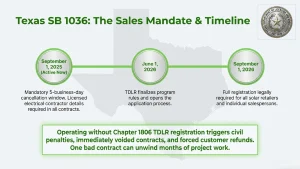
September 1, 2026 — Full registration required. All solar retailers and individual salespersons must be registered with TDLR. Operating without a valid Texas solar license registration after this date is prohibited and subject to enforcement action. Sign up for TDLR’s email updates at tdlr.texas.gov (outbound link) to track the application process.
What Does SB 1036 Registration Actually Require?
The registration process covers both companies and individual sales reps. Here is what you need to prepare:
- Background checks for all registered salespersons
- Registration numbers on all contracts and marketing materials
- Mandatory educational disclosures provided to every prospective customer before signing
- Licensed electrical contractor’s name and license number included in every sale or lease agreement
- Five-business-day cancellation right disclosed clearly in each contract
- No misrepresentation of government agency or utility company affiliations
- No solicitation at homes displaying “no soliciting” signs
These aren’t burdensome changes if you start preparing now. However, TDLR can cancel contracts and order full refunds for non-compliant agreements. One bad contract could unwind months of project work.
Why This Is Actually Good News for Legitimate Solar Companies
Here is the honest truth — if your company already operates with integrity, SB 1036 works in your favor. Consumers burned by predatory sales tactics will now look for registered companies. Your TDLR registration number becomes a trust signal that sets you apart from operators who don’t make the cut.
States across the country are moving in this direction. Florida, for example, took a similar pro-consumer stance with HB 683, but from the permitting side instead of the sales side.
Florida’s HB 683: The Permitting Law Running Parallel to Texas SB 1036
While Texas tightened the sales side, Florida streamlined the permit side. Florida’s HB 683 — the Florida solar permit law for 2026 — was signed by Governor Ron DeSantis on June 13, 2025, and took effect July 1, 2025.
Under the HB 683 5-day rule, local governments in Florida must approve residential solar permits within five business days. Miss that deadline and the permit is automatically approved by law. This applies to solar installers operating in Tampa, Miami, Jacksonville, Fort Lauderdale, and all other Florida markets.

Furthermore, HB 683 authorizes virtual inspections in FL, allowing private inspection providers to conduct plan reviews and inspections remotely. This eliminates the wait for a municipal inspector and cuts what used to be 30-day delays down dramatically.
For EPCs managing multi-site Florida pipelines, this changes the game. Soft costs go down. Timelines shrink. And your ability to close and install projects faster becomes a real competitive edge — especially now that the federal Investment Tax Credit has expired for residential systems installed after 2025.
How to Prepare for SB 1036 Compliance Right Now
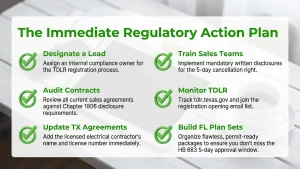
You don’t need to wait for September 2026 to start. Here are six steps to take today:
- Designate a compliance lead inside your company — someone who owns the TDLR registration process.
- Audit your current sales contracts against Chapter 1806 disclosure requirements.
- Add the licensed electrical contractor’s name and license number to every Texas agreement.
- Train your sales team on the five-day cancellation disclosure — it must be given in writing.
- Monitor TDLR updates at tdlr.texas.gov and join the email list for registration opening announcements.
- Build permit-ready plan packages if you also operate in Florida — disorganized plan sets cost you the 5-day window.
Your Compliance and Permitting Partner for Texas and Florida
Navigating state-level regulatory changes while managing active installation schedules is a real operational challenge. That is exactly where the right back-office partner makes a difference.
EnergyScape Renewables delivers permit-ready solar plan sets built for speed, accuracy, and code compliance — helping solar installers and EPCs across Texas and Florida hit the HB 683 5-day window and prepare documentation aligned with SB 1036’s emerging framework. Visit energyscaperenewables.com to learn more.
Sunscape Solar provides solar project management expertise and operational support for US solar businesses, helping you build processes that stay regulation-ready from day one. Explore what’s possible at sunscape.solar.
Texas SB 1036 compliance starts now — not in September 2026. Don’t let a registration gap or a non-compliant contract put your Texas pipeline at risk. And don’t let slow permit sets cost you Florida projects.
👉 Get permit-ready solar plan sets: energyscaperenewables.com
👉 Streamline your solar operations: sunscape.solar
Frequently Asked Questions About Texas SB 1036
What is the Texas solar license requirement under SB 1036? SB 1036 requires all residential solar retailers and salespersons in Texas to register with the Texas Department of Licensing and Regulation (TDLR) by September 1, 2026.
When must solar retailers register in Texas under SB 1036? Registration with TDLR becomes mandatory by September 1, 2026. Contract disclosure requirements are already in effect as of September 1, 2025.
What happens if a solar retailer operates without a Texas solar license after September 2026? TDLR can impose civil and administrative penalties, cancel contracts, and order full refunds to customers for non-compliant agreements.
What is the HB 683 5-day rule in Florida? Florida’s HB 683 requires local governments to approve residential solar permits within five business days. If they miss the deadline, the permit is automatically approved by law.
Are virtual inspections allowed for solar in Florida? Yes. Under HB 683, private inspection providers can now conduct virtual inspections for solar and other single-trade projects in Florida.
sjayakanth@energyscaperenewables.com