
Solar Site Survey Checklist 2026: What Every Installer Must Assess Before Pulling a Permit

Solar Site Survey Checklist 2026: Stop Losing Projects to Permit Rejections
Permit rejections cost solar installers more than time. They quietly drain project margins and push back interconnection timelines. Frustrated customers who expected PTO weeks ago start asking questions. In most cases, the root problem isn’t the permit itself. It’s what happened before the application was ever filed — a rushed or incomplete solar site survey. A thorough pre-permit site assessment is your first real line of defense. It protects you against plan set revisions, AHJ pushback, and failed inspections. In 2026, with NEC code updates rolling out across jurisdictions and FEOC compliance reshaping equipment documentation, getting your solar site survey checklist right has never mattered more.
This guide walks through every major assessment area your team needs to nail — before a single permit package leaves your office.
Why Your Solar Site Assessment Starts With the Roof
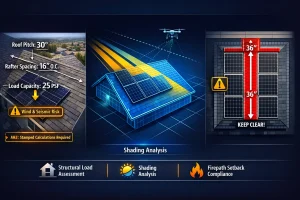
Most installers know to look at the roof. What separates first-time approvals from revision cycles is how thoroughly they document it. Your solar site survey checklist should capture roof material, age, condition, pitch, and orientation. But it should also include load-bearing capacity, existing penetrations, attic framing type, and rafter spacing. AHJs in 2026 increasingly require stamped structural calculations — even on projects that would have sailed through five years ago. This is especially true in wind and seismic zones.
Beyond structure, shading analysis is non-negotiable. Document all obstructions — trees, chimneys, HVAC units, and adjacent buildings. Model their shadow impact across seasonal sun paths. Drone imagery and LiDAR-assisted 3D site modeling are now standard practice among high-volume EPCs. They eliminate guesswork that sends plan sets back for revision.
Also, firepath setback requirements vary by AHJ, sprinkler status, and local fire code vintage. Map your proposed array footprint against these constraints before the design phase begins. A 36-inch pathway requirement you missed can force a full array redesign.
Electrical Assessment: The 120% Rule Still Trips Up Installers
The electrical portion of your solar site survey checklist is where permit applications most often stall. Start with the main service panel. Record the busbar rating, main breaker rating, and available breaker slots. This directly determines compliance under NEC Article 705.12 — the 120% rule.
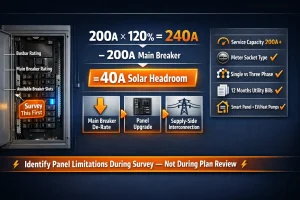
Here is how it works in practice. A customer with a 200A panel and a 200A main breaker can take a maximum 40A backfed solar breaker on the load side. That is 200A × 120% = 240A, minus the 200A main, leaving 40A of headroom. If your system needs more, you are looking at a main breaker de-rate, a panel upgrade, or a supply-side interconnection. Identify all of this during the survey — not during plan review.
Additionally, verify whether the existing service is 200A or greater. Document the meter socket type and whether the service is single-phase or three-phase. Capture 12 months of utility bills for accurate system sizing. Note smart panel compatibility too, especially for customers adding EV chargers or heat pumps. These load additions affect both system sizing and interconnection applications.
NEC 2026 Compliance: What Changed at the Survey Stage
Your solar site survey needs to be NEC 2026-aware — especially if you operate in jurisdictions that have already adopted the new code cycle. NEC 2026 added Section 690.4(G), which specifies that fractions less than 0.5 should be dropped from final voltage and amperage calculations after all correction factors are applied. That eliminates the rounding ambiguity that previously generated revision requests on otherwise solid plan sets.
More importantly, NEC 2026 requires engineers to use the highest Isc value from the datasheet or installation manual, with no exceptions. Document module Isc values at the survey stage. That way, your design team works from accurate field data — not spec sheet defaults pulled from memory.
Rapid shutdown is another area to flag during the survey. Assess whether the building layout supports RSD equipment placement per NEC 690.12. Photograph the proposed conduit path from the array to the main service panel. These photos become essential parts of your permit package.
Interconnection and Utility: Don’t Skip This Step

Solar installers working in California, New Jersey, New York, and Texas know that utility approval timelines can be just as project-critical as AHJ approval. During your solar site survey, capture the utility account number, meter number, and rate tariff. Note any NEM 3.0 agreements in California or existing distributed generation contracts on the property.
For commercial and industrial EPCs, urgency is real right now. Commercial and industrial EPCs must begin construction by July 4, 2026, to lock in the ITC four-year window. Factor interconnection queue position and utility approval timelines into your pre-installation solar site assessment today — not after the permit clears.
FEOC Compliance: Build It Into Your Pre-Survey Workflow
This section applies specifically to commercial projects and EPCs working with ITC-eligible systems. Starting January 1, 2026, commercial and industrial projects must source at least 40% of manufactured product value from non-FEOC suppliers, and that threshold climbs 5% annually, reaching 60% by 2029.
Practically speaking, verify FEOC compliance before the design is finalized. Document manufacturer certifications. Build FEOC verification into your pre-design checklist — alongside your solar site survey checklist. Submitting a permit with non-compliant equipment on the cut sheet doesn’t just trigger a revision. It can void tax credit eligibility even after the AHJ approves the permit.
Site Documentation That Supports First-Time AHJ Approval
The difference between a permit package that clears in 10 days and one stuck in revision often comes down to documentation quality. At a minimum, your solar site survey should produce the following.
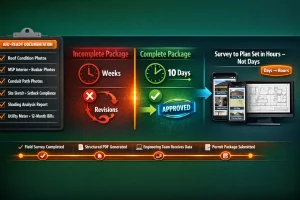
Roof photos showing material, condition, and all existing penetrations. A full set of electrical photos covering the MSP interior, meter socket, existing breakers, and busbar label. Conduit path photos from the proposed inverter location to the main panel. A site sketch showing array placement, setback compliance, and shading obstructions. A shading analysis report with seasonal coverage data. Utility meter photos alongside 12 months of consumption data.
High-volume EPCs now use field survey apps that generate structured PDF reports tied directly to the engineering team’s design workflow. This cuts handoff time between survey and plan set from days to hours. That speed compounds across a project pipeline.
How EnergyScape Renewables Supports Your Pre-Permit Process
A strong solar site survey checklist builds the foundation. But turning field data into a permit-ready plan set requires engineering precision and deep AHJ knowledge. That is exactly what EnergyScape Renewables delivers. EnergyScape provides PE-stamped plan sets, structural calculations, and interconnection packages across all 50 states. Their team turns submittals around in 24 hours and maintains a 99% first-submission AHJ approval rate. They also stay current on NEC 2026 adoption timelines by jurisdiction, FEOC documentation requirements, and state-specific permitting nuances.
As a result, your survey data gets translated into compliant, submission-ready packages — without revision cycles slowing you down. Furthermore, if you manage multiple projects simultaneously, pairing your field assessment process with a purpose-built solar CRM like Sunscape Solar keeps survey data, permit status, and interconnection milestones in one place. Your team gains the visibility to move faster and catch bottlenecks before they become delays.
A complete solar site survey checklist in 2026 is not just good practice. It is the difference between projects that close on time and projects that quietly cost you more than they should.
sjayakanth@energyscaperenewables.com